
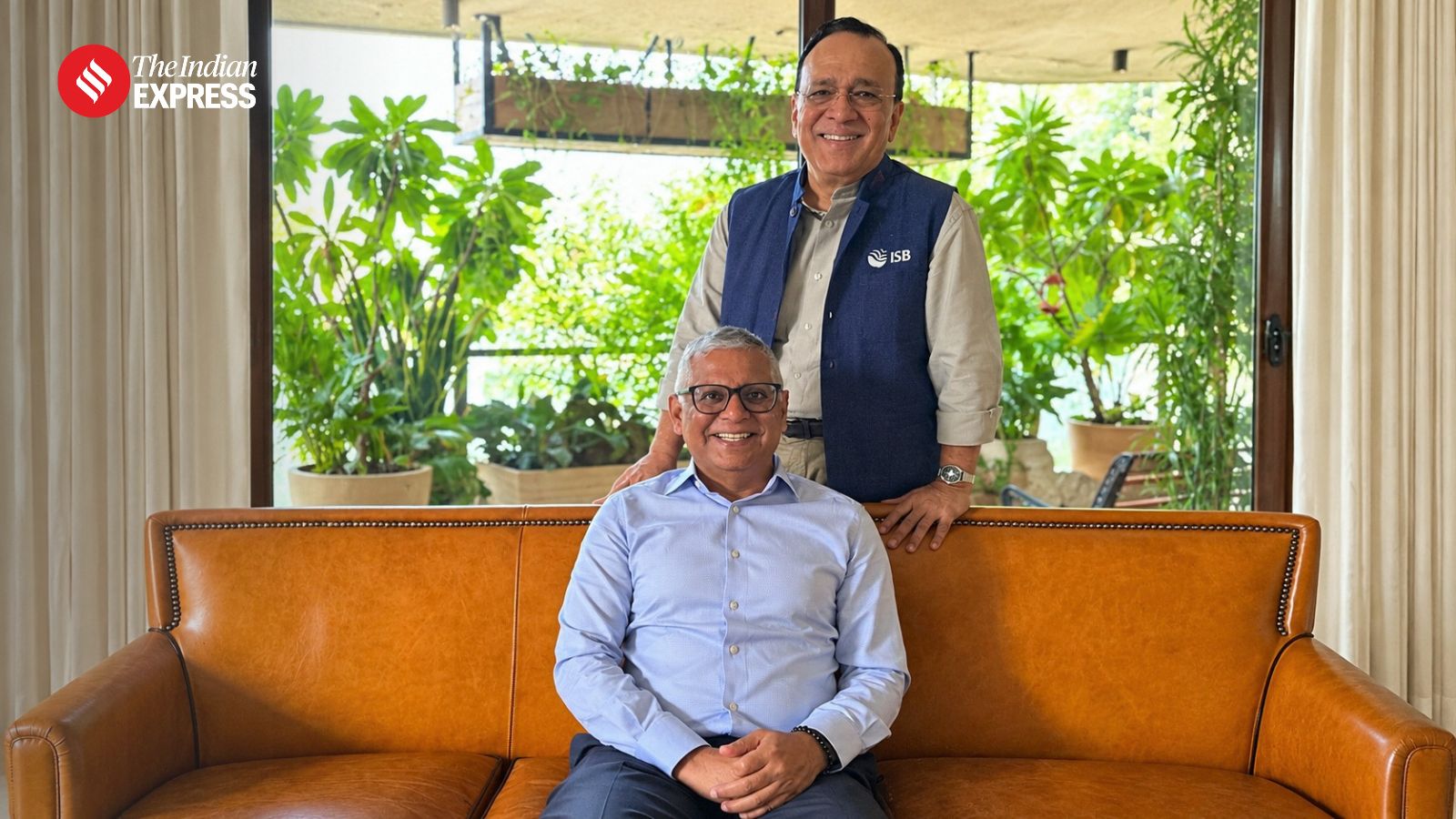
B S Raju and Rajat Gupta started the Indian School of Business to create a world-class institution. Founders faced regulatory hurdles and high land costs in Mumbai. Sinha recalled, “The ambition was to build a school with the freedom to select its own students, determine its fees and pay faculty.”
At the time, batches at the older IIMs and other leading management institutions were relatively small. The founders envisioned that post-liberalisation, the country needed more management graduates. The idea originated with B S Raju, then the director of IIT Delhi. He approached Rajat Gupta, global managing director of McKinsey and an alumnus, and asked whether he would help establish a business school at IIT Delhi.
Gupta’s professional associations with leading management institutions in the US, including Harvard Business School, Kellogg School of Management and the University of Chicago Booth School of Business, helped bring together a group of business leaders and academics who wanted to create a world-class management institution in India.
Sinha, an employee of McKinsey then, was added to the group. “The ambition was to build a school with the freedom to select its own students, determine its fees and pay faculty competitive salaries. However, we encountered our first major roadblock: India’s regulatory framework,” he recalled.
The founders realised that establishing the school within the IIT system would mean adhering to its salary structures and selection procedures. Since most founders were from Mumbai, it became a second and obvious choice.
Why Mumbai, the initial frontrunner, lost out
“Gurugram was still at a very early stage of development. Although land was available there, the city had not yet emerged as the corporate hub it would later become. The group eventually secured a sizeable parcel of land in the Mumbai region through a state agency. The industrialists on the board had strong business connections in Mumbai, and the initial negotiations appeared promising,” Sinha explained, sipping coffee at his posh South Delhi house.
However, when the final agreement came up for signing, the founders encountered an unexpected hurdle. “Development charges were added to the cost of the land, taking the amount from an initial estimate of around Rs 15-16 crore to approximately Rs 40-42 crore,” he recalled, adding that the escalation stunned the board members. They decided to approach Thackeray.
“Rahul Bajaj, Adi Godrej, Anand Mahindra, Anil Ambani and other prominent industrialists went to meet him,” said Sinha, who was not part of the delegation but remembered what followed.
Thackeray was meeting party members, with journalists from a newspaper also present. He then announced conditions for the proposed institution, said Sinha: 100 per cent of staff positions, 50 per cent of faculty positions and around 25 per cent of student admissions would be reserved for Maharashtrians.
“The delegation was taken aback. The members initially assumed it was political grandstanding. But the following day, the announcement was published on the front pages of newspapers, turning it into a political issue. Once the statement had been made publicly, it became difficult to retract for someone of Thackeray’s stature,” Sinha added.
For the founders, such conditions were incompatible with their ambition to build an institution that would recruit students and faculty on merit.
Rahul Bajaj reportedly suggested exploring a location near Pune, closer to the Bajaj group’s factory. But that would still mean remaining within Maharashtra. “The group then wrote to chief ministers across the country, partly to explore alternatives and partly in the hope that the prospect of taking the project elsewhere would put the Maharashtra government under pressure to resolve the impasse. However, that didn’t happen,” said Sinha.
Several states responded, and the founders eventually shortlisted Bengaluru, Hyderabad and Chennai.
A breakfast meeting that changed the course of ISB
The delegation, accompanied by senior IAS officers, was taken to the proposed site in Hyderabad. The group was then scheduled to travel to Bengaluru and Chennai, but the bus was diverted to the residence of then Andhra Pradesh chief minister Chandrababu Naidu, where he garlanded the team.
Naidu and his wife, along with the household staff, personally served the delegation breakfast. Recalling the hospitality, Sinha said Naidu told the visitors: “I know you left Bombay at 4 am. It must be around 7.30 now, and you must be hungry. Please eat.”
He also arranged for eggs to be prepared for the visitors, despite the household being vegetarian. After breakfast, the delegation thought it was time to leave. Instead, Naidu took them into an ante-room, where they sat through a detailed presentation and discussions on education, agriculture, etc.
“The warmth of the reception and the seriousness of the state’s pitch made an impression,” Sinha said.
The delegation then went to Bengaluru and was rushed to the house of then chief minister S M Krishna, who was allegedly furious because of the delay. Sitting on his chair, surrounded by his party members, he reportedly asked: “Yes, what do you want?”
“We later went to Chennai, where we met CM Jayalalithaa and were given garlands to greet her –a contrast to Naidu’s way of greeting us. We were promised a lakeside location. However, it was monsoon time, and it was all muddy. The group, therefore, was in favour of the Hyderabad location, which was way greener,” he recalled.
The decision came with its share of uncertainty. At the time, Hyderabad had not emerged as the major metropolitan centre it is today. Cities such as Pune, Ahmedabad, Bengaluru and Chennai were more prominent in the country’s economic imagination.
“The founders had, in effect, placed a bet on the city’s future. Its subsequent growth and the expansion of its technology and business ecosystem would eventually strengthen the case for the choice,” said Sinha.
The first brochure and a visiting faculty experiment
Choosing a location was only the beginning. The bigger challenge was to attract students and academics to believe in an institution without a track record.
“It was a classic chicken-and-egg problem. Students needed to be convinced that the school could offer a high-quality education, while established academics had little reason to leave secure positions at recognised universities to join an institution that was yet to prove itself,” said Sinha, proudly wearing his blue ISB jacket.
In a departure from the norm, ISB decided not to recruit permanent faculty in its first year. “The real breakthrough was the visiting faculty model. We decided that for the first year, we would bring leading academics from international business schools,” Sinha recalled.
The practice continues today, with approximately 40 per cent of courses taught by visiting faculty and the remaining 60 per cent by permanent faculty members.
Sumantra Ghoshal, a well-known professor at London Business School, was closely involved in the early years and was initially expected to become the school’s dean. Through his association, the current dean, Madan Pillutla, then at London Business School, also became involved with ISB. Pillutla began teaching at the institution from its first year, without having to leave his position in London. He moved to Hyderabad in 2021.
International academic partnerships were another important part of the institution-building exercise. Kellogg and Wharton were ISB’s initial academic partners, while London Business School joined later, following Ghoshal’s association with the project.
Sinha showed the first brochure, which played an important role in communicating the institution’s ambition. Photographs of internationally renowned academics and the school’s global partnerships helped make that case. The first class was held even though the campus was not fully ready.
The effort was aimed at attracting students from India as well as overseas. ISB managed to enrol two or three international students in its first batch, although international enrolment never grew to the scale initially envisaged.
The first class: 128 professionals, and no conventional mould
ISB’s first batch, which joined in 2001, comprised approximately 128 students. It was a small but unusually diverse group of professionals, with backgrounds extending well beyond the conventional pool of engineering and business graduates.
There was a student who had served in Kargil, a candidate who had been the first woman appointed as a shop-floor engineer at Tata Motors, and a doctor. The batch also included a former fashion model, an architect and a bank manager who had spent 11 years managing a branch of the State Bank of Patiala in Jalandhar.
Women accounted for approximately 16 per cent of the first batch, according to the recollection shared during the conversation.
The emphasis on professional experience and varied backgrounds was central to the school’s approach from the beginning. Unlike conventional two-year MBA programmes that largely admitted students directly after graduation, ISB launched a one-year, post-experience programme.
The decision was a departure from the prevailing model and attracted criticism. The fees were high, the institution was new, and prospective students had to consider whether a one-year programme at a school in Hyderabad could offer an education comparable to that of the established IIMs.
But the founders believed there was an unmet demand for management education in India. “The economic reforms of 1991 had accelerated the entry of multinational companies and the expansion of Indian businesses, creating a growing need for managers. The capacity of the leading business schools had not expanded at the same pace,” said Sinha, who is instrumental in setting up Ashoka University.
The MBA as a pivot degree
Twenty-five years after ISB’s launch, the relevance of an MBA is being questioned again—this time amid the expansion of specialised management programmes and the rapid adoption of AI.
Pillutla believes the MBA’s value lies partly in its ability to help professionals change careers. He describes it as a “pivot degree”, allowing people to move from one profession or specialisation into management or a different corporate role.
“The MBA gives employers access to people with analytical, problem-solving and leadership skills, even when their undergraduate backgrounds are unrelated to the roles for which they are being considered,” Pillutla said, assuring that general management programmes will remain relevant even as specialised courses in areas such as data analytics, sustainability and AI grow.
The school has also chosen not to introduce undergraduate management programmes like IIM-Bangalore, preferring to focus on its postgraduate offerings and doctoral training.
AI will change what is taught — and how students learn
AI is changing the way B-schools are teaching. Pillutla distinguishes between the long-term changes AI will bring to business and education, and the large number of specialised courses that have emerged around individual AI applications.
“AI is affecting education in two ways: what we teach about AI so that students can use it, and how we use AI to improve education,” he said.
At ISB, AI is influencing the curriculum in two broad ways. The first is the content taught in existing courses. “A marketing course, for example, must examine the tools students will use in the profession and how AI is changing businesses and industries. The same applies to finance and other management disciplines,” he said.
The second is the use of AI to improve the learning experience. ISB’s Centre for Learning and Teaching Excellence is helping instructors explore how the technology can complement classroom teaching, including through personalised feedback for students.
The school is also changing how it assesses students as AI tools become more widely used. Pillutla recalled that after noticing students using AI to complete assignments, he stopped giving conventional assignments in his course. “Instead, students research a company or a problem before class, using AI and other resources if they wish. They are then assessed through live classroom discussions, where they have to think on their feet and respond to questions,” he said.
In a negotiation course, students have been asked to negotiate with an AI bot. Their performance is assessed not simply on the outcome of the negotiation, but on the tactics and strategies they use and the preparation they undertake, he added.
For Pillutla, the challenge is not to prevent students from using AI but to ensure that they understand how to use it effectively and ethically. The technology is changing both the knowledge students need and the way institutions teach and assess them.
He believes the MBA will undergo significant changes, but does not agree that the one-year or two-year format will necessarily become irrelevant. Both have a place, particularly at institutions that offer a high-quality educational experience, he said. What matters is how they adapt their curriculum and teaching methods.