
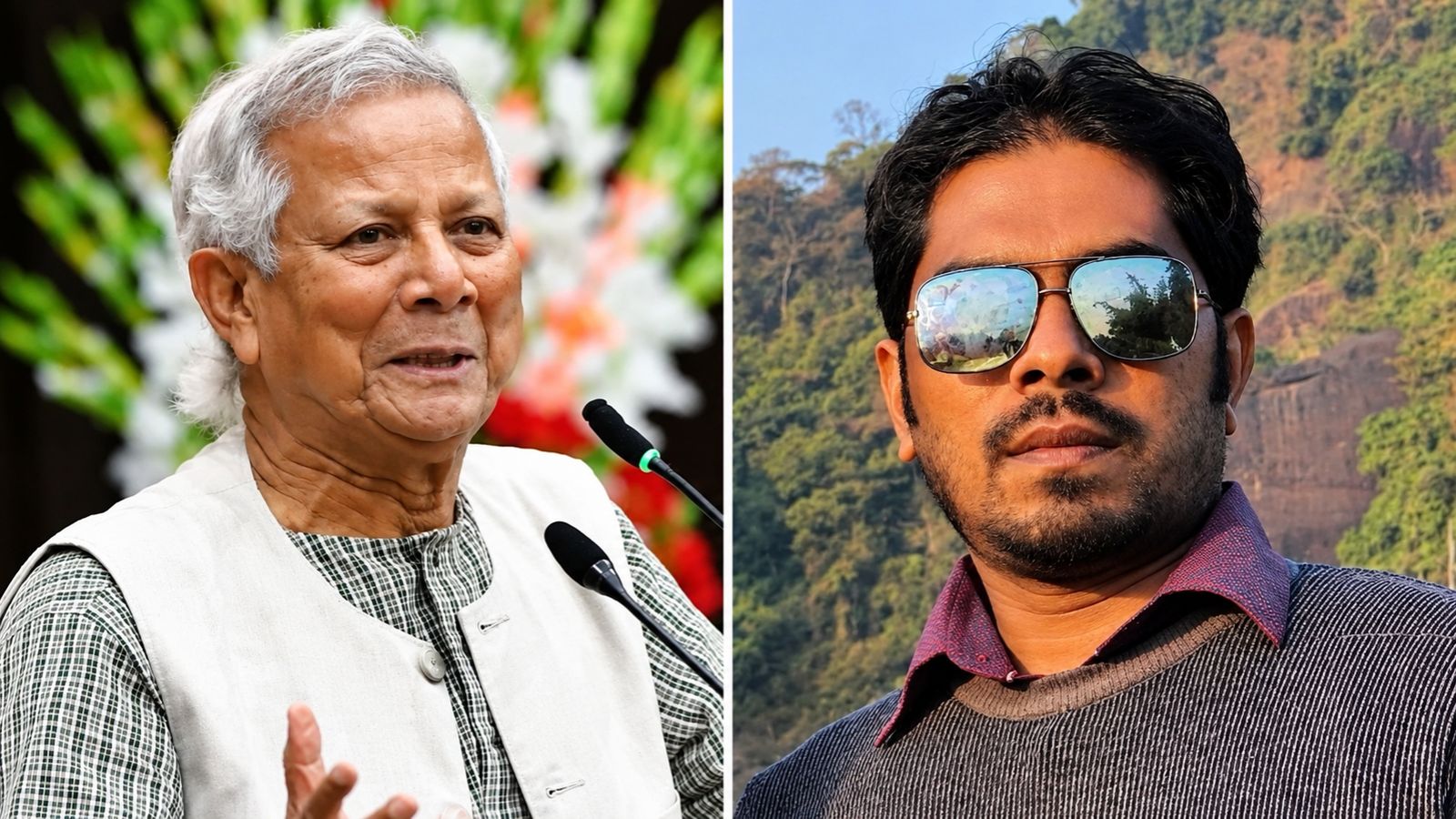
AFP journalist Qadaruddin Shishir helped student leaders contact Muhammad Yunus before Sheikh Hasina left power in Bangladesh. Shafiqul Alam said, "Qadaruddin Shishir stepped up to fulfill that critical role." Shishir managed this secret outreach while working at the AFP Dhaka bureau. He also gathered evidence of killings during the regime.
Shishir was simultaneously gathering video evidence of killings attributed to the regime reportedly, even as he managed the secret outreach
The process of bringing Nobel laureate Muhammad Yunus into Bangladesh's interim government after former Prime Minister Sheikh Hasina's ouster involved a discreet outreach by student leaders, with a journalist playing a key role in facilitating the initial contact.
Shafiqul Alam, who served as press secretary to Yunus during the interim government, has recounted how AFP journalist Qadaruddin Shishir helped establish communication between the two sides.
In a Facebook post, Alam said the student leaders needed a trusted intermediary to approach Yunus. At the time, Shishir was the editor of AFP's Dhaka Fact Check team and was working from the agency's Dhaka bureau, where Alam said his desk was just a yard away.
Describing how Shishir became involved, Alam said the journalist took on the responsibility of approaching Yunus on behalf of the student leaders and initiating communication between them.
"When student leaders wanted to reach out to Nobel Laureate Professor Muhammad Yunus and invite him to head the interim government in a post-Hasina scenario, they needed a trusted bridge-builder. Qadaruddin Shishir stepped up to fulfill that critical role.
"At the time, Shishir was the editor of AFP Dhaka Fact Check team. Sitting just a yard away from my desk in the AFP Dhaka bureau, he managed this high-stakes operation in complete secrecy. Only a select few trusted individuals knew what was happening. It was Shishir who first approached the 2006 Nobel Peace Prize winner on behalf of the student leaders and facilitated the initial talks between the two parties.
Alam said the outreach remained undetected even as Hasina continued in power for another two days. He highlighted the risks involved, saying that discovery by the regime's security apparatus could have placed Shishir and the AFP team in danger.
"Hasina would remain in power for two more days, yet her brutal security machine -- notorious for mass killings and abductions -- never caught a whisper of it. Had they discovered what was happening, Shishir and our entire AFP team would likely have ended up in an Aynaghar (house of mirrors secret prison).
Alam also recalled that Shishir was simultaneously gathering video evidence of killings attributed to the regime, even as he managed the secret outreach.
"Throughout it all, Shishir remained remarkably cool and composed, even as he quietly started gathering video evidence of the cold-blooded murders being committed by the regime," Alam wrote.
Following the ouster of Hasina on August 5, 2024, Bangladesh established an interim government led by Muhammad Yunus, who was sworn in as Chief Adviser on August 8. The administration was formed in consultation with student leaders, civil society representatives and the military.
Yunus later announced that Bangladesh would hold elections in February 2026.
The interim government's tenure ended after the Bangladesh Nationalist Party (BNP), led by Prime Minister Tarique Rahman, won the elections and formed the new government. Rahman was sworn in as Prime Minister on February 17, 2026, marking the transition from the Yunus-led administration to an elected government.