
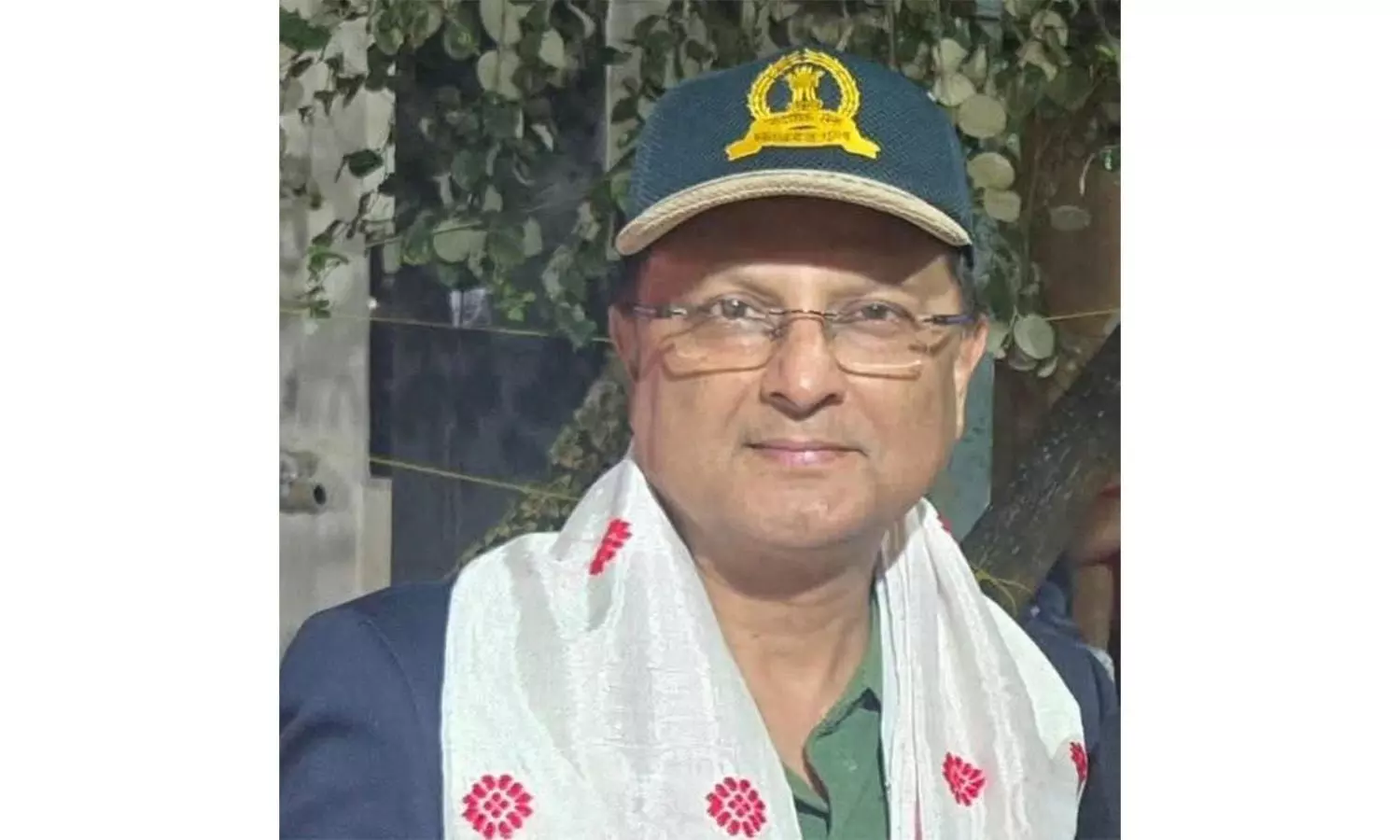
BJP candidate Devasish Sharma defeated AIUDF president Maulana Badruddin Ajmal in the Nagaon Lok Sabha constituency by-election. This result surprised many as the Congress fell to third place. The win challenges traditional voting patterns in Assam, where Muslims make up 34 percent of the population according to the 2011 Census.
A Lok Sabha constituency in Assam with a dominant Muslim electorate has delivered a victory to the BJP, a party whose leaders have repeatedly asserted that they do not need Muslim votes to win. In Nagaon, the constituency that saw a by-election recently, the political paradox is stark: BJP candidate Devasish Sharma has defeated Maulana Badruddin Ajmal, the president of the AIUDF and one of Assam's most prominent Muslim leaders, while the Congress has slumped to a distant third. The result has turned a local electoral contest into a larger question about the future of minority politics in Assam.
Has the BJP finally breached the Muslim political fortress? And if it has, what does that mean for a state where Muslims account for roughly 34 per cent of the population, according to the 2011 Census? The verdict challenges the conventional wisdom that Muslim voters will invariably rally behind the Congress or parties such as the AIUDF. But an electoral victory, however striking, is not proof of a wholesale political realignment. The real story lies in understanding why voters may have crossed traditional political lines -- and whether their choices signal lasting trust, tactical pragmatism or a search for security in an uncertain political climate.
The most striking feature of the Nagaon verdict is Mr Ajmal's defeat. For years, the AIUDF chief cultivated a political constituency by presenting himself as a defender of minority interests. The Congress, meanwhile, relied heavily on minority support to remain electorally competitive across several parts of Assam.
In Nagaon, both strategies appear to have faltered spectacularly. Given the constituency's substantial Muslim electorate, Mr Sharma's victory raises the possibility that a significant section of Muslim voters crossed conventional political lines to support the BJP. Yet the distinction between inference and evidence matters. Election results do not record voters' religious identities, and aggregate figures cannot establish precisely how many Muslims voted for Mr Sharma. Booth-level analysis and credible voter surveys would be necessary to determine the extent of this shift.
In Assam, land is far more than an economic asset. It is linked to identity, citizenship anxieties, livelihood and the security of families who have lived for generations with uncertain land rights. Eviction drives on government land have become one of the most contentious issues in the state, particularly for vulnerable communities.
Could some Muslim voters have concluded that supporting the ruling party is a more effective way of protecting their immediate interests than opposing it? The possibility cannot be ruled out. When a family faces the prospect of losing its home or livelihood, political ideology may take a back seat to the practical question of survival. A vote for the ruling party might be an attempt to secure access to the administration, obtain a hearing or avoid being left outside the political system.
There could also be expectations that closer engagement with the government might improve the chances of obtaining land pattas (deeds) or regularising possession where legally permissible.
But these remain hypotheses, not established explanations for the Nagaon verdict. There is no basis for concluding that fear of eviction or expectations of land rights were the decisive motivations of Muslim voters without supporting evidence. Nor does a BJP victory constitute a promise of protection from eviction or regularisation of land. The real test will be whether the government responds fairly to legitimate claims, follows due process and applies the law without discrimination.
The verdict is also a serious indictment of Mr Ajmal's political strategy. For years, he occupied a central position in Assam's minority politics, challenging the Congress's traditional hold over sections of the Muslim electorate. But identity-based political mobilisation has its limits. Community loyalty cannot indefinitely substitute for effective representation, credible leadership and tangible results.
The Congress, too, has reason to worry. Its distant third-place finish raises uncomfortable questions about its organisation, leadership and ability to remain a credible alternative to the BJP. The Opposition's traditional assumption that minority votes can be consolidated through an appeal to secularism and fears of majoritarian politics may no longer be sufficient everywhere. Voters may be asking a more immediate question: What can a party actually deliver?
That does not mean identity has ceased to matter. It means identity alone may no longer determine electoral choices. There is, however, a larger contradiction at the heart of this election. The BJP has built much of its political strength in Assam around indigenous identity, illegal immigration, demographic anxieties and the protection of land and resources. Its rhetoric has often heightened apprehensions among sections of the Muslim population. Its leadership has also repeatedly suggested that Muslim votes are unnecessary for electoral success.
Why, then, would Muslim voters support the party? The answer may lie in the distinction between ideological acceptance and electoral pragmatism. Voters do not necessarily endorse every position of a party they support. They may respond to a candidate's accessibility, personal credibility, perceived administrative competence or ability to deliver development.
Mr Sharma's administrative background (he was the district magistrate of Nagaon until recently) may have contributed to his appeal. The BJP's position as the ruling party also gives it considerable political visibility and an advantage in projecting its ability to influence governance.
For some voters, supporting the BJP may therefore be less an endorsement of its entire ideological programme than a calculation about who holds power and who can address their immediate concerns. If that is what happened, the BJP may have expanded its electoral reach without necessarily overcoming the mistrust that has historically separated it from sections of the Muslim electorate.
Assam's political arithmetic makes the verdict particularly consequential. With Muslims constituting approximately a third of the state's population, even a limited shift in voting patterns could influence outcomes in several constituencies.
The BJP will undoubtedly examine the Nagaon result for lessons that might be replicated elsewhere. But one by-election cannot establish a statewide realignment. Local candidate appeal, Opposition fragmentation, turnout and constituency-specific grievances can all influence an election. The verdict must therefore be assessed against detailed constituency-level evidence rather than treated as proof of a wholesale change in minority voting behaviour.
Nor are Assam's Muslims a homogeneous political bloc. Their preferences differ according to geography, language, class, livelihood, land ownership and local leadership. A shift in one constituency cannot automatically be extrapolated to the entire community.
The more important question is whether the BJP can convert an electoral opening into lasting political trust. That would require more than winning votes. It would require fair treatment, equal access to public services, economic opportunity and a credible commitment to the rule of law.
The Nagaon verdict has exposed the vulnerabilities of Mr Ajmal's leadership, the weakness of the Congress in this contest and the possibility that the BJP's appeal extends beyond its traditional support base.
But the central question is not simply whether Muslims have voted for the BJP. It is why they may have done so, what they expect from the party and whether those expectations will be met.
If the shift reflects a search for development, effective representation and greater security, it should compel every political party to rethink its approach to minority voters. If it reflects tactical accommodation with the party in power, its durability remains uncertain.
The BJP has won Nagaon. Whether it has won the trust of Assam's Muslim electorate is another matter altogether. That distinction will determine whether this election becomes a genuine turning point or merely another chapter in Assam's continuing struggle between identity, insecurity and political power.