
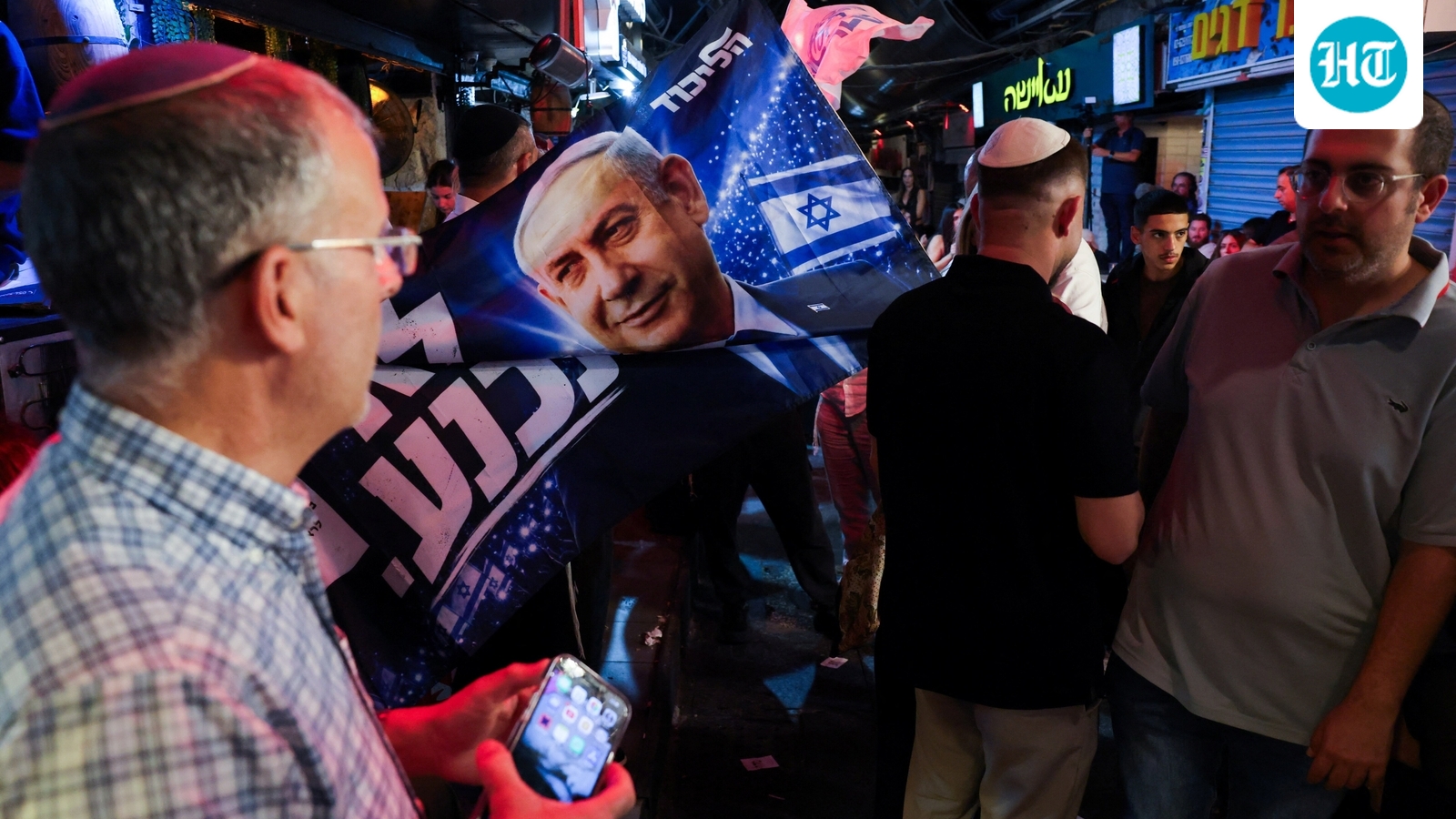
Israelis will vote on October 27 to elect the 26th Knesset as Benjamin Netanyahu seeks another term. The election follows the October 2023 Hamas attack and ongoing wars. Donald Trump backed Netanyahu, calling him a "Great Warrior Prime Minister." Opposition parties blame the government for security lapses during the conflict.
Benjamin Netanyahu, Israel's longest-serving prime minister, is seeking another term as Israelis prepare to vote on October 27 to elect the 26th Knesset. The election, the first since the October 2023 Hamas attack and the wars that followed in Gaza, Lebanon and Iran, will put the government's handling of the conflicts at the centre of the electoral contest.
US president Donald Trump has also backed Netanyahu, endorsing him for another term. In a Truth Social post on Sunday, Trump described Netanyahu as a "Great Warrior Prime Minister" and an "even greater Partner for Peace" in combating Iran.
"Bibi Netanyahu has been Strong, Brave, and Brilliant in the face of tremendous opposition, including that coming from even Israel, itself. Despite all of that, he has endured and, in fact, he has thrived!" Trump wrote.
Netanyahu's chances of winning another term remain uncertain, with the October 7 Hamas attack continuing to cast a shadow over his leadership. Opposition parties have made the attack a central issue in their campaigns, arguing that it exposed a failure of leadership for which he must be held accountable.
They blame his government for the security lapses that preceded what became the deadliest day in Israel's history and for the conflicts that followed. Nearly every campaign poster, stump speech and televised debate appears to refer to the attack, which remains fresh in voters' minds, the Associated Press reported.
Another setback for Netanyahu came when former Shin Bet chief Ronen Bar said the agency had taken several steps in the early hours of October 7 in response to concerns about an impending attack. These included informing Netanyahu's military secretariat at 3:55 am. Bar also detailed warnings he said he had issued to Netanyahu in the months leading up to the attack, according to The Times of Israel.
Netanyahu has rejected Bar's claims, arguing that if he had known about the planned Hamas attack on the night of October 6, he would have ordered military preparations and cancelled the Nova music festival. His defenders, meanwhile, argue that the military establishment failed to prevent the attack and credit him with leading Israel's military response.
Read here: What Ronen Bar claimed
A survey by the Israel Democracy Institute (IDI), published in September ahead of the third anniversary of the October 7 attack, found that 68% of Jewish Israelis considered the attack a central factor in deciding whom to vote for, The Times of Israel reported.
However, Tamar Hermann, the institute's leading public opinion expert who conducted the survey, said the attack had effectively pushed voters deeper into the political camps they already supported.
"It's been three years since the October 7 attack, something that, of course, made an entire society post-traumatic, but will it really make people decide which party to vote for? I doubt it," she said.
"Israelis in general still see Netanyahu as kind of the guy on security. And more to the point, they don't really see an alternative," Mairav Zonszein, an Israel-Palestine analyst at the International Crisis Group based in Tel Aviv, told Al Jazeera.
A June survey by Mitvim, the Israeli Institute for Regional Foreign Policy, found continued public support for the government's military and security-based approach, alongside opposition to efforts to resolve the Palestinian issue and end Israel's occupation of Palestinian territory. The findings came amid concerns about Israel's growing international isolation and declining global standing since the war in Gaza began, Al Jazeera reported.
The October 7 attack and its aftermath are not the only conflicts that could affect Netanyahu's chances of securing another term. Israel's war with Iran and its conflict with Hezbollah in Lebanon have also raised questions about the government's handling of national security and whether its military campaigns have achieved their stated objectives.
A report published by The Times of Israel on June 21 found that 92.1% of Israelis surveyed believed Iran had emerged victorious from the war. The poll surveyed 3,644 respondents between June 17 and 20 and was conducted by the Hebrew University of Jerusalem in collaboration with the Agam Institute. Even among voters who supported Netanyahu's right-wing bloc, 93.1% believed Iran had won.
The poll also found that 87.8% of respondents believed Israel had either failed to achieve its objectives in launching the offensive or achieved only some of them.
Netanyahu's reported preference for postponing further military action against Iran until after the October 27 election could also carry political risks. A message conveyed from Jerusalem to Washington in recent days indicated that Israel would prefer any new military action against Iran to begin after the election, The Jerusalem Post reported, citing sources.
According to the sources, Netanyahu believes launching a campaign before the vote could create two risks: the difficulty of postponing the election and the potential impact of Iranian retaliation on Israel's home front.
"These are precisely the scenes we cannot afford to see. A country in shelters, missile strikes, destroyed buildings, wounded people and, God forbid, deaths - that is what could lead to a victory for Eisenkot and his partners," a senior Likud official told The Jerusalem Post, adding that the remarks reflected Netanyahu's position.
Pre-election polls suggest Netanyahu's Likud party and its coalition partners could fall short of securing a majority in the 120-member Knesset, according to Israel.com (https://www.israel.com/israel-election-2026).
An average of the latest polls published by seven outlets over a 14-day period gives the parties in Netanyahu's outgoing coalition - Likud, Religious Zionism-Zehut, Otzma Yehudit, Shas and United Torah Judaism - a combined 48.7 seats. The polls project between 46 and 51 seats for the coalition, with none putting it close to the 61 seats needed for a majority.
Gadi Eisenkot's Yashar party leads the polling average with 22.4 seats, coming first in all seven polls, while Netanyahu's Likud follows with 19.4 seats.
The figures suggest Netanyahu's coalition faces a difficult path to retaining power. However, the projections are snapshots of voter preferences and do not determine the final election result.
Netanyahu, who has spent around 19 years in office across his terms as prime minister, is seeking another term while standing trial on corruption charges. Losing the election could end his current tenure and weaken the influence of the far-right parties that have been part of his government.
Arab voters could also play an important role in determining the outcome. Israel's Arab minority makes up around 21% of the population. Most are of Palestinian heritage and hold Israeli citizenship. Higher turnout among Arab voters could influence coalition calculations in favour of an anti-Netanyahu alliance led by former military chief Gadi Eisenkot, Reuters reported.
Israeli pollsters expect Arab voter turnout to be higher than in previous elections, including those held in 2022 and 2020. The Stat-Net Research Institute, based in an Arab Druze town near Haifa, projects turnout of 63%, compared with 56% in 2022, Reuters reported.
Although Netanyahu and his main opponents have said they would not form a coalition with Arab parties, fearing a backlash from right-wing voters, a closely contested election could put that position under pressure. Arab parties could play a decisive role in coalition negotiations and influence who becomes Israel's next prime minister.
Around 7.3 million eligible voters aged 18 and above are expected to cast their ballots on October 27, according to Israel's Central Elections Committee, Al Jazeera reported. Most polling stations will be open from 7 am to 10 pm. Voters still in line when polling closes will be allowed to vote, and election day is a national holiday.
Israelis vote for political parties rather than individual candidates. The parties then negotiate alliances to form a coalition government with a parliamentary majority. In Israel's history, no single party has won a majority of the 120 seats in the Knesset.
This gives smaller parties considerable influence in efforts to assemble a coalition of at least 61 members. Parties must secure at least 3.25% of the vote to enter the Knesset.
The main parties contesting the election include Netanyahu's Likud (Unification), Israel's major right-wing party; the far-right Otzma Yehudit (Jewish Power) and Religious Zionist Party; Shas; United Torah Judaism; Amcha Yisrael (Your Nation of Israel); Yashar (Straight); Beyachad (Together); the Democrats; Yisrael Beiteinu; and the Reservists-Economic Party. Arab-led parties, including Ra'am (United Arab List) and the Joint List, are also part of the political landscape, according to the Associated Press.