
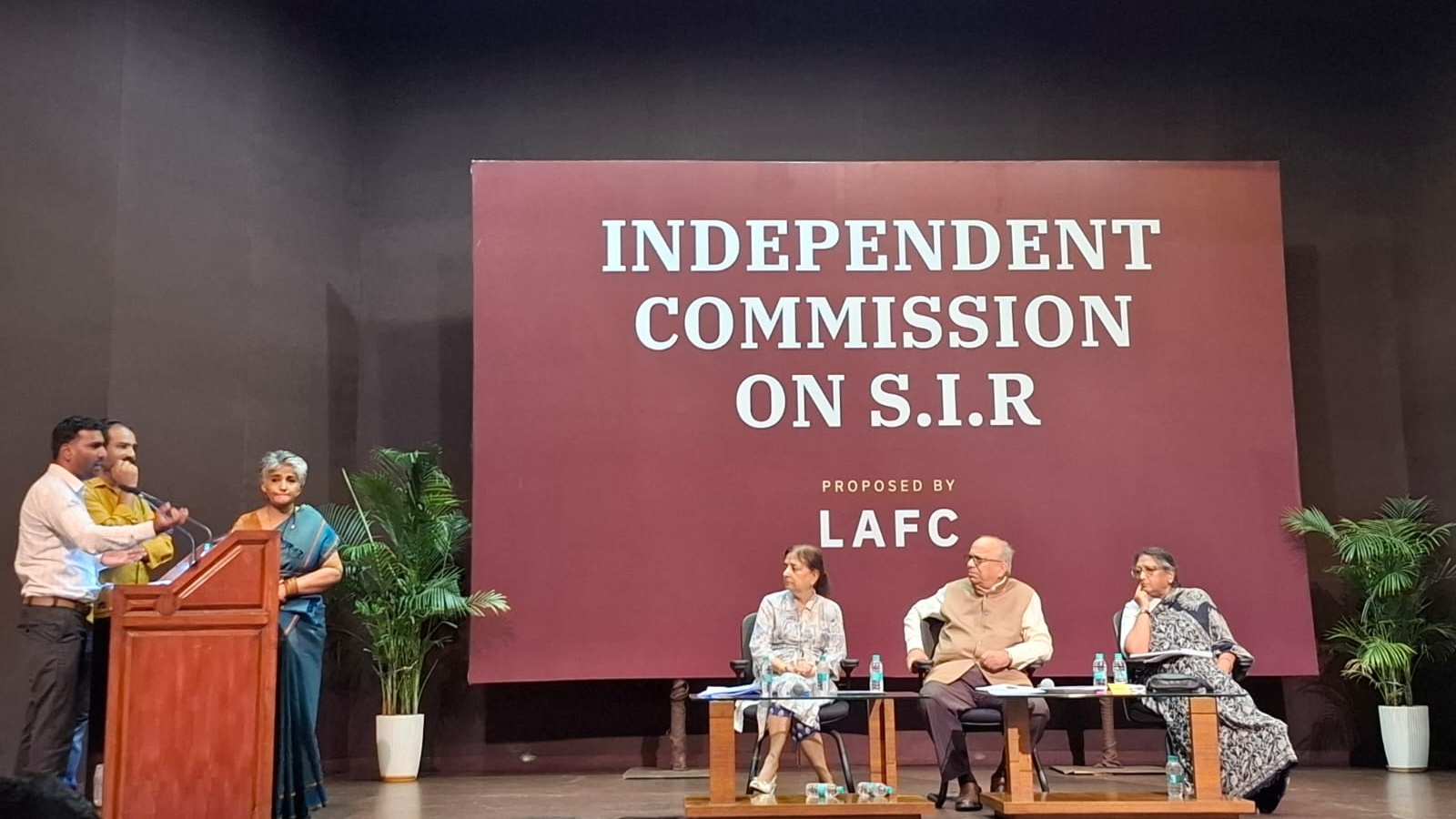
Kamal Lal told an independent inquiry commission on Thursday that 729 voters from Bela Estate were deleted from the electoral roll. Justice Angana Prakash said, "Data one can access anywhere, but first-person accounts would be difficult to get by." Many residents now face issues after officials removed their voter IDs.
Barring one, names of all 729 voters of Bela Estate were deleted from the electoral roll during the Special Intensive Revision (SIR), Kamal Lal, a resident of the settlement, told the LAFC independent inquiry commission on Thursday.
Lal said residents had been living in the settlement since 1913, but now, officials told them they could not have voter IDs anymore. Reason: Bela Estate is on Delhi Development Authority land and faces demolitions. After the issue got media attention, residents filed 496 applications for inclusion, which Lal said had not been processed yet.
Lal was among voters and civil society representatives from six states -- Karnataka, Delhi, Rajasthan, West Bengal, Odisha and Telangana -- who presented their testimonies at a public hearing organised by the 'Lawyers Association for Constitution (LAFC)' in Delhi Thursday.
A former judge of the Patna High Court, Justice Angana Prakash emphasised the importance of recording individual experiences, saying, "Data one can access anywhere, but first-person accounts would be difficult to get by."
Constituted to examine "the constitutional validity of the SIR", the commission is headed by former Supreme Court judge Justice Madan Lokur. Besides Justice Prakash, it includes three other members: Former SC judge Justice A K Patnaik, former Jammu and Kashmir HC Chief Justice Badar Durrez Ahmed, and former Delhi HC judge Justice Rekha Sharma.
Justice Lokur and Justice Durrez were not present at the hearing on Thursday.
The hearing, first among many the commission plans to conduct, brought together civil society groups, including Mazdoor Kisan Shakti Sangathan (MKSS) from Rajasthan, Eddelu Karnataka, and Delhi-based Jan Sarokar. The testimonies would form part of the commission's inquiry alongside analysis of electoral roll data and the legal framework governing the revision.
The LAFC commission had invited the ECI to nominate a senior officer, but said no representative attended the hearing.
Civil society organisations told the commission that while the 2002 guidelines limited verification to questions of age and place of residence, the current exercise had put voters through requirements to prove citizenship.
Eddelu Karnataka, a civil society organisation from the southern state, said there was no public awareness campaign ahead of the exercise.
"Anganwadi teachers had absolutely no knowledge. In some places, there was no training for booth-level officers (BLOs)... An independent survey found that only 7% said they understood the training," it told the commission.
It claimed that 1 crore voters had been deleted in the state and 43 lakh had received notices. The 50 constituencies with the highest deletions included areas with large minorities, Dalit and backward class populations, it said.
Ramakrishna from Karnataka's Tumkur district said his younger son received a notice over a "logical discrepancy" in the age difference between him and his elder brother. Ramakrishna said he ended up submitting eight records.
"This is the fate of every voter of our polling station and thousands of our people," Ramakrishna told the commission, urging it to halt the SIR process.
Abdul Qadir, who travelled from Vijayapura, said that three of his relatives had been wrongly declared dead following objections filed against their names on the electoral roll.
From Jangpura, Hira Lal said the number of voters in his settlement had fallen from 643 in 2025 to 243. He said residents who sought to re-enrol were asked to apply online instead of being given physical Form 6 applications. "This posed a barrier for residents unfamiliar with online systems," he said.
Sabar Institute, a public policy group from West Bengal, said that the SIR had disproportionately affected Muslims and women in West Bengal.
Former MP Dr Tarun Mandal tokd the commission that his name was deleted from West Bengal's electoral rolls despite submitting several documents. He said an official advised him to appeal to a tribunal and apply through Form 6, meant for new voters.
In Rajasthan, the SIR removed 41.85 lakh names from the electoral rolls, reducing the electorate from 5.47 crore to 5.15 crore, said MKSS. Yet, local body elections used an older roll with 5.45 crore voters, it said. This included 17 lakh people marked as permanently shifted during the SIR but still listed at the same addresses, prompting officials to recheck the deletions in what was described at the hearing as "an SIR on the SIR".
In Odisha's Mayurbhanj district, findings presented on behalf of Lok Shakti Abhiyan convenor Prafulla Samantara claimed that 1,11,265 enumeration forms had not been collected, with 63,945 people categorised as dead. "An uncollected form is not by itself conclusive proof that a person has died, permanently shifted, or become ineligible," it said.