
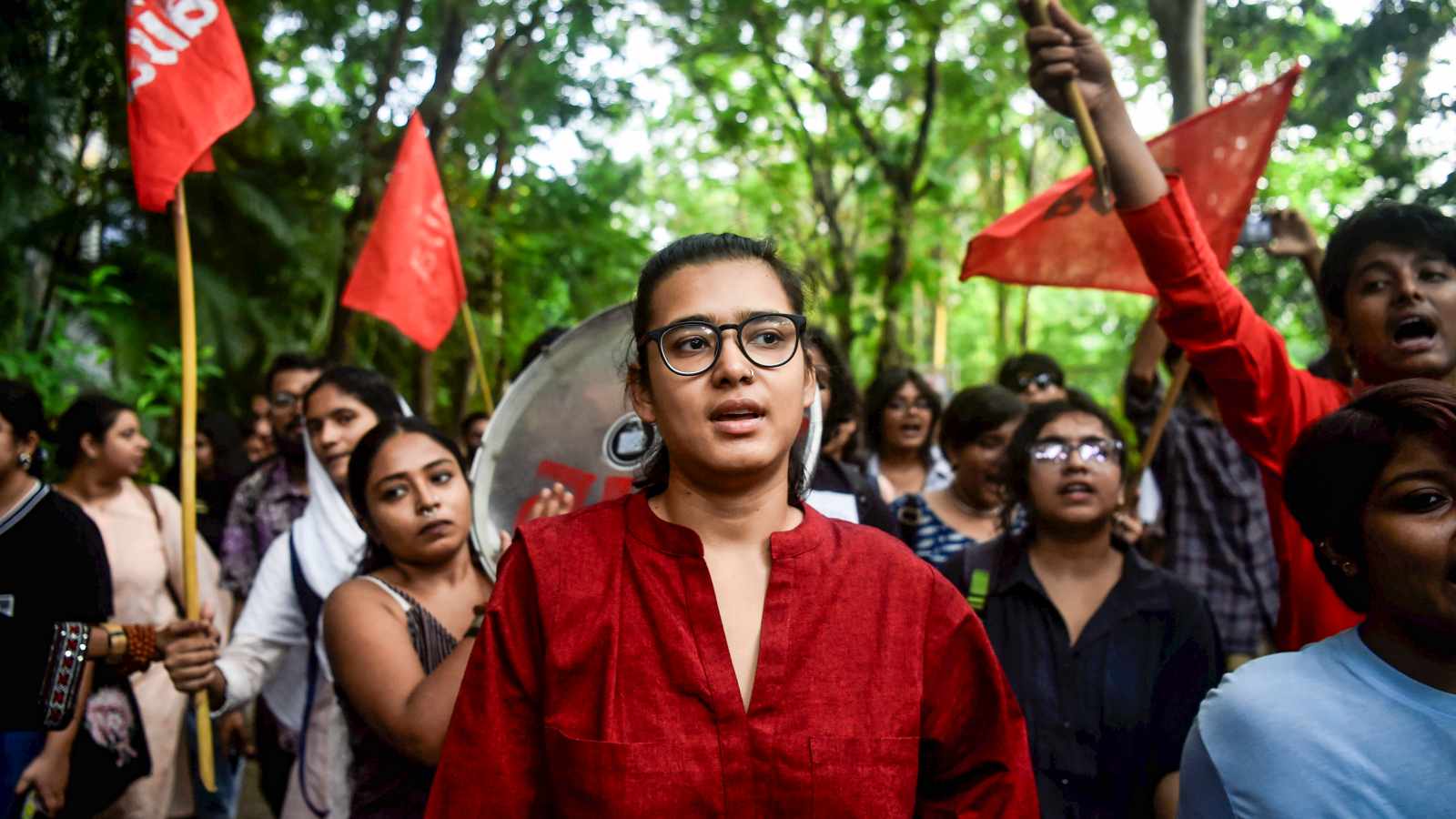
The July Uprising in Bangladesh showed how a limited anti-quota movement grew into a broad call for toppling a government. Kuriakose Mathew and Arjun Ramachandran said, "Leftists tend to lose demographic realism" during such protests. The movement got help from radical flanks but faced many pitfalls after the change.
Thank you for your feedback.
Your feedback has been reported succesfully.
Written by Kuriakose Mathew and Arjun Ramachandran
Given major divergences in their respective political traditions, the key values of the protesting youth in India and Bangladesh's July Uprising are markedly different: It is the Indian Gen Z that should set an example for the Bangladeshi youth.
Radicalism in politics is unavoidable. In any political movement, there is a radical flank which thinks that the point of politics is outbidding people on their own side -- like asking for "regime change" when a protest against voter exclusion is going on. This is not necessarily a bad thing. Whether a radical flank helps or hurts a movement depends also on the conjunctural correctness, not just political correctness, of the demand. Politics is a temporal art as much as it is temperamental: It often matters who demands when, rather than who demands what.
The anti-SIR protests are ripe for being one-upped by a radical flank. In this scenario, Neha Bora's appeal to the Bangladesh example can be read with a twist: The July Uprising was characterised by the benefits and pitfalls of such one-upmanship. On the one hand, it showed how a limited anti-quota movement grew well beyond its initial confines and became a broad call for the toppling of a government. Although egged on by state violence, it was the timeliness of the radical flank which moved the movement.
So what's wrong with taking Bangladesh as an example?
The leftist groups played an important part in the "regime change" in Bangladesh, but once again fell into the usual leftist self-entrapments. Leftists have been at the heart of most democratic movements over the past century, whether or not they succeeded. In many recent failures, however, we notice a peculiarity: Leftists tend to lose demographic realism, a sensible estimate of the mass base of contesting parties and their organisational reach, as soon as they find themselves in the heat of a movement. They look at only the relatively minor increase in numbers on their own side, not the manifold increase in the numbers of rival formations. Moreover, like the student left of Delhi, they confuse being at the centre of media attention with being at the centre of a long-term movement.
Perhaps the paradigmatic case of this loss of touch with reality was the Iranian Revolution, which immediately turned against its leftist enablers with tragic consequences. Something similar, though in lower intensity, happened in Bangladesh as well. As the movement wore on, the reality of demographic weight began to exert its influence, utterly sidelining leftist groups and leading the National Citizen Party, the largely non-Left outfit launched by student radicals, to desperately make an alliance with the Jamaat-e-Islami to stay relevant.
The NCP added to the climate of insecurity in Bangladesh, marked by intermittent assaults on civil society and social harmony by both state actors and radicalised mobs. The radical flank, sections of it in alliance with the religious fundamentalists, maintained its one-track mind and insisted on radicalising further. Their zeal for one-upmanship contributed heavily to the sacrifice of the Mujibist legacy (comparable to the Nehruvian consensus in India), the strengthening of majoritarian impulses against minorities and the press, the subversion of the Bangladeshi constitution, and ended with the movement's youthful leadership -- except those who resigned in protest -- as bedfellows of religious fundamentalists. Bangladesh's democracy came out of it with one less secular party, not more.
you may like
Lest one forget, the original demand of rolling back quotas was fulfilled, and women and ethnic minorities no longer have any guaranteed representation in state institutions. Overall, the July Uprising can be understood as having traded social liberties for political freedom. The full gravity of their bargain is yet unclear. But we do know this: Had Tarique Rahman, a political dynast like Rahul Gandhi with a deep democratic sensibility, not betrayed the July spirit and taken up the responsibility of saving the republic, the democratic backslide in Bangladesh would have been far worse than that of India. To this day, Rahman's party continues to try and reform the July Charter that sought to fundamentally alter Bangladesh's existing constitution.
It is the "cockroaches" of India, with their emphasis of Gandhian values of pluralism and moderation and Ambedkarite constitutionalism, who should set an example for the Bangladeshi youth on how to reclaim one's own country. In many ways, they are a more mature Gen Z than their counterparts in Bangladesh.
Mathew teaches politics and international relations at the School of Liberal Arts and Management Studies, P P Savani University, Surat and Ramachandran is a research scholar at the Department of Communication, University of Hyderabad