
A 16-year-old boy from Bihar faces a long struggle for justice after losing his arm while forced into labour. He must travel 1,400 km to Haryana for court hearings. The teen said, "To this day, I am unable to understand why he wronged me. What did I do?"
Missing for months, the 15-year-old was found abandoned in Haryana with his left arm severed. Now back home in Bihar, every court appearance means a costly journey from his village, and going through the ordeal of recounting his trauma.
Swimming in the Ratwa River, looking after the family's cows, and staying close to his home in Bihar's Kishanganj - the 16-year-old boy only wants to return to the simple pleasures of village life. But nowadays, home offers only a temporary respite. The teen is still living with the consequences of what happened after he left home a year ago in search of work. Held captive at a farm in Uttar Pradesh, he was thrashed, made to work long hours, and was abandoned in a forest after he lost an arm in an accident involving a fodder-cutting machine. Back in Bihar now, he has to repeatedly travel over 1,400 km to attend court hearings in Haryana - where he was found - and recount the trauma he has been struggling to forget.
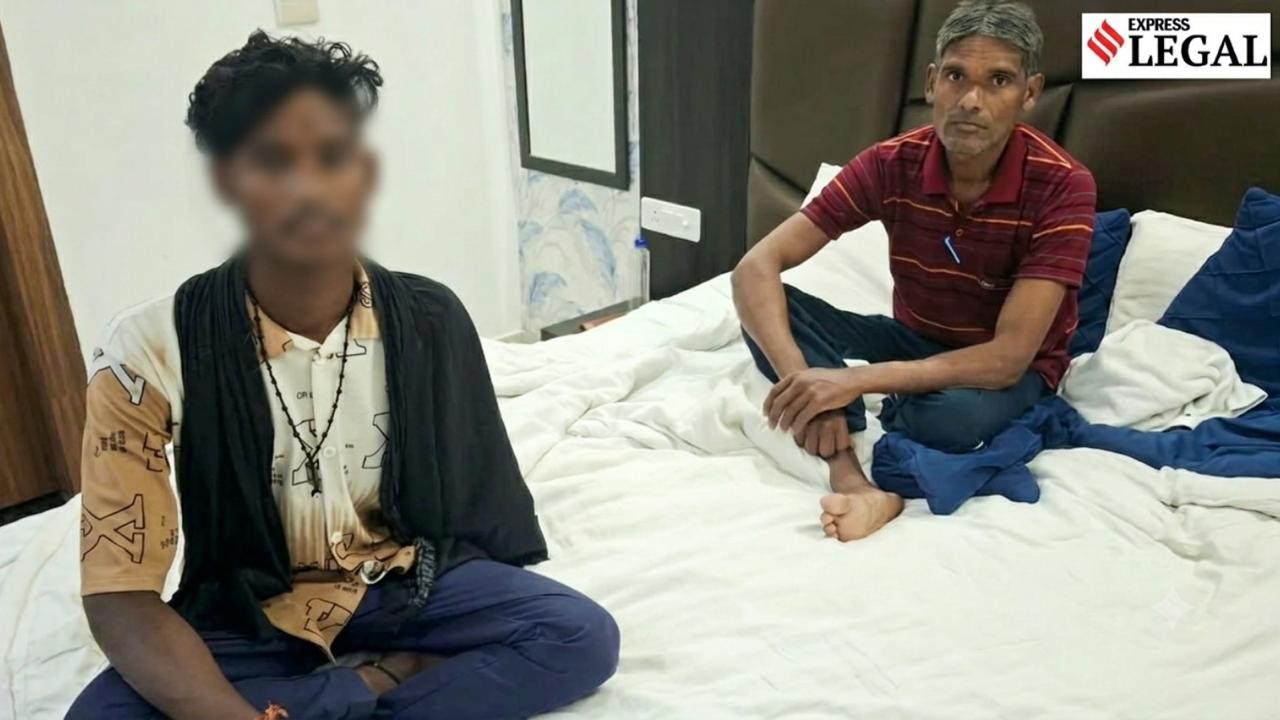
In a hotel room, the teenager sits on the edge of the bed, dressed in a beige printed T-shirt and navy trousers. A black stole rests across his shoulders. His father, Bhimlal Rishidev, 58, sits beside him in a red striped shirt. They have travelled from Khurkhuria village in Bihar's Kishanganj district for a court hearing in Jhajjar, Haryana.
The minor gestures with his right hand as he speaks. His father listens. There are moments when Bhimlal sits quietly behind him, letting his son speak. The teenager is less concerned about his journey or the money it has cost. What troubles him is something else - he can't understand why the man he trusted treated him the way he did.
"Unhone itna galat kyu kiya hamare samjh me nahi aata aaj tak. Humne unka kya bigada tha? (To this day, I am unable to understand why he wronged me. What did I do to him?)," he asks.
The minor was just 15 when he was allegedly taken to the dairy farm in Gautam Buddha Nagar. He says he was promised food, water and a monthly wage but, instead, was made to work long hours, beaten up, and kept away from his family. Today, he is back in his village, but with the case being heard in Haryana, he is required to travel back for the proceedings.
His father says the family has spent more than Rs 25,000 on the latest trip, flying from the nearest airport in Siliguri to New Delhi. Their village is around 50-60 km from the Kishanganj district headquarters and the train journey takes 36 hours. Only Bhimlal and his elder son, Jitendra, earn for the family. Both work as daily-wage labourers in agriculture and allied fields with a combined monthly income of around Rs 10,000.
"We are not looking for money but only justice and to empower my child to be able to live his life with dignity. We even get threat calls now and ones asking us to meet for settlement from the opposite party," Bhimlal says.
"Hamare bacche ke sath jisne galat kiya usko sajaa milni chahiye. Aisa kisi ke bacche ke sath na ho (One who wronged my child should be punished. This should not happen to any child)," he insists. For Bhimlal, every trip to court means spending money that could have gone towards household expenses, but he cannot afford to miss the hearings, he says.
The family belongs to a Mahadalit community, among the most disadvantaged groups within Bihar's Scheduled Castes. The state government had in 2007 introduced the Mahadalit category to identify the most marginalised Dalit communities and direct welfare measures towards them.
The family's circumstances reflect the wider economic challenges in Kishanganj. According to NITI Aayog's 2023 report based on data from the National Family Health Survey-5 (2019-21), 45.55 per cent of the district's population lives in multidimensional poverty, down from 64.75 per cent in 2015-16. Its literacy rate was 57 per cent, according to the 2011 Census. The district's per capita domestic product stood at Rs 48,908 in 2023-24 (provisional), below Bihar's per capita income of Rs 69,321 in 2024-25.
Train journey that changed his fate
The family had been trying to bring him home even before the incident at the dairy farm. In May last year, Bhimlal and Jitendra travelled from Bihar to Kangra in Himachal Pradesh, where the boy was working. He had told them that he missed home and did not want to continue working there.
The three boarded the Farakka Express train from Jind in Haryana. When it stopped at Bahadurgarh Railway Station in Jhajjar district, the boy got down to fetch water. A crowd gathered, and he could not get back on the train. His father and brother continued the journey. He was left at the station.
He says a man approached him there and offered him work at a dairy farm for Rs 10,000 a month. "I believed the man as he was nice to me. He offered me water, food and work. I trusted him and agreed to go with him," the teen recalls. He was 15 and accepted the offer thinking it would help him earn money.
At the dairy farm, his day allegedly began at around 4 am and continued until 10 pm. He was made to look after cattle and do other work for 16-18 hours a day. He says he was abused and beaten for even minor mistakes. "Once I was told to carry a sack of ration for animals and I walked a bit slowly as it was heavy. The man abused me and said I was lazy. Her hurled all kinds of abuses and then gave a blow to my head with a lathi. I lost consciousness," he recalls.
The minor says he spent around two months at the farm. On July 27, 2025, while chopping fodder using a machine, he accidentally severed his left arm just above the elbow. He says the accused then cut off the remaining portion of the arm and threw it away.
"I kept pleading with Anil (the main accused) for medical help but he ignored it. He tied a piece of cloth around it but the bleeding did not stop. I was begging and writhing in pain. I had to tear my T-shirt to tie it around my wound. Later, at around 8-9 pm, he put me in a vehicle only to abandon me in a forest area after two hours," he alleges.
He says he regained consciousness later and managed to get up and walk. A schoolteacher found him on July 29, 2025 - he was in Haryana by then - and informed the police. The minor was taken to a government hospital and underwent multiple surgeries. The police registered a case and began looking for the dairy farm and the accused. The farm was located on the basis of the description he provided, and the accused was arrested.
Months of search, then a call
For over two months, Bhimlal did not know where his son was. The family was still searching for him when the Kishanganj district administration called to say that he had been found in Haryana. Bhimlal and Jitendra travelled to see him.
"After learning that he is alive, I was relieved," says Bhimlal, "But it pained me to learn of what my child had to undergo. My elder son and I travelled to see him. His mother couldn't stop crying. She was inconsolable throughout. Somehow, we all gathered ourselves, arranged money and travelled to get him back home."
After multiple surgeries and two months of treatment at two government hospitals, including the Post Graduate Institute of Medical Sciences (PGIMS), Rohtak, he was able to return to Kishanganj.
Bhimlal hired a vehicle for Rs 20,000 to take him home by road. Given the boy's condition, he did not want to risk a train journey. The debt piled up, but he believes it was worth the expense.
The teenager remembers the journey mostly for one reason - he was going to see his mother. "Raste bhar hum bas yahi sochte rahe ki kaise karke maa ke paas pahunch jayein bas. Ghar pahunche to maa se mile aur bahut rona aaya. Hum bole ki ab hum kabhi kahin nahi jayenge (All along the way, I was just thinking that I just wanted to see my mother. I reached home, met her, and cried a lot. I said I would never leave home again)," he says.
Finding solace in the river, but troubles continue
In Khurkhuria, the minor has once again taken up some of the things he used to do before. He wakes up between 3 am and 4 am and helps look after the family's two cows. He also helps with household work. He likes cinema and music. Swimming, however, is what he enjoys the most.
The Ratwa River flows along the outskirts of the village. He goes there occasionally, sometimes to swim, at other times to just sit by the water. "Sitting beside the river, swimming in it, I have my moments of peace. I just like to be there and immerse myself in it," he says. It remains one of the things he looks forward to when he is home.
But his return has hardly meant an end to the family's difficulties. The court case continues, and along with it, the recurring cost of travelling to Haryana.
In May this year, the Haryana State Human Rights Commission ordered Rs 10 lakh compensation for the boy, observing that he had suffered physical injury and mental agony, besides sustaining a permanent disability.
Bhimlal says some of the compensation has gone towards travel expenses. "I make Rs 5,000-7,000 per month but had to spend this Rs 25,000 from the compensation money because this has enabled us to keep our fight to get justice. Attending the court hearings is important. I do not want to miss any appearance in court," he says.
The family also gets recurring threats. "We have received multiple calls from different numbers threatening us and asking us to settle the matter. But I am not going to budge. I want justice for my child. This takes precedence over everything else," Bhimlal emphasises.
Can the hearing be transferred?
No, says Pradhan. "The jurisdiction is of Jhajjar court only. There is a provision for deposition by videoconferencing. We had initially tried applying for it, but there were some technical issues."
"Videoconferencing is available at district courts, but usually the defence counsels contest such virtual cross-examination. Cross-examination is usually preferred in person," he adds.
'Recounting the trauma not easy'
The trial is currently at the stage of cross-examination. Advocate Pradhan says repeatedly recounting the events has made the proceedings difficult for the teenager. "For a 16-year-old, to relive the trauma again and again takes a heavy toll on his body, mind and spirit. During his deposition on November 20, seeing his condition, the honourable court gave us a break," he says.
"I do not blame the counsel appearing for the opposite party as cross-examination is their right as per law. However, this child is going through a lot and it is really hard for him to repeatedly relive that trauma," the counsel adds.
Simultaneously, the family is also pursuing a separate process with district administrations to get a release certificate identifying the teenager as a bonded labourer. "That opens up several benefits, government schemes and benefits, including immediate cash assistance. He will also get preferential allotment of government benefits, schemes, and jobs he is qualified for," Pradhan says. "Now, our fight is two-way. One is with the administration in different districts across three states - Uttar Pradesh, Haryana and Bihar - where we are trying to prove that he was a bonded labourer. Another is in the court."
Following a report by The Indian Express in August last year, the Haryana State Human Rights Commission had taken suo motu cognisance of the case and sought a detailed medical report, a rehabilitation plan for him and an inquiry into possible violations of labour laws. In November 2025, it criticised the police probe as "incomplete, vague, and lacking in vital details."
In the wake of media reports earlier this year, the National Human Rights Commission (NHRC) also took suo motu cognisance of the matter. "The Commission has observed that the contents of the media report, if true, raise a serious issue of human rights violation. Therefore, it has issued notices to the Chief Secretary and the Director General of Police, Haryana as well as the Commissioner of Police, Gautam Budh Nagar, Uttar Pradesh and the District Magistrate, Kishanganj, Bihar. The response is expected from the authorities within two weeks," a press release dated January 15 said.
The NHRC also sought information on whether compensation had been paid to the boy and whether a disability certificate had been issued to enable him to access benefits under the Rights of Persons with Disabilities Act, 2016.
Long journey home and the fight ahead
Now, the minor and his father are preparing for another journey - a 36-hour train ride back to Khurkhuria. He is looking forward to seeing his family. The next hearing will bring him back to Haryana, but for the moment he wants to be home.
There is a lot waiting for him there: his mother, the two cows, household work, and the Ratwa River. His father, meanwhile, is thinking about the next court date and how to arrange the money to attend it.
Even if he does not understand everything about the case, the teenager knows its significance. "I understand this is important. I am not ready to give up yet. Will fight this with whatever it takes," he says.