
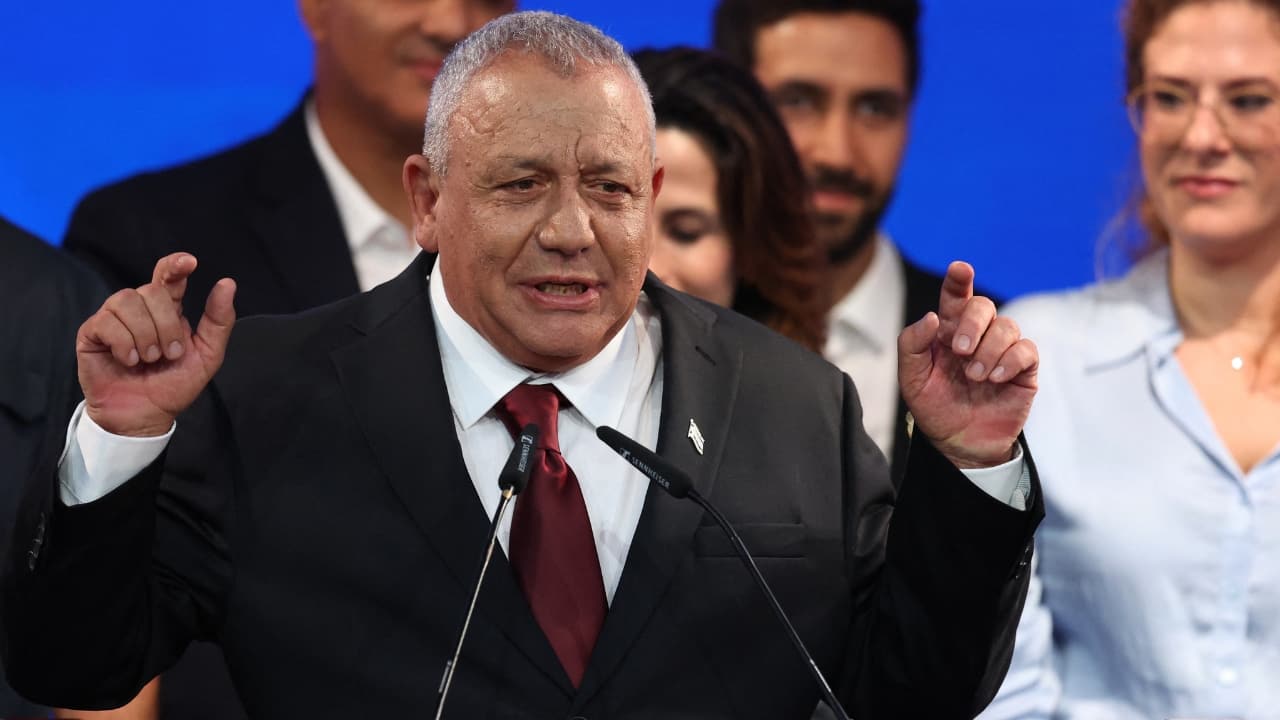
Israeli opposition leader Gadi Eisenkot vowed to form a government after Tuesday’s elections showed no clear majority. Exit polls gave his bloc 52-53 seats, while Benjamin Netanyahu’s coalition got 50. "The people have spoken against the continuation of Netanyahu's rule," Eisenkot said. Now, both sides face difficult coalition negotiations ahead.
Israeli opposition leader Gadi Eisenkot has vowed to form the country's next government, claiming voters have chosen political change. However, exit polls suggest he faces a difficult path to securing a parliamentary majority. Exit polls from Tuesday's legislative elections projected Eisenkot's opposition bloc to win 52-53 seats in the 120-member Knesset, compared with 50 for Prime Minister Benjamin Netanyahu's Likud-led coalition. Arab-led parties were projected to secure another 17-18 seats, potentially giving them a decisive role in government formation. Neither major bloc is projected to reach the 61 seats required for a majority, leaving Israel facing potentially prolonged coalition negotiations.
"The people have spoken against the continuation of Netanyahu's rule," Eisenkot said early on Wednesday while addressing supporters. He also warned Netanyahu against using national security concerns for political purposes, after the prime minister raised the prospect of an Israeli attack on Iran during the final days of the campaign. "Netanyahu, don't you dare use Israel's security for your political needs," Eisenkot said. Eisenkot argued that another election would be a mistake given the high turnout. However, the exit-poll figures do not establish whether his bloc can assemble enough support to govern.
Netanyahu's bloc faces coalition challenge Opposition leader Yair Lapid described Netanyahu's projected performance as a "crushing defeat", saying the public had told the prime minister's bloc to leave office. However, Israel's Foreign Minister Gideon Saar, a member of Likud, cautioned against premature celebrations. "Likud is the largest party in Israel. It is always good to learn something from the past," Saar said in a social media post. Netanyahu has served as Israel's prime minister for nearly 19 of the past 30 years and has repeatedly survived political crises. Ehab Jabareen, a Palestinian political analyst and researcher in Israel, told Al Jazeera that the exit polls indicated "a clear weakening of Netanyahu's bloc".
However, he cautioned that Netanyahu's opponents faced a difficult task in building a majority. Netanyahu could remain in office as caretaker prime minister if neither side succeeds in forming a government. Arab-led parties could hold the balance of power The projected 17-18 seats for Arab-led parties could prove crucial to determining whether the opposition can secure enough parliamentary support to form a government. However, both Netanyahu and Eisenkot have ruled out partnering with Arab-led parties, citing a lack of shared values. This complicates Eisenkot's path to a majority even if his bloc retains its projected lead.
One possibility is a minority government, in which a party or coalition governs without holding a parliamentary majority but relies on support from other lawmakers on key votes. The distinction between joining a government and supporting it from outside could be significant. Raam, led by Mansour Abbas, joined a coalition led by Naftali Bennett and Yair Lapid in 2021-2022. The Joint List, another Arab political grouping, is unlikely to join a coalition outright but could provide a parliamentary "safety net" to a government seeking to remove Netanyahu from power. Political commentator Tal Elovitz said the high turnout among Arab voters indicated a strong desire for political partnership.
Whether that translates into parliamentary support for an Eisenkot-led government remains uncertain. Who will form Israel's next government? Israeli President Isaac Herzog will consult party leaders once the final vote tally is available on November 4. He will then nominate the candidate he believes has the best chance of forming a government, who will not necessarily be the leader of the party with the most seats. The designated candidate will initially have 28 days to assemble a coalition, with the president able to grant an additional 14 days. If the attempt fails, Herzog can nominate another lawmaker, who will have 28 days to form a government.
If that effort also fails, a majority of Knesset members can nominate a third candidate, who will have a final 14 days to secure support. If no candidate succeeds, the Knesset could be dissolved and fresh elections called within 90 days. Netanyahu's government would remain in office as a caretaker administration in the meantime. Could Israel face another election? A national unity government involving Netanyahu and Eisenkot is another possibility, although it would face significant political obstacles. Such an arrangement could bring together parties from across the political divide, but Eisenkot's campaign has centred on ending Netanyahu's rule.
A poll published on October 16 found that 55% of Israelis preferred a national unity government over another election if the vote failed to produce a clear majority. Israel has previously tried a power-sharing arrangement to break a political deadlock. After three elections in less than a year, Netanyahu and Benny Gantz reached an agreement in 2020 that envisaged rotating the premiership. The partnership collapsed after about a year, triggering another election. The final seat tally and subsequent coalition negotiations will determine whether Eisenkot can assemble a governing coalition or whether Israel faces another round of elections.