
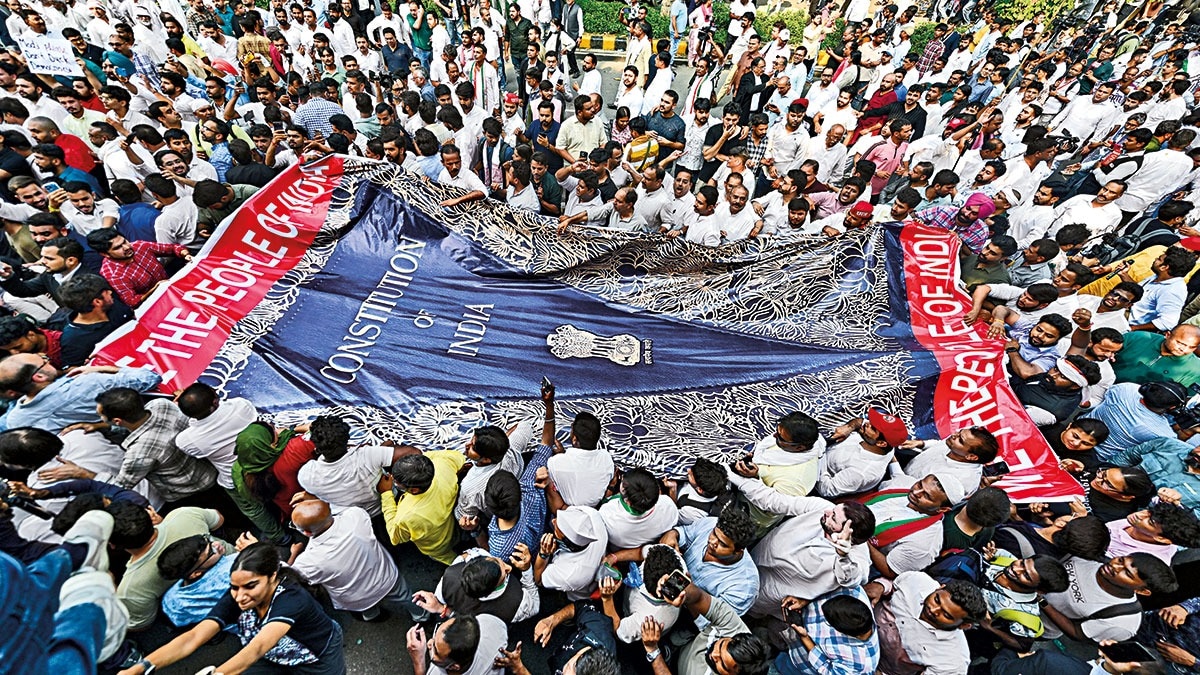
On September 23, The Indian Express reported that election commissioners Sukhbir Singh Sandhu and Vivek Joshi raised 14 written objections to decisions by CEC Gyanesh Kumar. This sparked protests from the Opposition and CJP. Rahul Gandhi called the situation an act of treason, as many groups started fighting the ECI.
CEC Gyanesh Kumar's decisions have become a rallying point for the Congress-led Opposition and the CJP. But this time around, the BJP and the Centre have a plan to counter it. Who will prevail?
Earlier this month, a senior cabinet minister called on Prime Minister Narendra Modi on routine business and, as a courtesy, asked how he was doing. The PM, always ebullient and never short of ideas or opinions, had none to offer this time. "You know what's happening," he said. Indeed, the whole country knows. In the 12 years of its rule, the Modi government has weathered the anti-Citizenship (Amendment) Act (CAA) protests at Shaheen Bagh, the farmers' siege of the national capital and the wrestlers' sit-in at Jantar Mantar. Those battles were over laws, policies or individuals. This time, the referee is under scrutiny. On September 23, The Indian Express reported that election commissioners Sukhbir Singh Sandhu and Vivek Joshi had raised 14 written objections to decisions issued in the name of Chief Election Commissioner (CEC) Gyanesh Kumar, mostly over the Special Intensive Revision (SIR) of electoral rolls.
The revelations gave the Opposition forces validation for their allegations and became a rallying cry against the government. For Congress leader Rahul Gandhi, whose 'votechori' campaign seemed short of evidence, dissent within the Election Commission of India (ECI) offered fresh ammunition. The challenge also came from the Cockroach Janta Party (CJP), the student-led movement that had forced education minister Dharmendra Pradhan's resignation over the NEET paper leak controversy.For the government, the stakes were existential. It could, grudgingly, repeal a law or sacrifice a minister, but acknowledging flaws in the electoral roll revisions risked undermining its own mandate. As the churn started in right earnest, three competing strategies emerged from the three sides. CJP protest in Delhi. (Photo: Arun Kumar)THE FIRST MOVEROn September 23, Rahul Gandhi called votechori an "act of treason" by the BJP, RSS and ECI. On September 30, 19 Opposition parties resolved to fight the "theft of the people's franchise" with all its might. The agitation quickly gathered pace -- an eight-hour sit-in at Akashvani Bhavan on October 6, a meeting with President Droupadi Murmu to petition for Kumar's removal and suspension of the SIR on October 9, an INDIA bloc march to the Supreme Court to file a joint petition under Article 32 on October 12.The protest visuals have started taking effect, says Rajya Sabha MP Praveen Chakravarty, chairman of the AICC's data analytics department. He says an informal dipstick survey suggests even lay voters are now asking, "Kuchh to ho raha hai aur sarkar chup hai. To kyun chup hai? (Something is going on and the government is silent. Why?)" Chakravarty believes the Centre's silence has compounded its difficulties. "If there is nothing to hide, why is the ECI not holding a presser?" he asks.Lok Sabha MP and Tamil Nadu Congress president Manickam Tagore claims the crisis has already cost the Modi regime its legislative calendar as it had planned a special session before the festive season. "Their plan was to have a session and pass the delimitation bill," he alleges. That never happened.Meanwhile, the Congress is not boycotting the coming assembly polls despite the apprehensions about the electoral process. "We can't leave the field open for Modi to choose the opposition of his choice," says Pawan Khera, Rajya Sabha MP and head of the AICC's media and publicity department.The legal offensive is a bit more nuanced. Rather than directly challenging the SC's May 27 judgment upholding the ECI's authority to conduct the SIR, the INDIA bloc petition raises a more focused point. Was the exercise carried out lawfully, through decisions taken collectively by the commission? It seeks access to the ECI files and database-access logs, booth-wise disclosure of voter deletions, an independent audit and an interim suspension of the SIR. The attempt is to shift judicial scrutiny to the way the commission's powers are exercised. Police arrest CJP supporters in Mumbai. (Photo: AFP)THE ROACHES DIG INOctober 10 was meant to showcase the CJP's ability to mobilise independently of established political parties. Instead, police detained its leaders, Abhijeet Dipke, Saurav Das and Ashutosh Ranka, as soon as their flight landed in Delhi. Jantar Mantar was sealed within a four-kilometre exclusion zone, entry was restricted at 45 metro stations and mobile internet was suspended in central Delhi. Barricades prevented protesters from assembling. Delhi Police reported nearly 2,500 detentions, the SC petitioners put the number at 7,000.The crackdown forced a tactical shift. On October 12, the CJP leadership met some 150 state coordinators and decided to decentralise the agitation. Dipke announced a Jail Bharo Andolan in Mumbai, while Maharashtra organiser Ajinkya Shinde proposed protests in Goa, Bengaluru, Kolkata and Ranchi. "Wherever they stop you will become your Jantar Mantar," he told supporters.On October 13, Delhi Police withdrew Jantar Mantar's status as a designated protest site. The CJP immediately turned "Give us back Jantar Mantar" into its new rallying cry. The next day, Das and Ranka, who had crossed the barricades carrying the tricolour, were remanded to five days in judicial custody. By portraying their arrests as punishment for carrying the national flag, the CJP turned the dispute over a protest venue into a question of patriotism and democratic rights.Denied a central stage, the CJP is now dispersing its protests and turning police action into political publicity. The strategy may guarantee visibility and online outrage, but whether the CJP can translate this into sustained pressure on the government remains uncertain.The Congress-CJP relationship has evolved from competitive distance to cautious convergence. After the arrests of Das and Ranka, Rahul declared that waving the tricolour at Jantar Mantar was "not a crime" and jailing youth for it was "an act of cowardice". Dipke thanked him. Yet, neither this statement nor Rahul's earlier assertion that "all protests are one" mentioned the CJP by name. This is perhaps because the Congress wants to lead the broader agitation without formally acknowledging the CJP as an equal partner. Publicly, the Congress is accommodating. "Whoever they are, whoever is supporting them, this is immaterial right now, as long as they are fighting," says Khera. Privately, the calculations differ. A Congress leader says the CJP is not yet an electoral threat but could become one if it forms a party or contests elections. Until then, he says, "they can have a free run".The CJP, meanwhile, is wary of both state suppression and Congress absorption. Dipke calls it a "political pressure group" that welcomes party support but rejects integration into an INDIA-led campaign. After October 10, he warned that "by treating different protests differently, the government creates suspicion and mistrust". Ranka explains the strategy. "Cooperation does not always have to be on the same platform, at the same time. There must be pressure from various angles." THE CENTRE'S PLAYBOOKThe government's response was shaped by its experience in July. Then, it had allowed the CJP to occupy Jantar Mantar for weeks and march on Parliament before a lathi charge left more than 100 students injured. Images of the police action generated sympathy and swelled the protests. Within weeks, Pradhan was out of the education ministry and Modi had conceded every demand. The BJP's assessment was that its mistake lay less in using force than in allowing the movement time and space to assemble, attract sympathy and dominate public attention. "They do not want any visuals like the last time," says Neelanjan Sircar of the Centre for Policy Research. October 10 was designed to prevent that. There was no lathi charge. Most detainees were released by evening, while the three CJP leaders were freed the next morning.The second element of the strategy concerns Kumar, on whom the government has far less room for manoeuvre. A BJP insider told india today that any action against Kumar would be interpreted as an admission that elections had been manipulated, undermining the legitimacy of the government itself.Kumar, a former home ministry official who helped draft the legislation abrogating Article 370, also enjoys constitutional protection. A CEC can be removed only through a process similar to that required for the impeachment of an SC judge. The government, therefore, has little incentive to move against him.The third element is a carefully calibrated division of labour. Shah has assumed responsibility for the political defence of the SIR. His accusation that Rahul is shielding the "ghuspaithiyas (infiltrators)" seeks to change the terms of the debate. The argument also makes Shah the principal target of the Opposition's attacks, keeping Modi largely outside the line of fire. BJP president Nitin Nabin's allegation of the involvement of "foreign forces" might appear reflexive, but the party's internal assessment suggests that, unlike in July, this is resonating with its core supporters.The fourth element is the most calculated. The BJP is relaxed about protests by established parties, and detaining Opposition leaders for a few hours costs it little. What worries it is the CJP's influence on young people outside party structures. So, the cockroaches are treated as a security problem with 'foreign links', while the Congress is allowed to march near the SC and dismissed as a sore loser. THE SCALES OF JUSTICEThere is, however, one element the government cannot fully control: the judiciary. On October 5, Chief Justice Surya Kant rejected the ECI's claim that the SC had approved its modified Form 6 declaration. On October 11, Justices Joymalya Bagchi and V. Mohana issued notice on a contempt plea concerning the lockdown and ordered the restoration of metro, rail and internet services. The courts, which the government might have hoped would provide institutional cover for the SIR, have begun raising questions of their own.The government may well win the battle of the barricades and keep Kumar in office, but every sealed street hands its opponents a fresh grievance, and the SC may eventually step in, deciding how long the umpire will escape scrutiny. The Congress has found a potent issue, but must show organisational strength to sustain the fight. The CJP has the energy to survive, but not yet the leverage to force change. For now, a prolonged conflict seems likely, with the BJP banking on wearing its opponents down.- Ends