
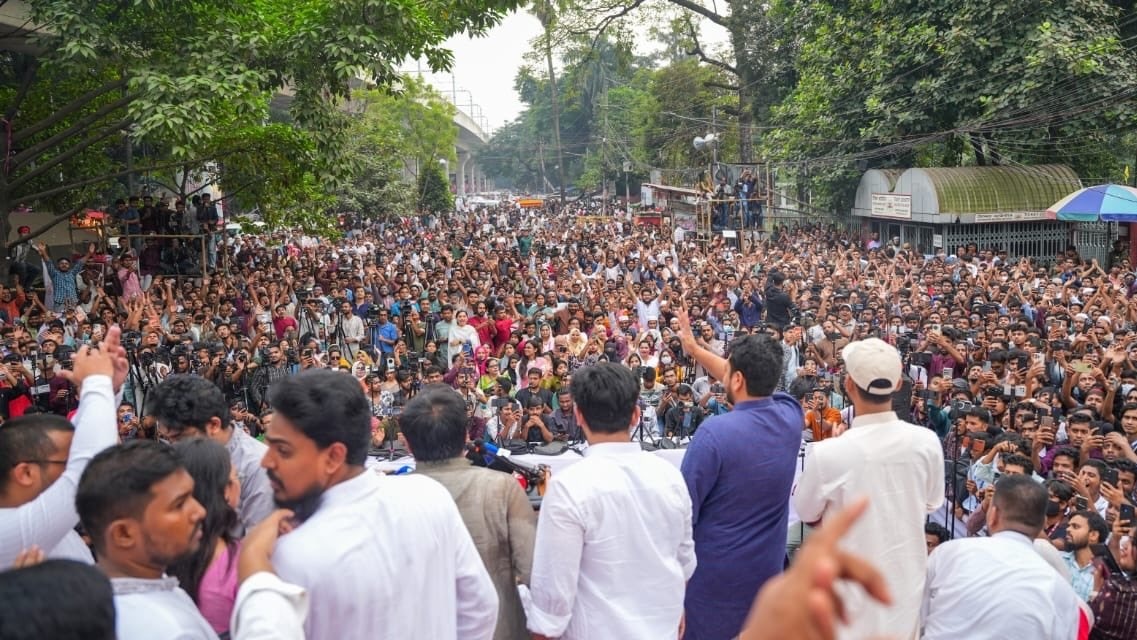
Anti-India slogans returned to Dhaka streets during a massive protest rally on Friday. Organised by the National Citizen Party, the event saw thousands chant against India amid rising local prices. Convenor Nahid Islam said, "The current government will not be able to protect Bangladesh from India's conspiracies," during his address.
Anti-India slogans were raised at a massive protest rally organised by the National Citizen Party, which was born out of the 2024 student-led uprising that led to the ouster of former prime minister Sheikh Hasina. What is the reason behind it?
'Dilli na Dhaka? Dhaka, Dhaka'. Anti-India slogans once again echoed in Dhaka as protests returned to Bangladesh, this time against Prime Minister Tarique Rahman over rising prices, a prolonged power crisis and fuel and gas shortages. On Friday, National Citizen Party (NCP) convenor Nahid Islam, known for his anti-India rhetoric, held a mass protest rally in Dhaka and demanded the resignation of the Home and Energy ministers.
However, the rally, which was held in front of the National Museum in Dhaka and drew a massive crowd, was not limited to domestic issues. Videos circulating on social media show NCP leaders raising the slogan "Dilli na Dhaka", with thousands gathered at the rally responding with "Dhaka, Dhaka". Nahid Islam and the NCP are known for whipping up anti-India sentiments at their rallies, as was seen in the run-up to the Bangladesh elections earlier this year.
The agitation was also attended by radical NCP MP Hasnat Abdullah, who last year threatened to "cut off" India's Seven Sisters and drew India's ire.
ANTI-INDIA SLOGANS RETURN IN BANGLADESH
The usual rhetoric of India conspiring against Bangladesh was raised by Nahid during his address. "The current government will not be able to protect Bangladesh from India's conspiracies," Nahid said, according to a report in Prothom Alo.
Nahid, one of the prominent faces of the 2024 July uprising that led to the ouster of Sheikh Hasina, also mentioned alleged killings along the border and claimed Muslims were being persecuted in Assam and West Bengal. He also alleged there were plans to demolish mosques in Delhi.
However, he offered no evidence to substantiate any of these claims or back them up with facts.
The NCP convener also warned that if the Ganga Water Sharing Treaty was not renegotiated fairly, the people of Bangladesh would take to the streets again. "This time, we will not compromise even an inch on our rightful share," Nahid said.
The 30-year-old treaty between India and Bangladesh expires in December this year. It has become a critical diplomatic issue between the two countries amid turbulent bilateral ties.
Bangladesh's Water Resources Minister has pressed for the conclusion of a new treaty by December 12. The treaty governs the sharing of the Ganga waters at the Farakka Barrage in West Bengal during the lean season from January 1 to May 31.
The Ganga River is known as the Padma, the lifeline of Bangladesh, in Dhaka. Nearly one-third of the country's population depends on the river system for their livelihood. This is why the treaty is so important for Bangladesh.
ANTI-INDIA RHETORIC POST HASINA
The latest slogans against New Delhi come against the backdrop of a steady rise in anti-India rhetoric in Bangladesh following the ouster of Hasina in August 2024. During the regime of interim chief Muhammad Yunus, the rhetoric sometimes turned sharp.
During Yunus's controversial tenure, several political and student leaders made provocative remarks targeting India as Bangladesh warmed up to Pakistan.
Nahid, before the Bangladesh elections, had called for nationwide rallies against "Indian interference", while Hasnat Abdullah threatened to isolate India's seven north-eastern states and shelter "anti-India elements".
Hasnat also invoked the sensitive Siliguri Corridor, popularly known as the Chicken's Neck, which connects the Northeast to the Indian mainland.
"If Bangladesh is destabilised, the fire of resistance will spread beyond borders. Since you are housing those who destabilise us, we will give refuge to the separatists of 7 sisters too," Hasnat had said in December last year.
Such anti-India rhetoric was not restricted to student leaders. Abdullahil Amaan Azmi, a retired brigadier general and son of former Jamaat-e-Islami chief Ghulam Azam, went a step further by saying that Bangladesh could not achieve lasting peace unless India was "shattered into pieces".
After the Tarique Rahman-led BNP government came to power in February, such provocative remarks subsided. However, fresh unrest in Bangladesh over a power crisis and domestic issues has seen the return of anti-India slogans.