
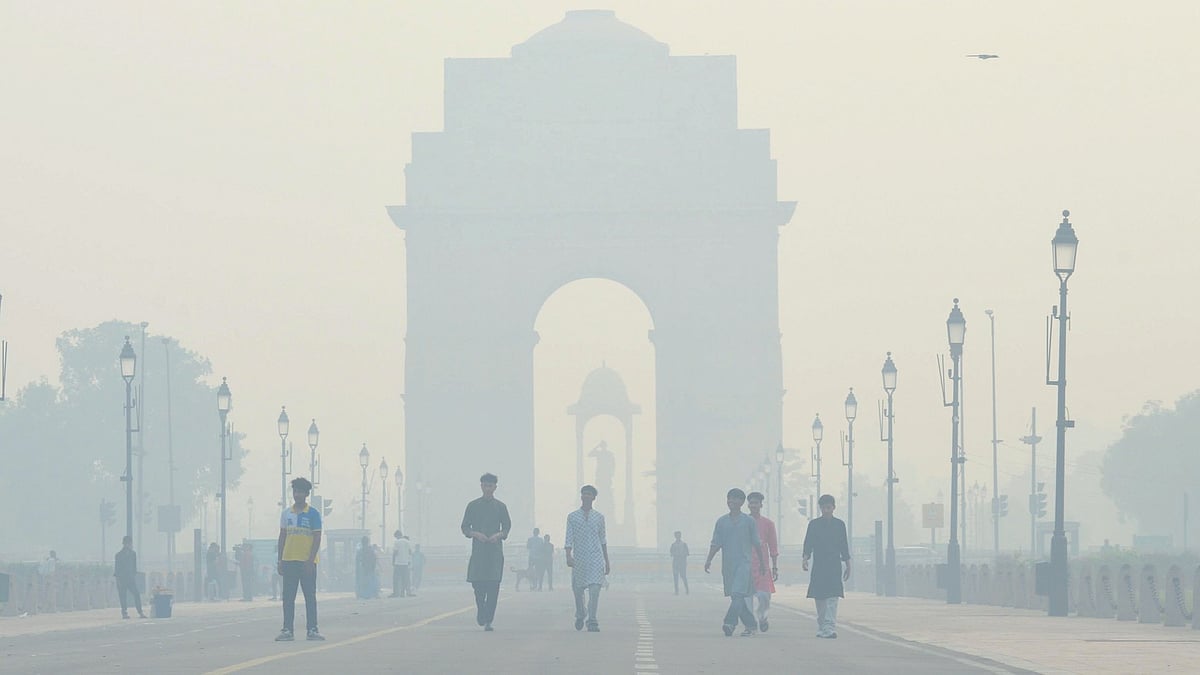
Delhi continues to grapple with deteriorating air quality despite many government measures. Experts said that vehicle exhaust, road dust, and construction work contribute to the problem. Data showed vehicles were the largest contributor to PM2.5 pollution Saturday. "Weather conditions play an important role as well," said activist Manoj Kumar.
Government initiatives offer hope, but sustained action and accountability must take precedence over announcements to find a permanent solution, writes city team.
For years, winters in the capital have been synonymous with air pollution. Despite multiple government measures, awareness campaigns, and court orders, citizens continue to grapple with deteriorating air quality as temperatures fall and atmospheric conditions trap pollutants close to the ground.
This year, the situation is no different. As the winds cool down, the question looms again that Delhi, ironically one of the greenest capitals, is ready to tackle the problem. The query also assumes importance because the Supreme Court of India has recently allowed partial use of fireworks this festive season.
Multiple sources of the problem
Delhi's winter pollution cannot be explained by a single source, said experts. While smoke from stubble burning is one of the major causes, local emissions from vehicles, industries, construction activities, road dust and open waste burning also contribute to the problem.
"Stubble burning in Punjab and Haryana can send smoke towards the capital, but vehicle exhaust, road dust, construction work, industrial emissions and waste burning also contribute to the problem," said Alash Vashistha, environmentalist and NGT lawyer.
A Noida-based environmental activist, Manoj Kumar, opined that weather conditions play an important role as well. "During October and November, lower wind speeds and changes in temperature can trap pollutants close to the ground, making the air more harmful to breathe. Firecrackers during festivals can add to the pollution load. The exact contribution of each source varies with the season and weather," he said.
.
Experts called for a strategy that combines regional coordination with local enforcement, addressing both the pollutants entering from outside and those generated within the capital.
Some even asked if the odd-even mechanism for vehicles could be reintroduced to tackle the problem better. The question assumes significance since vehicles were the single largest contributor to Delhi's PM2.5 pollution Saturday, accounting for 25%, according to data generated by the Indian Institute of Tropical Meteorology's (IITM) newly inaugurated Integrated Atmospheric Chemistry and Aerosol Toxicity Analysis Laboratory (AATAL).
Secondary organic aerosols contributed 18.4%, followed by secondary inorganic aerosols (16.5%), road dust (10.9%) and waste burning (5%).
The laboratory, which was inaugurated in New Rajendra Nagar by Union Minister of State Jitendra Singh, provides real-time source-apportionment data. The data generated over the past five days show that vehicles, secondary organic aerosols and secondary inorganic aerosols have consistently been the top contributors to Delhi's PM2.5 levels.
The data shows that on Friday, when AQI was in the poor category, secondary organic aerosols, which form when volatile organic compounds (VOCs) released by vehicles, industries, solvents and vegetation react in the atmosphere to form particulate matter, were the largest contributor at 24.6%, while vehicles and secondary inorganic aerosols each accounted for 20.7%. Secondary inorganic aerosols are formed through chemical reactions involving gases such as sulphur dioxide, nitrogen oxides and ammonia, producing sulphates and nitrates.
Further, road dust also remained a significant contributor, accounting for 5-10% of PM2.5 in recent days.
.In the courts
The judiciary has repeatedly emphasised that festivals must be balanced against the right to a clean environment. In its October 23, 2018, judgement, the Supreme Court addressed deteriorating air quality in major cities and prohibited the production of traditional firecrackers, including joined crackers, also known as series crackers or laaris, using barium or its salts.
In 2020, the National Green Tribunal directed a ban on the sale of firecrackers in districts where air quality was worse than the poor category, corresponding to an AQI of 201 or above. In September 2021, the Supreme Court upheld restrictions, stressing that authorities must implement the applicable orders in letter and spirit rather than allow people to suffer from air and noise pollution.
In December 2021, the court also defended restrictions on the manufacture and sale of traditional firecrackers, observing that celebrations could not come at the cost of other people's lives and encouraging noiseless festivities.
These interventions establish an important principle: public sentiment is a legitimate consideration, but it cannot automatically override public health. Any relaxation of restrictions must therefore be accompanied by credible safeguards, transparent enforcement and clear accountability.
On September 30, a Supreme Court bench of Justices M M Sundresh and PB Varale said it will neither impose a complete ban on firecrackers nor allow round-the-clock fireworks, stressing that the first option will "hurt sentiments".
The court is considering 'next-generation joined green crackers', developed in collaboration with the Council of Scientific and Industrial Research - National Environmental Engineering Research Institute (CSIR-NEERI), which is reportedly designed with reduced "barium salts" to lower emissions.
.
Barium salt, which gives fireworks a vivid green flame and provides oxygen to help the powder burn fast, is the main ingredient contributing to air pollution and health hazards. Burning barium sends toxic particulate matter into the air, which harms the lungs and heart. Swallowing firecrackers with barium causes rapid drops in blood potassium (hypokalaemia), leading to muscle weakness, heart rhythm problems, and breathing failure.
Considering the potential damage, the next generation crackers are a concession. But there is a problem. According to an NGO's survey report submitted to the top court in 2021, most of the "green crackers" that were tested were found to contain the banned chemicals and were sold with "fake QR codes" printed on the boxes, which were meant to show standard conformity.
The problem is it is not the issue of the past yet. Fireworks using fake QR codes and misleading labels continue to be sold in abundance in the national capital.
Also, if the past has any lesson, the overall fireworks-related problems are only going to get grim. Last year, after several years of a blanket ban, the top court permitted regulated sales between October 18 and 20, with bursting allowed only on October 19 and 20, during specified morning and evening hours. Yet, the restrictions were widely violated.
Even now, the scary impact is widely visible. On Wednesday, a day after Dussehra celebrations, Delhi's air quality index (AQI) worsened from 179 at 4pm on Tuesday to 245 at the same time the following day. According to the experts, much of the change was attributed to widespread firecracker use during Dussehra.
.Government measures
The Delhi government has rolled out its Winter Action Plan 2026-27 to tackle pollution through mechanised cleaning, scientific monitoring and stricter enforcement. A key initiative will extend mechanical road sweeping to 854 smaller roads across 250 wards, covering approximately 609 km. The Municipal Corporation of Delhi (MCD) will receive a grant to procure 30 electric vehicle-based mechanical road sweeping machines to address road dust, a major source of particulate pollution.
The Cabinet has also approved a five-year partnership with IIT. Delhi, estimated to cost ₹19.22 crore, for real-time monitoring and source apportionment of PM2.5 and PM10. The project will restart an existing supersite and mobile laboratory, establish a real-time dashboard and analytical reporting system, and strengthen the technical capacity of Delhi Pollution Control Committee (DPCC) officials. The initiative aims to identify and quantify pollution from vehicles, road dust, biomass burning and other sources.
Meanwhile, the DPCC is conducting regular and surprise inspections at government and private construction sites. Deficiencies in dust-control measures have been found at certain projects linked to the Delhi Jal Board, NHAI, DMRC and NBCC. Show-cause notices have been issued to the agencies concerned, with proposed penalties including work stoppages, electricity disconnections and environmental compensation. Construction operators have also been directed to cover materials and debris, sprinkle water, use anti-smog guns where required and install dust barriers.
.
The government has additionally implemented the 'No PUC, No Fuel' initiative since October 1 to curb vehicular emissions. Delhi recorded an AQI of 191 on October 24, compared with 306 in 2024 and 275 in 2025. While encouraging, this improvement alone does not establish a lasting turnaround. Sustained enforcement and cleaner air through winter will determine whether the plan delivers meaningful results.
Political slugfest
The Commission for Air Quality Management (CAQM) has recently reviewed pollution-control measures in Punjab and Haryana, calling for stronger action against stubble burning and other sources. The CAQM has urged Punjab and Haryana to strengthen the use of crop-residue management machinery, improve monitoring of farm fires, and ensure better collection and use of paddy straw.
While a uniform policy on stubble burning is far from achieved, the political blame game is already on. The BJP has accused the AAP government in Punjab of failing to control the burning of paddy stubble after the harvest season. The AAP, on the other hand, has accused it of using pollution as a political issue to target Punjab and its farming community. Punjab AAP leaders have said the state has provided machinery worth more than Rs 800 crore to help farmers manage crop residue without setting it on fire.
Congress, meanwhile, has criticised the handling of Delhi's pollution crisis and has called attention to the need for stronger government action.
.
For farmers, stopping stubble burning requires affordable machinery, timely access to equipment and reliable ways to sell or reuse crop waste. For Delhi, better public transport, cleaner vehicles, strict dust control and action against open waste burning are equally important.
As the BJP, AAP, and Congress continue to question one another, the main concern remains the health of millions of people living in and around the capital. Political accountability is important, but lasting improvement will require cooperation between the Centre and the governments of Delhi, Punjab, Haryana and Uttar Pradesh.
The road ahead
Uncovered construction sites, congested roads and dust from damaged surfaces remain major local contributors to Delhi's recurring winter pollution, compounded by smoke and dust from neighbouring states.
Tackling the crisis requires more than seasonal plans and political blame games. Measures such as mechanised road cleaning, real-time pollution monitoring, stricter construction controls and vehicle-emission checks must deliver sustained improvements in air quality and public health.
Any relaxation of firecracker restrictions must be backed by strict enforcement, verified green-cracker standards and action against illegal products. Festivals and public sentiments matter, but not at the cost of people's right to breathe clean air.
Equally crucial is coordinated action against stubble burning vehicular and industrial emissions, road dust and waste burning. Farmers need affordable alternatives to burning crop residue, while governments must work across state boundaries to address this regional crisis.
Schemes such as odd-even may be considered where evidence supports their effectiveness, but they cannot replace long-term structural reforms. Delhi needs scientific planning, transparent monitoring, strict accountability and sustained public participation. Clean air must be a year-round governance priority, not merely a winter promise. The real test lies not in announcements, but in ensuring that every citizen can breathe safely.