
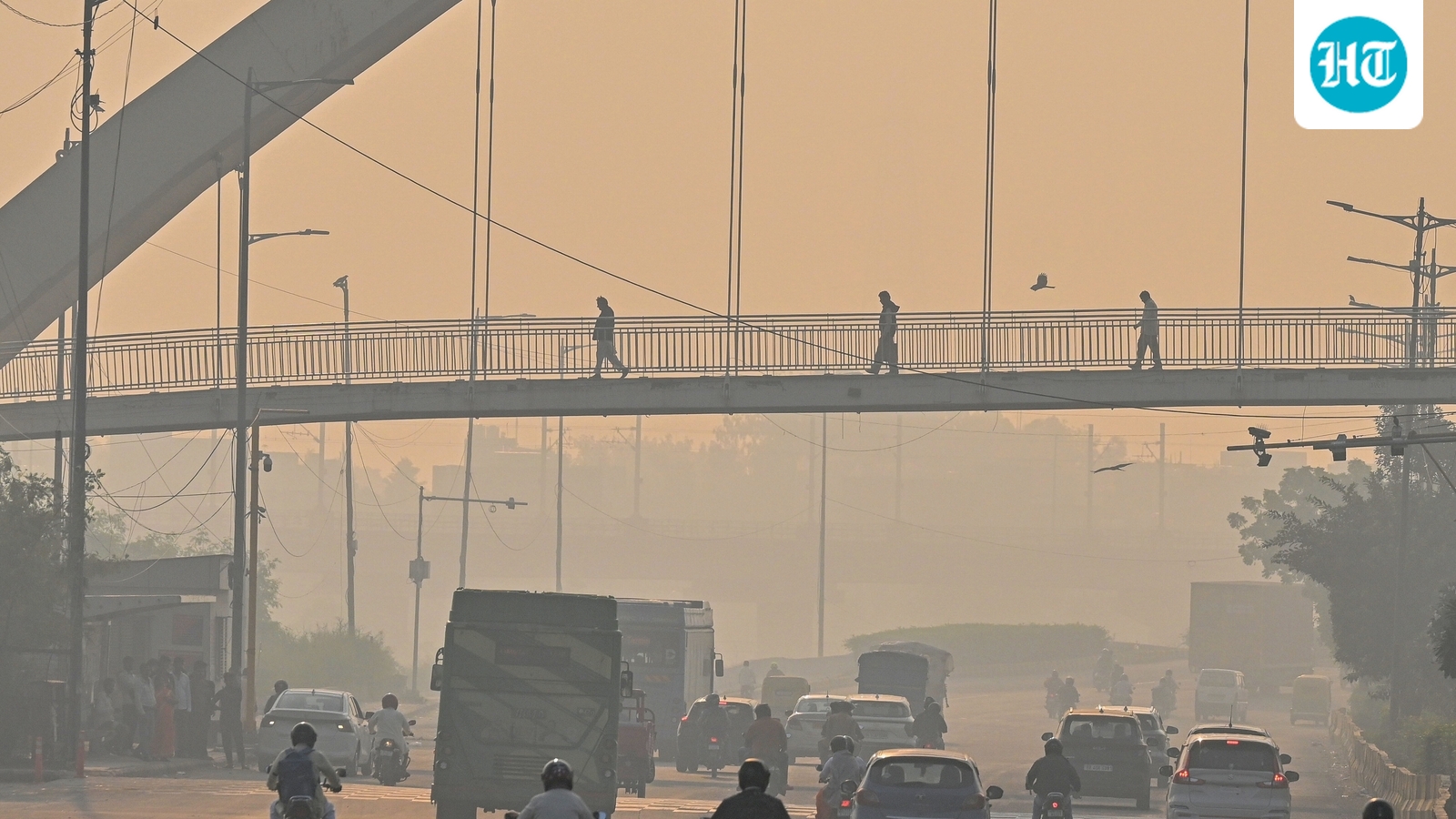
Delhi air quality reached its worst level since April 17 as anti-pollution curbs started on Sunday. Officials banned non-Delhi vehicles and dust-generating construction work to manage the crisis. Stubble burning contributed 18.57% to the pollution on Sunday. Experts said two-thirds of fine particles in Delhi’s air came from outside the city.
This is the worst air quality since April 17, when the Capital recorded an average AQI of 263 (“poor”) on April 17. It recorded an AQI of 261 on July 12.
CPCB classifies an AQI of 0–50 as “good”, 51–100 as “satisfactory”, 101–200 as “moderate”, 201–300 as “poor”, 301–400 as “very poor” and 401–500 as “severe”.
According to the Centre’s Air Quality Early Warning System (AQEWS) for Delhi, the AQI is likely to remain in the “poor” category on Monday and Tuesday, and may further deteriorate to the “very poor” category by Wednesday.
The AQEWS bulletin added, “The outlook for the subsequent six days is that the air quality is likely to be in the very poor to poor category.”
To be sure, Delhi winter pollution action plan came into effect on Sunday, which bars non-Delhi vehicles below BS-VI emission standards, bans all dust-generating demolition and outdoor civil construction activities, and mandates 50% attendance in offices and work from home.
Data from 57 of the city’s 59 monitoring stations showed that 22 recorded “very poor” air quality, with Jahangirpuri logging the worst AQI at 378 at 4pm. It was followed by Rohini (352), Punjabi Bagh (351), Mundka (337), RK Puram (335), and Chandni Chowk at 328.
At 8pm, CPCB listed PM2.5 as the main pollutant at 50 of Delhi’s 57 reporting stations and PM10 at 7.
According to the Decision Support System (DSS) for air quality management in Delhi, stubble burning’s contribution to Delhi’s air pollution rose to 18.57% on Sunday, up from 5.33% on Saturday. Past data shows the contribution of farm fires peaks typically in the first week of November, making it an important time of the year to capture data.
The maximum was 29°C, two degree below normal.
Typically, low temperature and wind speeds as well as fog slow down dispersion by trapping pollutants near the surface.
As a result, on Sunday afternoon, the weather worked against clearing Delhi’s air, according to an HT analysis of IMD’s weather-balloon readings from Safdarjung. It showed that, by 4:30pm the day’s pollution had spread only 1,100 m up from the ground, where the wind averaged 10 km/h. On a typical early-November afternoon it spreads about 1,300m up, with wind of about 13 km/h.
Jinitha Varghese, programme manager at EnviroCatalysts, said two-thirds of the fine particles in Delhi’s air came from outside the city, including NCR industries and traffic, coal power plants upwind such as those in Jhajjar, and burning across the region, while Delhi’s own traffic is still its biggest single source. “About 40% of the particles form in the air from gases released in the airshed, so the smoke from coal, fuels and stubble shows up as ‘secondary’ pollution and is easy to undercount,” he added.
Meteorologist Navdeep Dahiya said, “Smog season begins now... Most AQI sensors across Delhi NCR are now reporting AQI levels above 300 and many are climbing 400-500 range tonight. The flow of winds are from north west with calm conditions. All emissions will persist in the atmosphere for longer duration.