
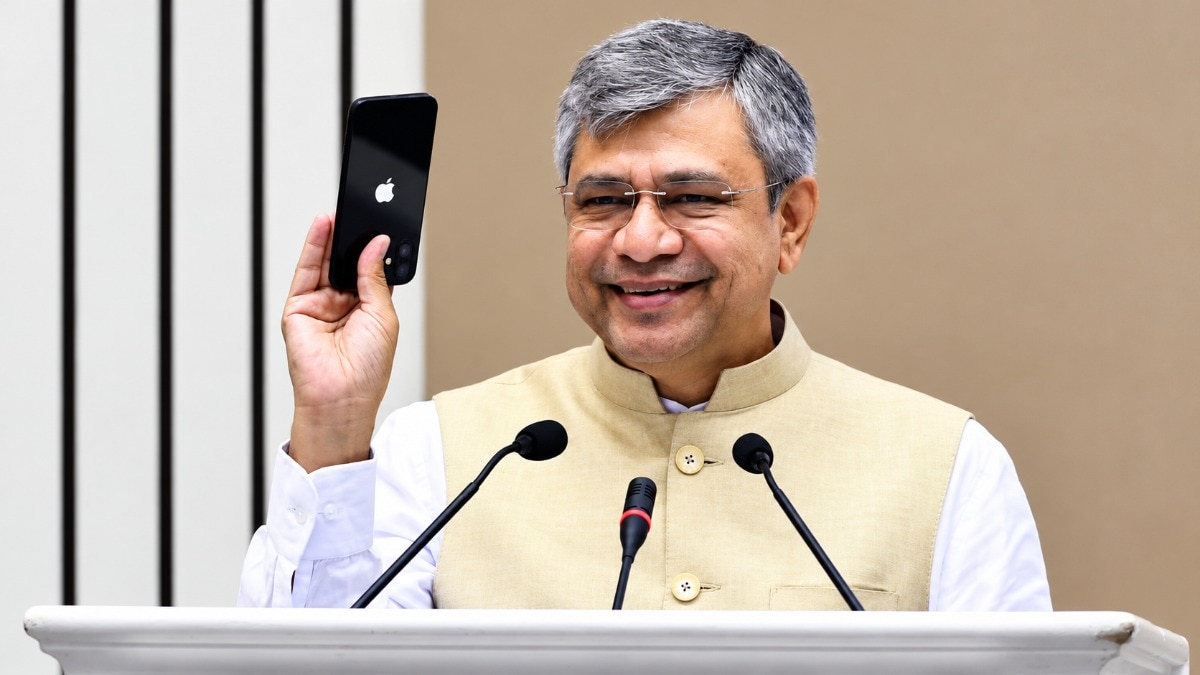
Union Electronics and IT Minister Ashwini Vaishnaw defended India’s iPhone manufacturing on Tuesday, October 27. He said the government paid Rs 19,000 crore in incentives but collected Rs 25,000 crore in direct taxes. Vaishnaw noted that electronics manufacturing employs 25 lakh people, telling critics of the PLI scheme to "Cope harder!!"
India's iPhone manufacturing boom has triggered a debate about whether subsidies given with taxpayer money are helping the country build a competitive electronics industry or is just paying companies to assemble products whose most valuable components are still imported. A recent Bloomberg report has reignited the debate, with Union Electronics and IT Minister Ashwini Vaishnaw pushing back against the criticism with hard data and a "cope harder" counter message. He argued that the government's Production Linked Incentive (PLI) scheme has generated substantial tax revenue and employment.
Vaishnaw on Tuesday (October 27) hailed India's PLI scheme while responding to a Bloomberg video report that questioned the economics of the country's iPhone manufacturing push. Sharing the official numbers on X, the Union Minister of Electronics and IT said the government had paid Rs 19,000 crore in mobile manufacturing incentives but collected Rs 25,000 crore in direct taxes and Rs 3 lakh crore in GST.
"Mobile PLI stats as follows," Vaishnaw wrote, before listing the figures and adding that electronics manufacturing employs 25 lakh people, of whom 12 lakh work in mobile manufacturing. In the last portion of his post, Vaishnaw used internet slang to the scheme's critics, saying "Cope harder!!"
The 56-year-old Union minister's response framed the mobile PLI scheme as a fiscal and employment success. However, the Bloomberg report raised a question that how much economic value does India retain from manufacturing iPhones when a substantial portion of their components continues to come from overseas?
WHAT BLOOMBERG SAID ABOUT INDIA'S IPHONE BOOM
In a video report filmed in Hong Kong's Sham Shui Po district, Bloomberg Opinion columnist Andy Mukherjee dismantled an iPhone to examine its components and study India's progress in electronics manufacturing. He questioned whether India should attempt to replicate China's success in high-tech manufacturing.
Mukherjee acknowledged that India had made progress. "Indian factories had moved from importing pre-assembled mainboards to importing bare circuit boards and fitting electronic components locally," he said in the video report. The Bloomberg columnist estimated that this shift had improved India's mobile trade balance by $2.1 billion in a year.
He also pointed to India's growing role in Apple's supply chain, with roughly one in every four iPhones now manufactured in India.
However, the Bloomberg report argued that India continued to depend heavily on imports for memory chips, processors, displays, camera lenses and batteries.
According to Andy Mukherjee, the cost of importing components remained greater than what India earned through exports of finished handsets.
The Bloomberg report stressed that subsidies could make the economics even more challenging. If manufacturing costs remained high, taxpayers could end up spending more on incentives than the additional wages paid to factory workers. Rising global memory prices, driven partly by demand from artificial intelligence, could further complicate economics, he suggested.
WHEN RAGHURAM RAJAN MADE SIMILAR ASSESSMENT ON SEMICONDUCTORS
"Now India wants to move into advanced semiconductors, which are a lot harder to make," said Mukherjee, adding, "But even with billions of dollars in subsidies, India has only gotten to only testing and packaging."
"A real high-end fab is still years away. India would be better off building on its strengths in engineering and design. And investing in industries like clothing and footwear that can employ tens of millions of people," said Mukherjee.
The debate over India's manufacturing subsidies and semiconductors brings to mind the recent remarks by former RBI governor Raghuram Rajan, who questioned the rationale for investing billions of dollars in building a domestic semiconductor industry.
In an interview with Frontline magazine, in September 2026, Rajan questioned whether India needed to spend so heavily on chip manufacturing when semiconductors could be sourced internationally. He argued that even with substantial investment, India could not achieve complete self-sufficiency because chip production requires machinery, materials and other inputs from abroad.
"When I see people say that India needs to make semiconductor chips [by pouring several billion dollars], my question is, why? This is the most easily smuggled thing on Earth," Rajan said in the interview.
Rajan was citing the ability of countries facing export restrictions to obtain chips through intermediaries and argued that India should be more selective about which industries it considers strategically essential. He also stressed the need to improve fundamentals such as education and the business environment.
His argument drew criticism from Zoho founder Sridhar Vembu, who defended India's semiconductor ambitions, saying the country needed to develop its own capabilities rather than assume foreign suppliers would always provide the technology it required.
Rajan's comments are relevant to the debate over the iPhone PLI scheme because both raise questions about the costs of building domestic manufacturing capacity, dependence on global supply chains and the returns on public investment.
HOW PLI SCHEME HAS ACHIEVED BIG FOR INDIA
For the Centre, the expansion of electronics manufacturing is evidence that its industrial policy is working. The PLI scheme was designed to encourage companies to increase domestic production by linking financial incentives to incremental manufacturing.
The government has repeatedly highlighted the growth of mobile phone production and exports, alongside the creation of jobs across manufacturing facilities and their supplier networks.
Official figures cited in Parliament in July 2025 showed that the large-scale electronics manufacturing PLI scheme had attracted Rs 12,390 crore in cumulative investment and generated Rs 8.44 lakh crore in production by June 2025. Mobile phone exports under the scheme had reached Rs 4.65 lakh crore, according to the government.
The broader electronics ecosystem has also expanded, with Apple and its manufacturing partners increasing production in India as the company diversifies its supply chain beyond China under the China-Plus-One strategy.
From being an importer, India has emerged as the world's second-largest mobile manufacturer. Smartphones have become India's top export category with overseas shipments valued at $30 billion in 2025, Vaishnaw had said in February this year.
Vaishnaw's latest figures seek to reinforce the argument that the benefits extend beyond factory output. The tax revenue cited by the Union minister is significantly higher than the incentives paid, while the employment figures highlight the sector's growing role in the economy.