
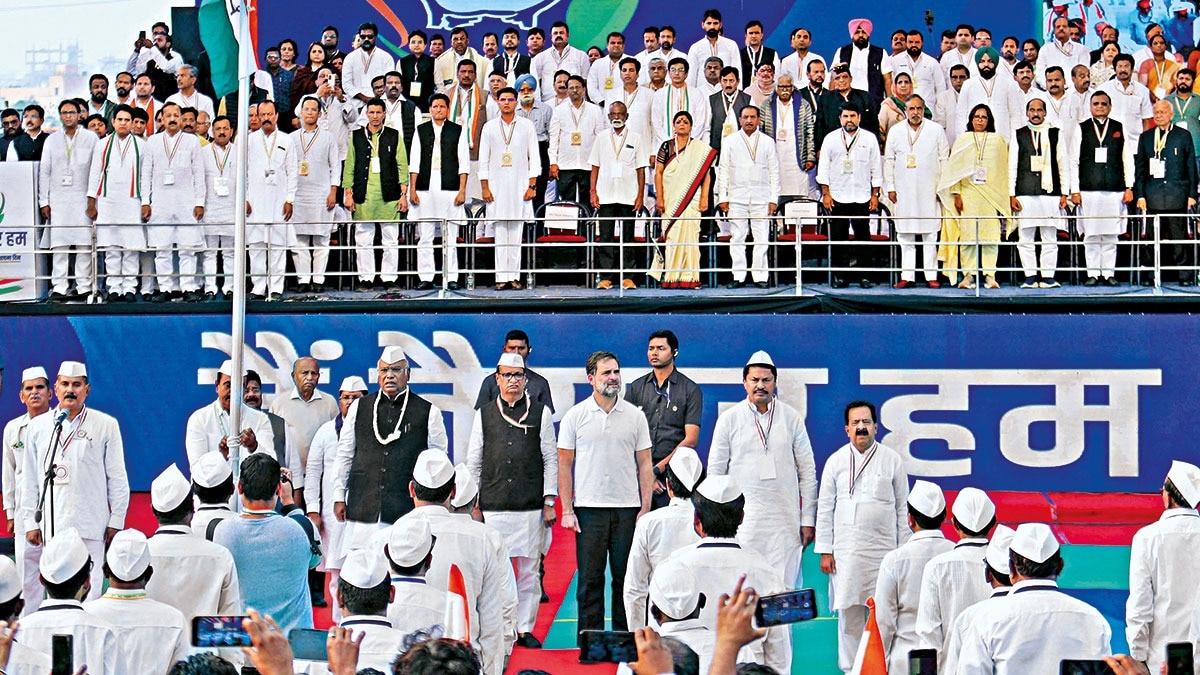
The Congress is trying to revive the Seva Dal as a grassroots force to counter the RSS. On October 31, volunteers saved the INDIA bloc rally by clearing waterlogged grounds. Srinivas said, "Many people credited the Seva Dal with the rally's success because our volunteers were visible on the ground."
The Congress believes the Seva Dal could be its answer to the RSS, a cadre-based counter taking the party's message to the villages. But after decades of neglect, can it be resurrected as a grassroots force?
On the night of October 31, 2026, 24 hours before the November 1 rally of the Indian National Developmental Inclusive Alliance or the INDIA bloc, Delhi's Ramlila Maidan was a swamp. Heavy rains had left the ground waterlogged, and with thousands of Opposition workers expected in the capital, the Congress faced an embarrassing logistical crisis. Till Seva Dal chief organiser B.V. Srinivas, along with Delhi PCC president Devender Yadav and others, came to the rescue. Volunteers drained the water and dumpers filled the slushy patches with dry mud. By morning, the venue was ready, and through the day 3,000 Dal volunteers guided the people, manned the gates and served water to the thirsty.
Srinivas declines to take credit, though. "Many people credited the Seva Dal with the rally's success because our volunteers were visible on the ground. Congress leaders and our front organisations worked and planned meticulously to ensure the success," he says. For Rahul Gandhi, however, it was a glimpse of what the party's oldest volunteer organisation could do as a grassroots force. The harder question is whether a body that spent decades unrolling carpets at party sessions can become the permanent cadre he has wanted for a decade, one that can take on the ruling BJP's alma mater, the Rashtriya Swayamsevak Sangh (RSS).Congress president Mallikarjun Kharge appointed Srinivas, a 45-year-old OBC leader from Karnataka, chief organiser on June 26, replacing Lalji Desai in a reshuffle that insiders say bore Rahul's stamp.
Srinivas, a former Indian Youth Congress (IYC) president known as the 'Oxygen Man' for running a volunteer command centre during the second Covid wave in 2021, brings the reputation of a street organiser who is equally at home at protest sites and seva centres. TWO SCHOOLS OF SERVICERahul reads the Congress's defeats since 2014 as a sign of organisational hollowing. The BJP's strength, in his view, rests on the RSS's vast booth-level machinery, ideological training and community networks. He wants the Seva Dal to be the "backbone and protector of the Congress ideology" and its "first line of defence".
The rivalry has a history. RSS founder Keshav Baliram Hedgewar was a Seva Dal worker before he set up the RSS in Nagpur in 1925.The two differ fundamentally in their ideological roots and organisational roles, though. The Seva Dal is an arm of a political party. Its creed comes from the freedom movement: non-violence, pluralism, constitutional citizenship and service across religious and caste divisions. The RSS, by contrast, defines its mission through Hindu cultural nationalism and social organisation. Though it operates separately from the BJP, generations of its trained volunteers have entered the party's leadership and campaign machinery.The RSS builds its cadre through routine.
A swayamsevak typically begins at the local shakha, which meets for an hour every day, opens with a salute to the saffron Bhagwa Dhwaj and closes with the Sangh prayer. In between come games, physical drills, prayers and ideological discussions. A mukhya shikshak (chief instructor) runs each shakha. Weekly milans and monthly mandalis (gatherings) serve the places that have no daily shakhas. The RSS requires no formal membership application. Regular attendance creates the relationship.Longer training then identifies future organisers and connects them with experienced leaders. Swayamsevaks climb a ladder of residential camps of various durations.
The camps teach volunteers how to run branches, discuss the Sangh's worldview and organise local service. The scale is formidable. On November 4, the RSS reported 99,423 daily shakhas, 34,982 weekly milans and 14,096 monthly mandalis, and claimed that its centenary outreach had reached more than 100 million homes.The Seva Dal, on the other hand, had faded into oblivion over the years. The first attempts to revive it came in June 2018, when Rahul picked Gujarat activist Desai as chief organiser. Desai put an end to the practice of volunteers serving as attendants for leaders, and ensured that salutes were reserved for the national flag.
Borrowing from the RSS playbook, a monthly Dhwaj Vandana, the hoisting of the tricolour, was planned across a thousand cities, and weekly Ravi Milan meetings mixed Gandhi's bhajans with debates on pluralism, unemployment and other issues. A Youth Brigade and the Dal's digital cells were other innovations.Yet, the RSS remains way ahead in the game. Most importantly, unlike its workers, Dal volunteers rarely find a path into politics. Former Rajasthan chief minister Ashok Gehlot is virtually the only one to have risen from its ranks to high office. Seva Dal's chance came with the Bharat Jodo Yatra of 2022-23, which gave it national visibility.
On Rahul's 4,000-km march from Kanyakumari to Kashmir, Dal volunteers led the daily flag-hoisting, carried the tricolour at the head of the procession, and helped with local mobilisation. For once, it was seen doing more than managing party functions. THE NEW PLAYBOOKSrinivas has kept Desai's foundation and added a sharper political edge. He calls his cadre the "true Babbar Shers of Rahul Gandhi" and says he is training "Seva Dal vicharaks", ideological communicators meant to counter the RSS's pracharaks. His two immediate goals -- a stronger training system and wider recruitment among the young.The enrolment push runs on several fronts.
A membership drive is planned at block, district and state levels, aimed at young people who know little about the Congress or the Dal's history. Srinivas is also planning a nationwide tour to talk about the party's role in the freedom struggle and nation-building. An online membership portal listed 32,863 registrations across 34 geographical categories on November 3. He is tapping his old IYC network, particularly workers who stayed active without getting posts or promotions and searching the Dal's own ranks for veterans who have worked for decades without political reward. Grassroots workers, he concedes, have often been denied recognition, and giving them responsibility is a priority.Service is the main recruiting tool.
Under #SOSSevaDal, volunteers have run flood relief in Assam, Bihar, MP, Uttar Pradesh and Nepal, carrying out rescues and distributing food and survival kits in Assam. A programme called Seva Saathi runs health and eye camps and blood donation drives, arranges blood for patients, cleans ponds and beaches, and offers educational support and counselling to tribal children. A legal aid cell is also being planned.However, its most distinctive experiment targets students. On the late Rajiv Gandhi's birth anniversary, Seva Dal conducted examination-style quizzes at more than 100 locations, using OMR sheets.
Srinivas says thousands attended. Questions introduced the ideas of Congress while familiarising students with competitive-test conditions. The response in MP, UP, Karnataka, Kerala, Maharashtra and Telangana also helped him map where local networks were functioning and where they were weak. It was public engagement, ideological introduction and organisational reconnaissance rolled into one.THE 2027 TESTWhat the Dal cannot yet show is scale. No verified national membership, training-camp count or deployment figure is public. Desai had claimed units in 700 districts and, by September 2021, an active membership of 370,000.
Srinivas says an organisational audit is under way and expects an assessment of membership and structure by year-end.Srinivas's real test will come in 2027, when seven states with 940 assembly seats vote. Revival drives in the 1980s, 2010 and 2018 failed to have a lasting impact. UP, Punjab, Uttarakhand, Goa and Manipur are expected to vote early in the year, Gujarat and Himachal Pradesh later. Repeating the Ramlila operation across thousands of rural booths will need sustained patronage of the AICC leadership, funds and coordination with state units and other frontal organisations. The revival will be measured not by how many workers turn up at a national rally but by how many stay active in their villages and towns between elections.- Ends