
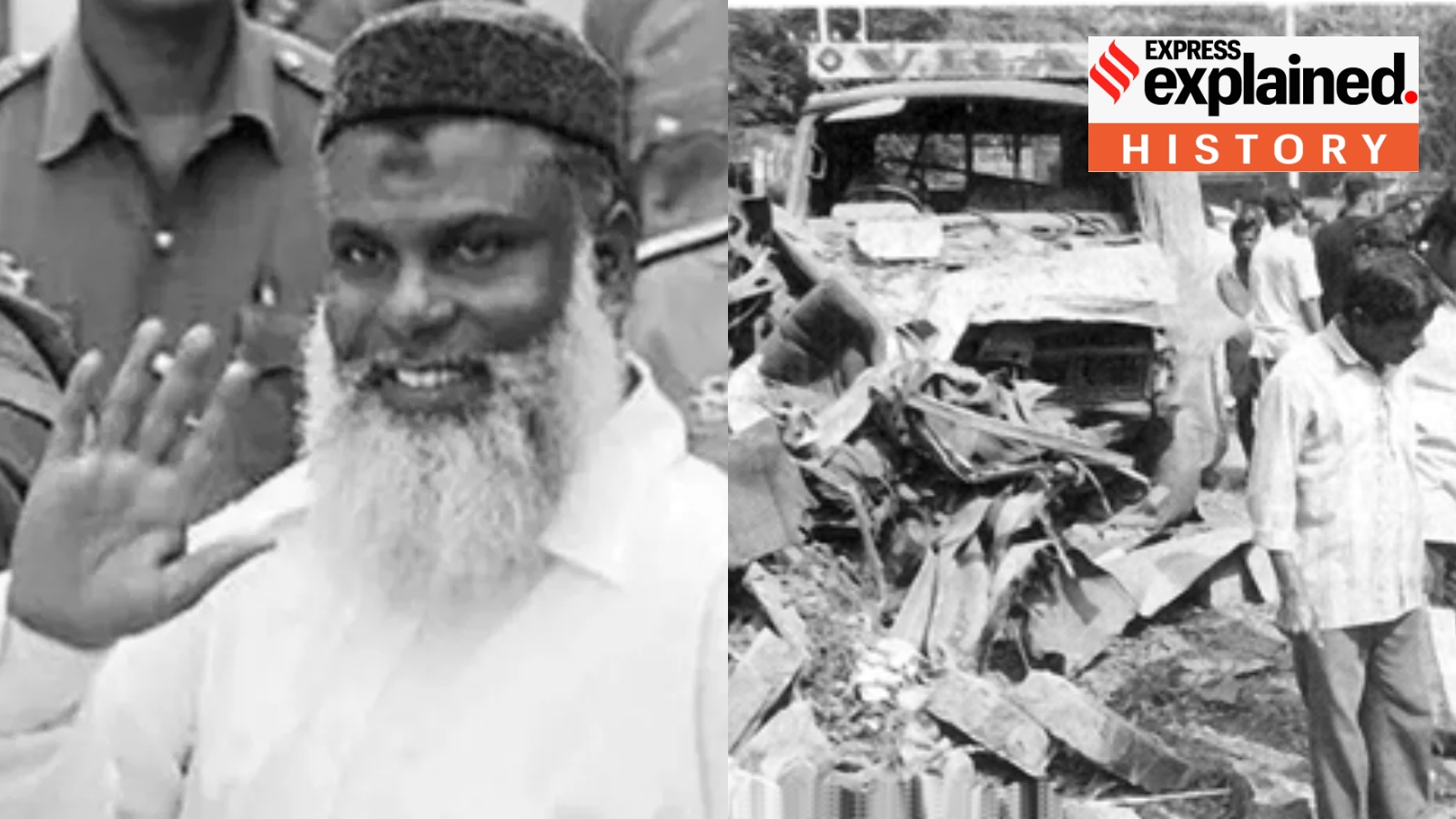
The Tamil Nadu government granted 60 days' parole to five life convicts in the 1998 Coimbatore serial bombings. These attacks killed 58 people and followed communal violence where 18 Muslims died. The decision sparked political debate, as many remember the deep grief and the long history of conflict in Coimbatore.
The Tamil Nadu government recently granted 60 days' parole to five life convicts in the 1998 Coimbatore serial bombings. The attacks, which killed 58 people, had been preceded by communal violence in which 18 Muslims were killed.
The Tamilaga Vettri Kazhagam-led Tamil Nadu government's decision to grant 60 days' parole to five life convicts in the 1998 Coimbatore serial bombings has drawn the BJP's demands for its reversal, reopening a debate shaped by decades of grief, punishment and political conflict.
The attacks, which killed 58 people and targeted BJP leader L K Advani, had been preceded by communal violence and police firing less than three months earlier, in which 18 Muslims were killed.
The two episodes form a connected history of communal polarisation, policing failures, and a terrorist conspiracy that transformed everyday life in Coimbatore and inflicted lasting political damage on the then DMK government. We recall the history of the serial bombings, the communal violence that preceded it, and its aftermath.
What preceded the Coimbatore serial bombings?
Coimbatore's communal tensions had been deepening since the early 1980s. Provocative speeches by Hindu right-wing leaders, counter-mobilisation by Muslim groups, and retaliatory killings gradually hardened divisions. The Babri Masjid demolition in 1992 intensified an already dangerous atmosphere.
On November 29, 1997, traffic constable R Selvaraj was murdered by cadres of Al-Umma, a Islamic extremist organisation founded by S A Basha in 1993 in Coimbatore. Selvaraj's killing triggered anger within the police ranks. Some personnel abandoned duty, creating a security vacuum in which Hindu militants attacked Muslims and their businesses.
Eighteen Muslims were killed during the ensuing communal violence and police firing. Shops were looted, property destroyed, and families traumatised before the Army and central forces restored order.
A fact-finding team of the People's Union for Civil Liberties (PUCL) -- a human rights and civil liberties organisation -- had alleged that sections of the police participated alongside Hindu militants. Its account included attacks on Muslim-owned establishments and assaults on injured Muslims who had sought treatment at the government hospital.
These deaths were subsequently invoked by extremists to mobilise support for retaliation. Photographs and recordings of the victims circulated. The suffering of civilians became material for a conspiracy against other civilians.
What happened in the Coimbatore serial blasts in February 1998?
On February 14, 1998, bombs exploded across Coimbatore as crowds gathered for Advani's election meeting at R S Puram. His flight was delayed, and he had not reached the venue when the explosions began.
The targets extended beyond the rally's vicinity: commercial establishments, transport facilities, a BJP election office, and the government hospital were among the places struck. Explosives were concealed in cars, two-wheelers, bags, and a pineapple cart.
The eventual death toll associated with the blasts was 58, with more than 200 injured. Several unexploded devices were recovered. One car near the rally venue contained approximately 70 kg of explosives; dismantling it required days of preparation.
Investigators identified Al-Umma as the organisation behind the attacks, for which it was subsequently banned.
What were the findings of the Justice Gokulakrishnan Commission?
The Dravida Munnetra Kazhagam (DMK)-led Tamil Nadu government under Chief Minister M Karunanidhi had set up a one-man inquiry commission under Justice P R Gokulakrishnan, a former Acting Chief Justice of the Madras High Court, to investigate the communal violence in November-December 1997. On February 22, 1998, it was asked to examine the bombings and the circumstances preceding them.
Its findings concerned different episodes and should be read separately.
In an initial report tabled in November 1998, the commission justified police firing as necessary to contain violence in November-December 1997. But it faulted policemen who refused duty after Selvaraj's murder, despite their commissioner's directions, and recommended disciplinary action.
For the serial bombings, the commission subsequently identified retaliation for the earlier Muslim deaths as the conspiracy's motive. Its final report in 2000 criticised failures of vigilance that allowed Al-Umma to execute the bombings.
How did the violence change everyday life?
Fear persisted in Coimbatore after the streets reopened. Ahead of the November 1998 anniversary, security plans included 4,000 additional personnel, 30 siren-fitted jeeps supplementing 12 existing vehicles, 17 checkposts, and 32 police pickets. Peace committees were also formed.
For Muslim neighbourhoods such as Kottaimedu, Ukkadam, and Al-Ameen Colony, insecurity included repeated searches and collective suspicion. Residents who opposed the bombings could nevertheless feel that their condemnation would not be believed.
There were also acts of solidarity. Hospitals admitted victims, doctors worked through personal grief, and residents supported bomb-disposal teams. The city's response contained compassion alongside suspicion.
Why did the DMK suffer politically?
Karunanidhi's government faced accusations of police complacency and failure to act on intelligence warnings. The BJP and its ally, Jayalalithaa's All India Anna Dravida Munnetra Kazhagam (AIADMK), made the bombings an indictment of the administration. Muslims also questioned the government's failure to protect them during the earlier violence.
The DMK-led alliance suffered in the subsequent 1998 parliamentary election, winning only nine of the state's 39 Lok Sabha seats. After the AIADMK broke with the BJP in 1999, the DMK joined the BJP-led National Democratic Alliance, which formed the government again that year.
Where does Basha's parole fit?
In 2007, a special court convicted 158 people and sentenced 43, including S A Basha and Mohammed Ansari, to life imprisonment. Basha died at 84 in December 2024, having obtained parole during his final years.
After Basha's death, the lawyer Prabhu Balasubramanian mentioned how Basha once told him things had spiralled beyond his control before he could stop it. Balasubramanian, who knew the Al-Umma founder, also described Basha's remorse and his desire to see his grandchildren.
Such recollections explain an aging prisoner's requests for family time, even as they cannot erase his conviction or the suffering of victims.