
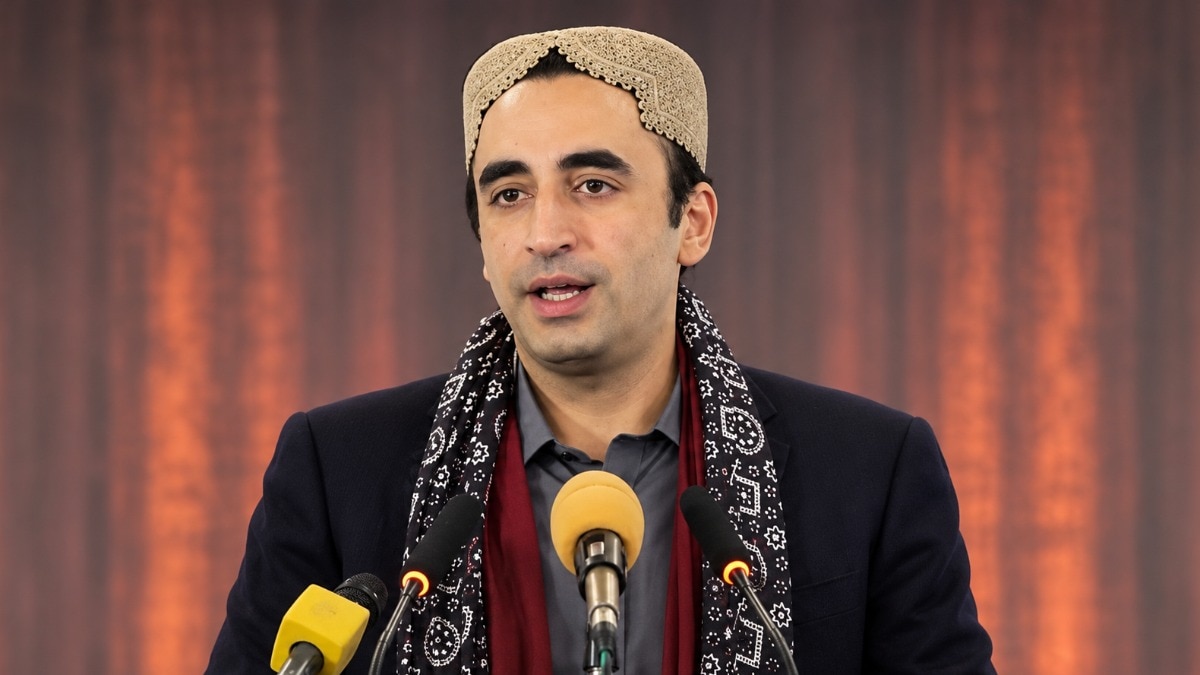
PPP chairman Bilawal Bhutto-Zardari warned of bloodshed in Karachi if Sindh province is forcibly divided. He opposed the proposal pushed by the Shehbaz Sharif government. "If Sindh is forcibly divided, questions will be asked about the blood that will flow," he said. The plan has triggered a massive row.
PPP chairman Bilawal Bhutto-Zardari has warned of bloodshed in Karachi if Pakistan's Sindh province is forcibly divided. Here's why he is opposing the proposal to create new provinces, pushed by the Shehbaz Sharif government and backed by the Asim Munir-led military establishment.
Pakistan and the words "division" and "split" might evoke memories of 1971, when the Islamic Republic lost its eastern province, East Pakistan. But the division and split we're discussing today is of a different kind. It's a division that Pakistan's civilian-military hybrid regime seems to be aggressively pursuing, and has now triggered a massive row.
Pakistan Peoples Party (PPP) chairman Bilawal Bhutto-Zardari has warned of bloodshed on the streets of Karachi if Pakistan's Sindh province is forcibly divided. His warning, directed at the Shehbaz Sharif government, comes days after Pakistan's Interior Minister Mohsin Naqvi, a close aide of Army chief Asim Munir, proposed a referendum on creating new provinces in the Islamic Republic.
Most importantly, the warning came despite Bilawal's PPP (with 74 seats) being a partner of the Sharif's PML(N)-led ruling coalition.
Bilawal's attack also came on a day when the PPP leader called his political rival, former Prime Minister Imran Khan, a "political prisoner" and called for an end to the political victimisation of civilian leaders in a country where the powerful military establishment has long wielded real power.
"If Sindh is forcibly divided, questions will be asked about the blood that will flow on the streets of Karachi. If the provinces are forcibly divided, there will be division in society and this division may lead to hostility," Bilawal warned. "I don't want to see that bloodshed."
The PPP chairman appeared particularly prepared to challenge Mohsin Naqvi's proposal to redraw the internal map of Pakistan, repeatedly questioning its constitutional basis, the government's intentions and the lack of consultations with the PPP and Pakistan's President Asif Ali Zardari (his father and PPP patriarch).
The controversy has been simmering for months after Naqvi argued that Pakistan's existing administrative structure had "collapsed" and needed an overhaul.
However, Naqvi's proposal has become particularly contentious in Sindh, where the PPP fears that creating new units could lead to the division of the province, including its capital Karachi. Also, this isn't the first time Pakistan has considered such a move, and we will also look at history, which shows why the issue of dividing provinces is so contentious.
Pakistan's Planning Minister Ahsan Iqbal said that he had heard a proposal being discussed that envisaged dividing the country's four existing provinces into 14, with four each in Punjab and Sindh, and three each in Khyber Pakhtunkhwa and Balochistan. The discussions also include the possibility of granting Islamabad separate provincial status, and the issue to be settled before the March 2027 elections to the Senate (Upper House of Pakistan's Parliament), reported Karachi-based Geo News.
WHY BILAWAL BHUTTO-ZARDARI WARNED OF BLOODSHED IN KARACHI
Bilawal said any attempt to divide Sindh against the wishes of its people could lead to violence extending beyond Karachi.
According to The News International, he warned that a forced division could deepen social hostility and lead ordinary people to take up arms. The PPP chairman added that the consequences could also spread to other cities in Sindh like, Hyderabad, Mirpurkhas, Tando Allahyar and Nawabshah.
Bilawal maintained that his party was not opposed to creating provinces in principle. However, he insisted that such decisions must reflect the people's wishes, consultation with stakeholders, and follow constitutional procedures.
"Up until today, neither the prime minister nor a single member of the provinces has brought up the issue with the president of Pakistan or me," Bilawal said, according to Karachi-based Dawn.
The Assembly in Sindh, which is ruled by the PPP and is the party's traditional stronghold, has repeatedly passed resolutions opposing the division of the province, including one in September 2026.
Bilawal said attempts to reopen the issue despite these resolutions disregarded the position of Sindh's elected representatives.
The former Pakistan External Affairs Minister also said, "The system was brought to collapse, and I had a hand in that too." The admission drew attention in Pakistan's political circles, with some even commending Bilawal for at least acknowledging his own role in the country's political troubles.
WHAT IS MOHSIN NAQVI'S NEW PROVINCES PLAN?
Back in July, Interior Minister Mohsin Naqvi, who is known to be a close aide of the Asim Munir-led establishment, questioned Pakistan's existing administrative structure and suggested creating new provinces to improve governance.
On November 12, Naqvi proposed holding a referendum to determine whether people supported creating additional provinces.
According to a BBC Urdu report, Naqvi argued that public opinion should determine whether the country needed more administrative units.
On Wednesday (November 18), Pakistan's Planning Minister Ahsan Iqbal told Pakistani newspaper The News International that he had heard of a proposal to divide the country's four existing provinces into 14, with four each in Punjab and Sindh, and three each in Khyber Pakhtunkhwa and Balochistan.
"I have heard of four provinces in Punjab, four in Sindh, three in Khyber Pakhtunkhwa and three in Balochistan," Iqbal said, meaning that the proposal has implications for Pakistan's all four existing provinces.
While Pakistan's Constitution provides a procedure for changing provincial boundaries and adding more, constitutional experts have warned that a referendum cannot replace the constitutional amendment process, BBC Urdu reported.
While the way Pakistan creates new provinces is a legal and constitutional matter for the government and courts to decide, Bilawal's onslaught is driven by political concerns, particularly the PPP's fear of losing its grip over Sindh, its traditional stronghold, and the political and economic dominance that comes with controlling Karachi, Pakistan's largest city, financial capital and main commercial hub.
BILAWAL QUESTIONS SHEHBAZ SHARIF'S CONTROL OVER NAQVI; PAK GOVT HITS BACK
Bilawal Bhutto-Zardari, whose PPP supports the Sharif-led ruling coalition of 243 members in Pakistan's National Assembly (total 336 seats) with its 74 members, questioned why Interior Minister Mohsin Naqvi was pressing ahead with the proposal when the federal cabinet had not even formally discussed it. Naqvi, who also heads the all-powerful Pakistan Cricket Board (PCB), was paradropped into the Sharif Cabinet as Interior Minister (equivalent to Home Minister in India) after the 2024 general elections.
"I don't know what Mohsin Bhai is trying to do," Bilawal said, according to BBC Urdu. He also questioned why the PPP and other political parties had not been consulted and alleged that "neither he nor his father, President Asif Ali Zardari, had been taken into confidence." His father, Zardari, was the PPP chief before the Munir-led establishment made the President of Pakistan.
However, contrary to Bilawal's claims, Karachi-based Dawn on November 14 reported that Zardari and Sharif discussed the issue and agreed that any decision on new provinces must follow constitutional procedures.
Bilawal also said that Shehbaz Sharif should have "enough authority to control his ministers", warning that if his "own ministers will weaken him", he should not complain about the system collapsing.
While the PPP has openly opposed the plan, several Pakistani journalists and PPP leaders have questioned why Nawaz Sharif and his PML-N have not clearly stated their position on the proposed division of Sindh, even as Naqvi, a key member of the Shehbaz Sharif government, continues to push for new provinces. Apart from Naqvi, Defence Minister Khawaja Asif and Planning Minister Ahsan Iqbal have also pushed for creating new provinces among members of Sharif's Cabinet.
WHY PPP, BILAWAL ARE WORRIED ABOUT MORE PAK PROVINCES?
Bilawal's opposition to the move is a reflection of deeper concerns about the PPP's political survival, its hold over Sindh and Balochistan, and the economic influence that comes with controlling Karachi, Pakistan's financial capital. The PPP has governed Sindh continuously since 2008, and carving Karachi out of the province would fundamentally alter the political and administrative balance in its traditional stronghold.
In a September 9 analysis for Dawn, Pakistani political scientist Asma Faiz explained that the PPP has long defended Sindh's interests, particularly its share of federal funds and control over provincial affairs. Any division of Sindh, especially separating Karachi, could weaken the PPP's political and economic influence.
Writing in Dawn on September 6, columnist Nadeem F Paracha said the dispute was not just between Sindhis and Mohajirs (Urdu-speaking migrants who settled in Pakistan after Partition). Karachi is also home to large Pashtun, Punjabi and Baloch communities, each with its own political and economic interests. The proposed division could revive ethnic tensions in Karachi, which witnessed deadly clashes between rival communities in the 1980s and 1990s, Paracha warned.
While the PPP is resisting the move to create new provinces, another Sindh-based key party, the Muttahida Qaumi Movement-Pakistan (MQM-P), a party of Mohajirs, has called for new provinces, The Express Tribune reported.
And, even as it's opposing the division of Sindh, it has supported the creation of a province in the southern part of Punjab.
WHY PAKISTAN'S HISTORY MAKES DIVIDING SINDH SENSITIVE
This isn't the first time Pakistan is mulling new provinces. It has experimented with redrawing its administrative boundaries before, with consequences that shape the debate even today.
Pakistan started-off in 1947 with five provinces, including East Bengal, West Punjab, Sindh, the North-West Frontier Province and Balochistan. It subsequently underwent major administrative changes, although its current four-province structure emerged through a longer process.
Sindh had become a separate province in 1936, after being detached from the Bombay Presidency under British rule. Following Partition in 1947, Karachi was separated from Sindh to serve as Pakistan's federal capital, with Hyderabad becoming the provincial capital.
The next major change came in October 1955, when Pakistan's One Unit scheme merged the territories of West Pakistan into a single province, ostensibly to establish parity with East Pakistan. The policy provoked resistance among Sindhis, Pathan and Baloch, who saw it as an attack on their provincial identities and autonomy.
The One Unit arrangement was abolished in 1970, after which the western provinces were restored. In 1971, East Pakistan separated from Pakistan and became Bangladesh after the Liberation War.
Former Pakistani diplomat M Alam Brohi, writing in The Friday Times newspaper in September, recalled how Sindhis had opposed Karachi being made a federal territory and Sindh being merged into West Pakistan in 1955. He argued that PPP patriarch and President Asif Ali Zardari knows the political risks of dividing Sindh again. According to Brohi's analysis, the PPP's opposition is not just about losing control over Karachi's wealth and resources, but also about its historic ties with Sindhi nationalism.
There are also concerns whether creating more provinces would address Pakistan's underlying problems of poor governance and weak institutions. It could increase administrative costs and add financial pressure on the cash-strapped Pakistani state.
So, Bilawal's remarks have brought the cracks within Pakistan's ruling coalition into the open, even as the PPP continues to support the Sharif government. More than having disagreements about creating new provinces, the PPP is also looking to protect its own base in Sindh and its influence over Karachi. And there is still no clear answer as to how creating more provinces would fix Pakistan's longstanding problems of poor governance, weak institutions and interference by the hybrid regime.