
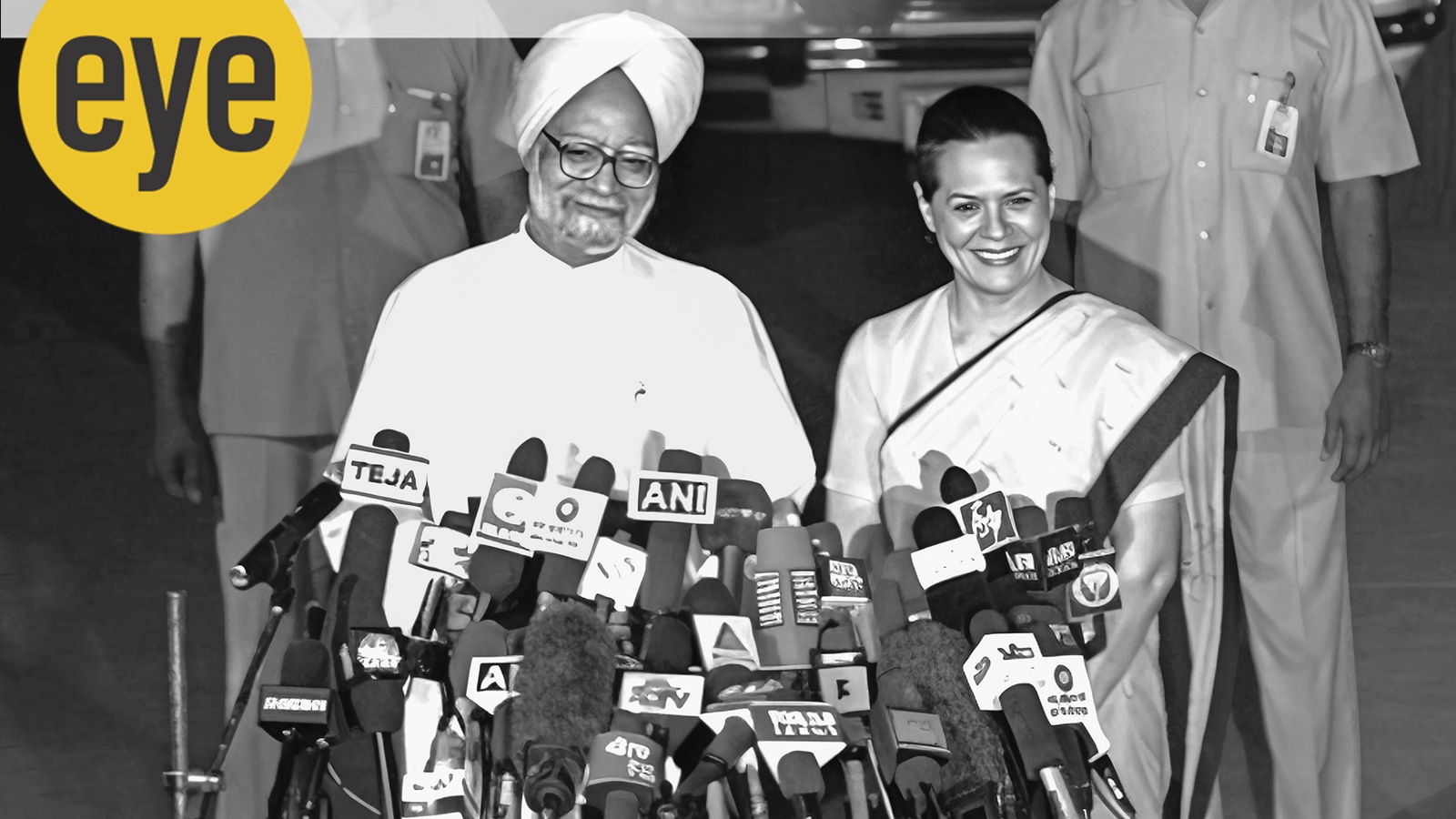
Sonia Gandhi’s memoir, Belonging, offers a rare look into her life from Italy to India. She shares memories of her childhood and the love that struck like a "bolt of lightning" in Cambridge. The book also covers the tragic assassinations of Indira and Rajiv Gandhi, shaping her political journey today.
The memoir reveals her idea of politics, which has consequences for the still unfolding stories of Sonia and India
One of the most incredible arcs in India's politics belongs to Sonia Gandhi. Its sweep, from small town Italy to '10 Janpath' in faraway India, from a ringside witness to the nation's saga to a lead player in it, is cinematic. For decades, this story has played behind curtains, wrapped in enigma and hauteur. It was obscured by stilted speeches and curated appearances, closed coteries and the disembodied remote control. Now through Belonging, the memoir, we catch the first glimpses of the woman at its throbbing centre. She, who set out from a distant land. She, who stayed.
We listen to her reclaim her story, in rich detail, from the telling of others. Her voice is tender and lively as she talks of a childhood filled with playmates and daydreams, trapping fireflies in small jars and watching them stream out at family picnics, music on the radio, friendly ghost stories. Her tone takes on an unembarrassed mushiness when she speaks of the love that strikes like a "bolt of lightning" on a January Sunday in Cambridge. The romance renders her tremulous, but it also lies behind her grit as she makes a home in a strange place with fierce spices.
She writes about the two assassinations -- the narrative shifts to an urgent present tense -- first of her mother-in-law, Indira Gandhi, perhaps the most nuanced character in the book. The senior Mrs G intimidates people -- "Mood theek hai?", they ask. But she seeks respite from her own battles in sorting through old photos and rearranging her saris, and makes sensitive gestures to put her Italian daughter-in-law at ease. And then, the killing of her beloved Rajiv. Sonia writes of the numbing grief, and later the hesitations and anxieties as she made her way into politics.
Sonia's book would have been a show-stopper at any moment. It is especially so now, when citizenship debates are stoked daily, the "Other" is an inescapable theme. Who is "us", who is "them", what does it take to "belong" -- the sprawl of Sonia's story could rescue those questions from their narrowing setting.
Even though "foreign origins" chases her in the opponent's smear campaign, even though it becomes a reason why she refuses prime ministership, Sonia makes India her own, and India, too, draws her close. One of the most moving anecdotes in the book is set in Allahabad, 1970, when Indira shows Sonia, then in India for only two years, around Anand Bhawan. Here, memories of family meld with the nation's freeze-frames. Here, Indira asks Sonia, Rajiv and Sanjay to take three urns containing the ashes of her father, mother and grandfather, and immerse them at the confluence of rivers, the Triveni Sangam. Sonia writes about that moment of strangeness and belonging: "And I wondered at the destiny that had brought me there from a faraway land, from a different people, and from different circumstances to participate in this sacred and intimate ritual".
Two asassinations that shaped her politics
But as much as this book is about a journey that opens up new horizons, it is also about a journey circumscribed by two assassinations. The killings of Indira and Rajiv spur, overhang and constrict Sonia's tryst with politics. They settle in as a constant recoil and sense of siege, as she goes on to answer a colourless call of duty.
This is not Sonia's fault. She is also a victim of the tragic circumstances of her initiation into politics. But for both Sonia and India, it has enduring consequences.
It makes Sonia's discovery of India taper into a defensive crouch, a pessimistic and self-serving project to protect her family and its legacy. It obstructs her view of India and flattens her engagement with her political opponent and party.
In the book, it is hard to miss this convulsive shrinking. When pressure was building on Rajiv to enter politics after Sanjay's death: "I quarrelled with him every day, each time he stepped into the room... We had our own little world... I didn't see why all of it should be given up for a life in which our freedom to be ourselves would be forfeited... No, no way!" When it looks like he will be sworn in as PM after Indira's assassination, "I felt as if a knife had been plunged right into my heart." You can connect the dots to the moment when she herself enters politics. "Had I not fought at every step against a life in politics? ... I was caught in a war with myself".
Though Sonia becomes a politician, though she oversees the tenures of Congress-led governments and invites accusations of extra-constitutional power, though she becomes the longest-serving Congress president, she never takes the full-body plunge into politics.
What the memoir leaves out
Of course, the withholding that runs through the book's cursory section on politics is not just imposed by tragedy. It also reflects a choice to take a narrower path, to side-step accountability.
She gives short shrift to the role of her family and party in national events with a tumultuous after-life -- Emergency, Shah Bano, Bofors, opening of the gates of Babri Masjid and its demolition, Operation Blue Star, anti-Sikh violence in 1984, the unnatural division of labour at the top of two UPA governments that undermined prime ministerial authority. On the Emergency, she pins blame on Sanjay, but for the rest, exonerates her family and skims over the party's complicities.
In a memoir that frames the impossibility of barricading the personal from the political, she refuses to step up to larger questions. Why did the Congress lose its place as the polity's centrepiece? Why were "the people", cameo appearances in the book, offering her acceptance and warmth, "captivated" by "the image and the promises of Narendra Modi"?
There is little mention of the politics of seduction and persuasion that shores up the BJP's successes, apart from propaganda and awe. The lack of a more generous acknowledgement of the opponent connects to the complete absence of outreach. Together, today, they contribute to the breakdowns, in Parliament and other spaces, of dialogue and cordiality.
But it all comes back to Sonia's idea of politics. For her, politics is in the beginning and in the end, a nasty and brutish place, full of "ambition and greed, hypocrisy and treachery". Her party's old guard is dissatisfied and conniving, and the enemy is always "communal" and divisive, more RSS than BJP. Her invocations of the RSS seem less to uncover a shadowy player and more to avoid a fuller engagement with flesh-and-blood BJP.
But there are moments in the book when another Sonia, more self-aware and less hemmed in, makes an appearance, only to disappear just as suddenly.
On page 246, writing of the day she renounced her Italian nationality, she asks why the piece of paper matters. "It dawned on me that during all those years in India, I had been slowly and painstakingly working at obliterating my earlier identity... Had I brought to my country of adoption, to my husband's family, the lessons of obedience and submission that I had learnt from my childhood?"
On page 425, as she wrestles with the decision to be PM, amid clamorous tugs of family, party and country, she says, in a tone that is quietly assertive: "I knew I was capable of shouldering responsibility".
On page 463, she allows herself a glimmer of empathy with Modi. He has a discomfort with the ruling elites, that "I, too, had come to understand well".
These passages show a Sonia less interrupted, more unafraid to dig deeper within and to reach out across the boundary. She might have used her being with two worlds to arrive at a different belonging. She might have shouldered, more fully, her responsibility for shaping her own and her country's story, and answering its main challenge today, of re-democratising democracy.