
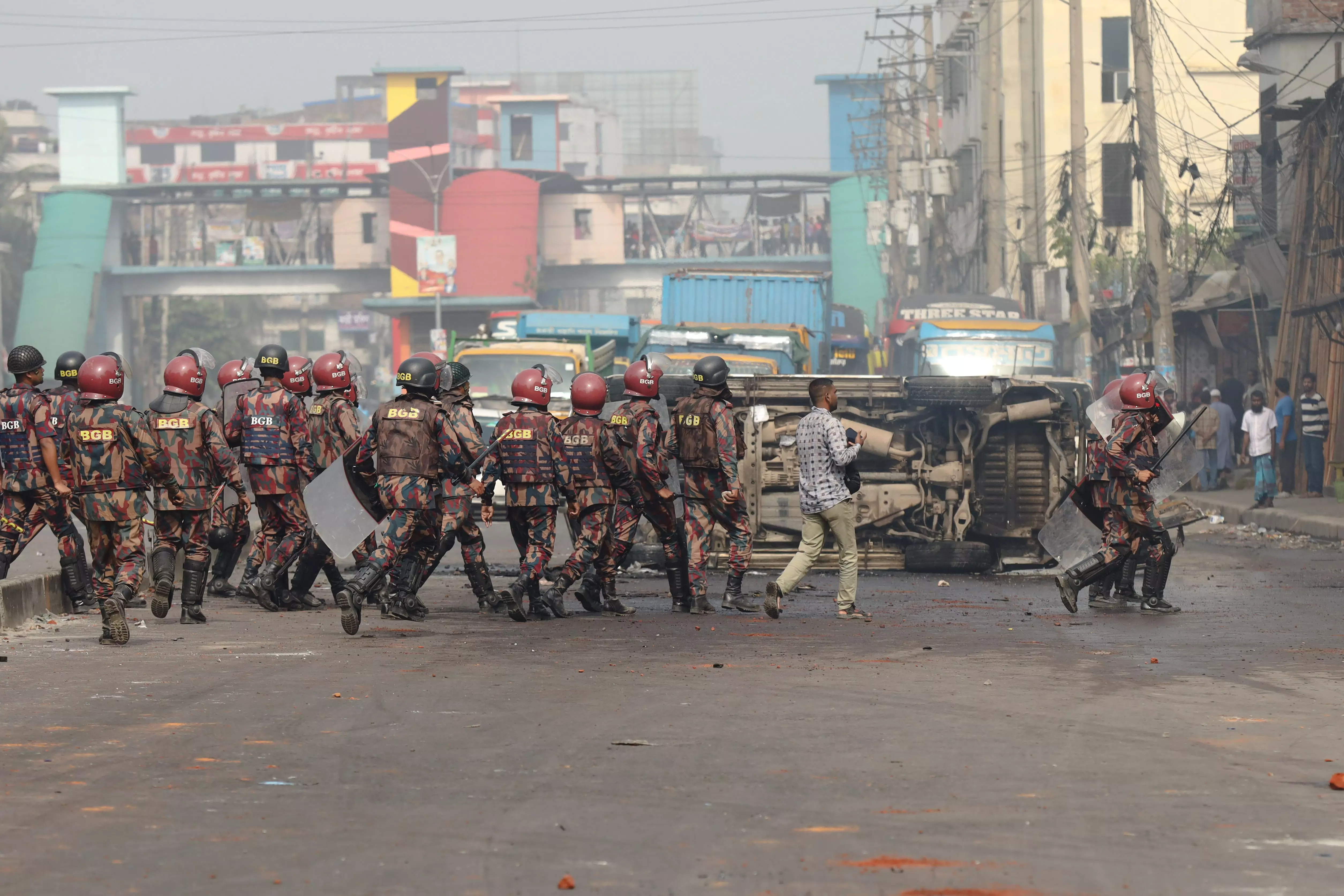
Bangladesh beefed up security and deployed nearly 3,000 paramilitary troops across seven districts on Thursday. This move followed sporadic violence and a nationwide lockdown called by the Awami League. Activists set fire to a police station and vehicles, while crude bombs caused panic in Dhaka amid rising political unrest.
Sporadic violence, arson and bomb blasts prompt heightened security across seven districts amid fears of political unrest
New Delhi/Dhaka: Bangladesh on Thursday beefed up security and deployed nearly 3,000 paramilitary troops across seven districts amid sporadic violence as former prime minister Sheikh Hasina's Awami League (AL) party called a nationwide dawn-to-dusk lockdown.
According to Bangladesh Home Ministry officials, 96 Border Guard Bangladesh (BGB) platoons comprising nearly 3,000 troops were mobilised to assist police in sensitive districts of Dhaka, Chittagong, Narayanganj, Gazipur, Gopalganj, Mymensingh and Faridpur to maintain law and order.
Fearing mass-scale protests and political clashes, the Bangladesh Home Ministry has also prepared an elaborate security plan for the possible unrest over Ms Hasina's return. All airports have been put on maximum alert following incidents of vandalism, arson, and cocktail explosions in different places.
On Thursday, AL activists set on fire a police station and a house of a Bangladesh Nationalist Party (BNP) leader. According to Prothom Alo, AL affiliated organisations attacked Muksudpur Police Station in Gopalganj, setting fire to the building and carrying out extensive vandalism. They also set fire to 10 vehicles, including a police vehicle parked inside the station. Prothom Alo also reported incidents of attacks, vandalism, and arson at the houses of several members, including a Member of Parliament of Bangladesh Nationalist Party (BNP) in Gopalganj.
Crude bomb explosions rocked Bangladesh's capital before dawn, while former interim government chief Muhammad Yunus's ancestral home was torched in Chattogram and branches of his Grameen Bank were attacked in northeastern Sylhet, northwestern Rajshahi and southwestern Barishal and Faridpur this week. In Dhaka, unidentified people set off a crude bomb beneath a metro rail station in the Agargaon area, sparking panic on Thursday, though no one was injured in the explosion.
According to local media reports, the lockdown, which coincided with garment factory workers' protests over wage hike demands in the industrial belt around Dhaka, paralysed the capital's road communications with several southwestern and northeastern districts.
Transport operators said unidentified people torched five parked buses and a truck in separate incidents in central Narayanganj, northern Mymensingh and northwestern Rajshahi early Thursday.
Awami League called the lockdown coinciding with the anniversary of a special tribunal verdict sentencing Hasina to death last year after trying her in absentia on charges of committing crimes against humanity.
As violence continued in Bangladesh, Prime Minister Tarique Rahman sought unity among "democratic forces" to prevent the "resurgence" of Awami League as political violence gripped the country. It is learnt Mr Rahman had invited Leader of the Opposition Shafiqur Rahman for discussions. Ahead of his address in parliament on Tuesday, Mr Rahman had met his party lawmakers and asked them to return immediately to their constituencies to maintain a visible presence on the streets.
He asked BNP lawmakers not to rely solely on government machinery or administration to counter Awami League activists and rather work closely with the party's grassroots leaders and workers.