
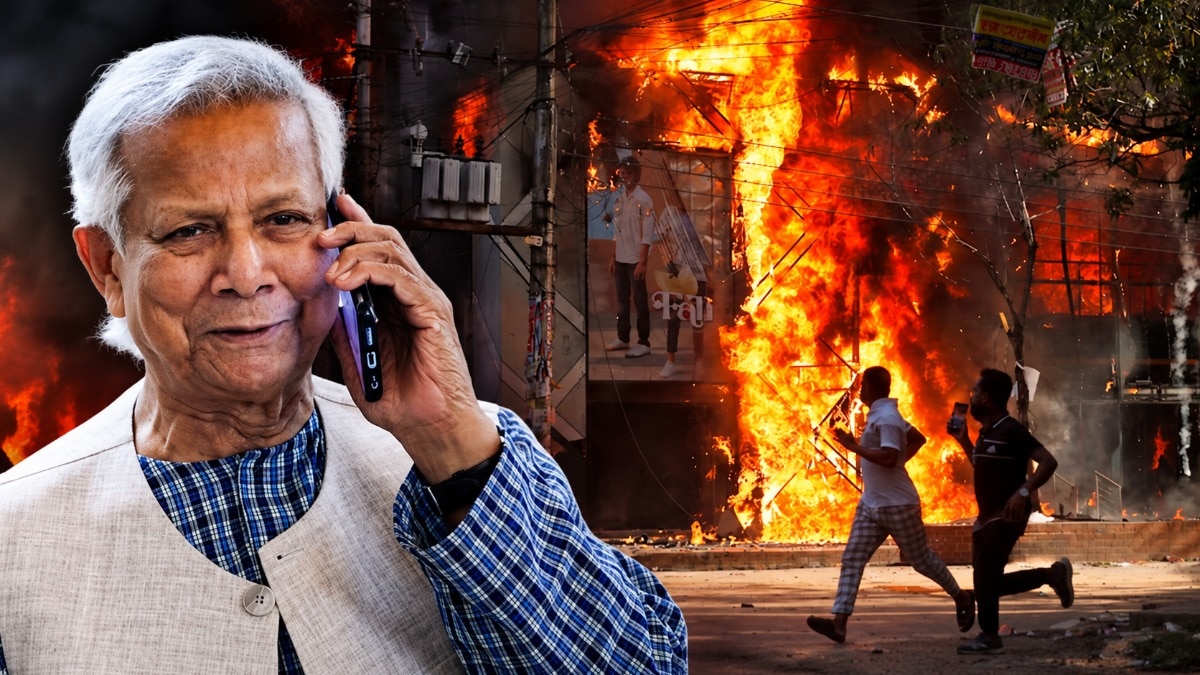
An AFP journalist helped student protesters contact Muhammad Yunus before Sheikh Hasina fled Bangladesh on August 5, 2024. Shafiqul Alam said on October 28 that his colleague Qadaruddin Shishir “stepped up to fulfil that critical role.” This showed the transition was planned ahead of the government’s fall, not a natural progression.
An AFP journalist secretly helped student protesters establish contact with Muhammad Yunus even before PM Sheikh Hasina fled Bangladesh on August 5, 2024. The revelation by Yunus's former press secretary, himself an ex-AFP journalist, raises fresh questions about how the Nobel laureate was approached to lead a post-Hasina government following the regime change in Bangladesh.
The stage had been set for Muhammad Yunus to fly in from Paris into Dhaka and take charge of the interim regime even before Prime Minister Sheikh Hasina was forced out by violent protesters. The person who acted as the conduit between the protesters and Yunus was a journalist working for French news agency AFP. This has been revealed by the AFP journalist's colleague, who went on to become Yunus's press secretary.
Shafiqul Alam, then the bureau head of AFP in Dhaka, said in a post on Facebook on Wednesday, October, 28 that the protesters needed a "bridge-builder" in August 2024 and his colleague in AFP's fact-check department, Qadaruddin Shishir, "stepped up to fulfil that critical role".
The July-August protests, which began as a student-led anti-quota agitation, had been projected as a spontaneous protest against Sheikh Hasina's government. However, more evidence has now emerged that the toppling of the Hasina-led government might have been what some would term a "regime-change operation".
India Today Digital was the first to report on the role played by Army officers and Islamists in the protests that forced Hasina to leave Bangladesh on August 5, 2024.
It had been evident to those with ears to the ground by the end of July that the protests had been infiltrated and that Hasina didn't have an alternative but to step down.
Shafiqul Alam's latest Facebook post shows that the arrival of Yunus was planned ahead of Hasina's exit, and not a natural progression.
"When student leaders wanted to reach out to Nobel Laureate Professor Muhammad Yunus and invite him to head the interim government in a post-Hasina scenario, they needed a trusted bridge-builder. Qadaruddin Shishir stepped up to fulfil that critical role," wrote Shafiqul Alam on Facebook on October 28.
Alam said Shishir, who was the editor of the AFP Dhaka Fact Check team, sat just a yard from him in office and "managed the high-stakes operation in complete secrecy."
"It was Shishir who first approached the 2006 Nobel Peace Prize winner on behalf of the student leaders and facilitated the initial talks between the two parties," wrote Alam.
Shafiqul Alam explained that though the Hasina government was on its last leg, it was still a "high-stakes operation". Had Hasina got a whiff of it, "Shishir and our entire AFP team would likely have ended up in an Aynaghar."
Aynaghar, which literally translates to the House of Mirrors, refers to the secret torture and killing dens allegedly operated by the Hasina regime. The term Aynaghar is from the solitary life that political prisoners spent without seeing anyone other than themselves.
"Throughout it all, Shishir remained remarkably cool and composed, even as he quietly started gathering video evidence of the cold-blooded murders being committed by the regime," wrote Alam.
The post comes amid the countdown of Sheikh Hasina's promised return from exile in India to Bangladesh. Even 10 days ago, she reiterated that she would return in December.
"I will go back to Bangladesh in December," Hasina said on October 19 at an online event. "I am not afraid. I know they can kill me, arrest me and torture me," she said, expressing her resolve.
The 2024 mass protests forced her to board a helicopter and then a plane to fly into India's Hindon Airbase on Ausgut 5, 2024. She has been in exile in Delhi since.
On Wednesday (October 28), the body of a former Bangladesh Air Force officer, reportedly linked to a video showing Hasina fleeing the country on August 5, was found dead in a river in Dhaka.
The clip of Hasina switching from cars to a helicopter was allegedly shot by 28-year-old Flight Lieutenant KM Tahsif Souri. The family of Souri, who was dismissed from service in August 2024 itself, has alleged murder, raising questions about the circumstances of his death.
A day after Hasina's departure, student protest leaders on August 6, 2024 publicly proposed Muhammad Yunus as the chief adviser of an interim government. The announcement was made by student leaders including Nahid Islam and Asif Mahmud. Both later served as advisers in the Yunus administration.
On August 8, 2024, within days of Hasina fleeing, Yunus landed at Hazrat Shahjalal International Airport in Dhaka from Paris.
He became the chief advisor to the interim government, and stepped down on February 16 this year, after Tarique Rahman of the Bangladesh Nationalist Party (BNP) was elected the Prime Minister.
Several of the leaders of the anti-Hasina protest were made part of his interim government, who then went on to form the National Citizen Party, which fought the elections as part of the Jamaat alliance.
In September 2024, at an event in New York, Yunus introduced special assistant Mahfuz Alam as the "brain behind the whole revolution".
"It's amazing. Meticulously designed thing. It's not just suddenly came. It's not like that. Very well-designed. Even the leadership pattern. People don't know who the leader is. So you can't catch one and say, okay, it's over. It's not over," Yunus said in 2024 about how the July-August protests were planned.
With students and other protesters on the ground, and Yunus in France, it was Shishir of French news agency AFP who played a role beyond journalists'. He was the bridge and the person to tell Yunus it was time to return and fill in as the Hasina regime would be toppled soon.