
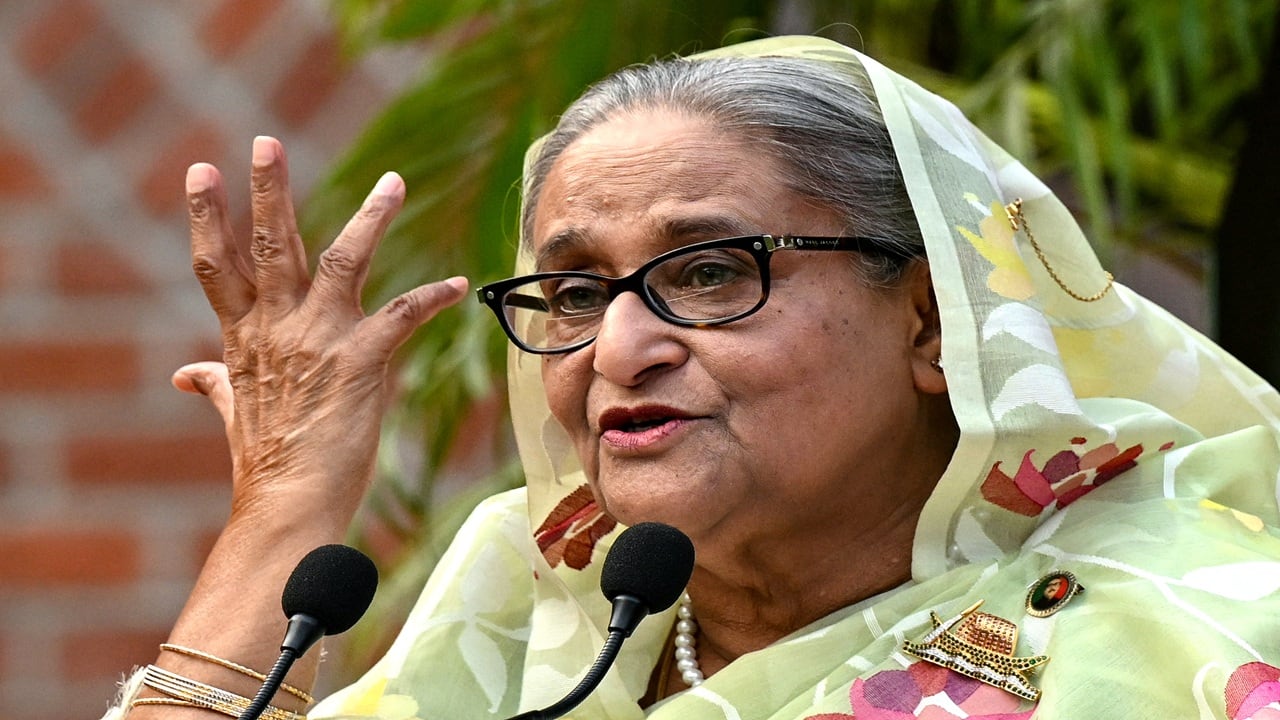
Sheikh Hasina’s Awami League called a nationwide dawn-to-dusk shutdown on November 19 to pressure the Yunus government. The party started a five-day protest programme on November 14, demanding the end of its political ban. Supporters took to the streets, and many clashes occurred as the group pushed for its demands.
Sheikh Hasina's Awami League is preparing for a major show of political strength in Bangladesh, calling a nationwide dawn-to-dusk shutdown on November 19 as the country grapples with a fresh wave of arson, bomb attacks and clashes. The mobilisation comes as the former prime minister steps up her efforts to return from India, where she has been living since fleeing Bangladesh in August 2024. Despite a ban on its political activities, the Awami League has begun mobilising supporters through rallies, marches and demonstrations, with its strongest show of activity emerging from Gopalganj, Hasina's home district.
Party supporters have taken to the streets carrying sticks and sharp weapons, raised slogans and blocked roads, signalling a renewed attempt to reclaim political space ahead of the proposed shutdown. The November 19 bandh is the culmination of a five-day protest programme announced by the party between November 14 and 19. In a statement on its official Telegram channel, the Awami League called on its organisational units in Bangladesh and overseas to mobilise members and press for the implementation of an eight-point charter. The demands include lifting the ban on the party, scrapping the International Crimes Tribunal, withdrawing what it describes as fabricated judgments and false cases, releasing political prisoners and addressing rising prices of essential commodities.
The party has also demanded the reopening of shuttered industrial establishments. As part of the shutdown, the Awami League has called for transport services, shops, factories, government and private offices, banks, courts and educational institutions to remain closed. Hospitals, ambulances, pharmacies, fire services and news organisations have been exempted, with party members instructed to ensure that emergency services continue uninterrupted. The programme began on November 14 with leaflet distribution, wall writings and public outreach. Rallies and marches followed on November 15, while party units were asked to submit memorandums to deputy commissioners, foreign embassies and international organisations on November 16.
November 17 was marked as a Black Day to protest the death sentence handed to Hasina. The most visible signs of the Awami League's renewed mobilisation have come from Gopalganj, where Hasina's birthplace, Tungipara, is located. Hundreds of party supporters and members of affiliated organisations took to the streets over the weekend, confronting police and attacking public property. According to reports by The Daily Star, demonstrators broke through police barricades, vandalised a police armoured personnel carrier and a police box, and set fire to the July Memorial near Sheikh Kamal Stadium. They also reopened the district Awami League office, which had remained shut since Hasina's removal from power in August 2024.
The violence extended to residences belonging to BNP leaders. At least seven houses were reportedly attacked on Sunday evening, including the home of Tungipara municipal BNP president Imdadul Haque Mollah, which was looted and set ablaze. A police sub-inspector was also injured in a machete attack, The Daily Star reported. On Monday, Awami League supporters marched through Tungipara and broke open the party's local office. As per a report by Bangladeshi daily Prothom Alo, more than 100 activists had gathered near the upazila parishad building, forced open the premises and held a meeting before proceeding towards the mausoleum of Sheikh Mujibur Rahman.
In neighbouring Kotalipara, another procession of party supporters vandalised and torched a commemorative arch associated with a local BNP leader, according to The Daily Star. The situation deteriorated further on Tuesday evening after police detained several Awami League and Chhatra League activists in Tungipara. Following announcements over mosque loudspeakers, supporters gathered outside the local police station and demanded their release. The protesters stormed the premises, damaged the building and set fire to the police station and vehicles. Several detainees were reportedly freed during the attack, while firearms were looted.
The residence of BNP lawmaker SM Zilani, who represents Gopalganj-3, was also torched. Videos of the attack circulated on Facebook, with some of those involved heard shouting 'Joy Bangla', Prothom Alo reported. The newspaper later reported that nine police vehicles and 15 motorcycles had been set on fire at the station. The violence continued into Wednesday, with activists reportedly using felled trees and bamboo poles to block roads at multiple locations along the Gopalganj-Tungipara route. A separate report by the newspaper described Tungipara Police Station as effectively deserted, with its rooms, computers and furniture damaged.
Police personnel were seen removing their belongings, while an officer confirmed that several weapons had been looted, although some were subsequently recovered. A petrol-bomb attack also killed Raju Mollah, an activist of the ruling BNP, in Gopalganj, senior police officer Md Shamsul Azam told AFP. Police spokesperson Kamarum Munira said at least seven personnel had been injured and eight vehicles damaged in separate incidents. Authorities have not publicly identified the suspects, although the BNP government has accused the banned Awami League of orchestrating the violence. The unrest is no longer confined to Gopalganj.
Bangladesh has reported a series of crude-bomb explosions, petrol-bomb attacks and arson incidents targeting public transport, government establishments, political offices and financial institutions. According to The Daily Star, at least 19 buses were set on fire and crude-bomb explosions were reported at 29 locations between November 7 and 9. In Netrokona, a compartment of the Haor Express was torched, while explosions were reported near two faculties of Dhaka University. Police had recorded dozens of crude-bomb explosions and vehicle arson incidents across at least 28 districts over the preceding 10 days.
Two crude bombs also exploded near Hazrat Shahjalal International Airport in Dhaka on November 16. The banking sector has also come under attack, with at least 37 Grameen Bank offices and branches reportedly targeted since November 10, according to the bank. Meanwhile, protests by garment workers seeking higher wages have added to the pressure on the administration. Demonstrations across Gazipur, Savar and Ashulia have led to highway blockades, confrontations with police and attacks on vehicles. In Gazipur, a vehicle belonging to a deputy police commissioner was set ablaze on the Dhaka-Mymensingh highway.
The separate labour unrest has also become a political flashpoint. Home Minister Salahuddin Ahmed accused Hasina's supporters of exploiting workers' grievances to fuel instability. Addressing parliament, he alleged that "some opportunists disguised as workers have infiltrated the labour unrest". The escalating violence has prompted the BNP-led government to mobilise its political and security machinery. Prime Minister Tarique Rahman has instructed party lawmakers to return to their respective constituencies and take steps to counter the activities of the banned Awami League. Addressing parliament, Rahman described the Awami League as a fascist force and called on people to resist its activities.
Police and Border Guard Bangladesh personnel have also been deployed in different parts of the country, alongside BNP leaders and activists, to prevent further disturbances. The government has blamed the Awami League for several recent incidents, although the police have yet to establish responsibility for every attack. Hasina, 79, fled to India in August 2024 after a student-led uprising brought an end to her 15-year rule. A Bangladeshi tribunal subsequently convicted her in absentia of crimes against humanity over the crackdown on protesters and sentenced her to death. She has rejected the legitimacy of the proceedings and maintained that she intends to return to Bangladesh in December.
Her proposed return has become a rallying point for Awami League supporters, even as the BNP government has ruled out any political future for the former prime minister. Dhaka has also formally sought her extradition from India. The Ministry of External Affairs has maintained that the extradition request is a legal matter that will be handled accordingly. MEA spokesperson Randhir Jaiswal has reiterated that India wants a "positive, constructive and forward-looking relationship with Bangladesh", while confirming that bilateral engagement continues through established institutional channels. The Awami League's shutdown call therefore presents a significant test for both the party's ability to mobilise supporters despite the ban and the BNP government's capacity to maintain public order.
With Hasina's proposed December return drawing closer, the latest escalation threatens to deepen an already volatile political confrontation.