
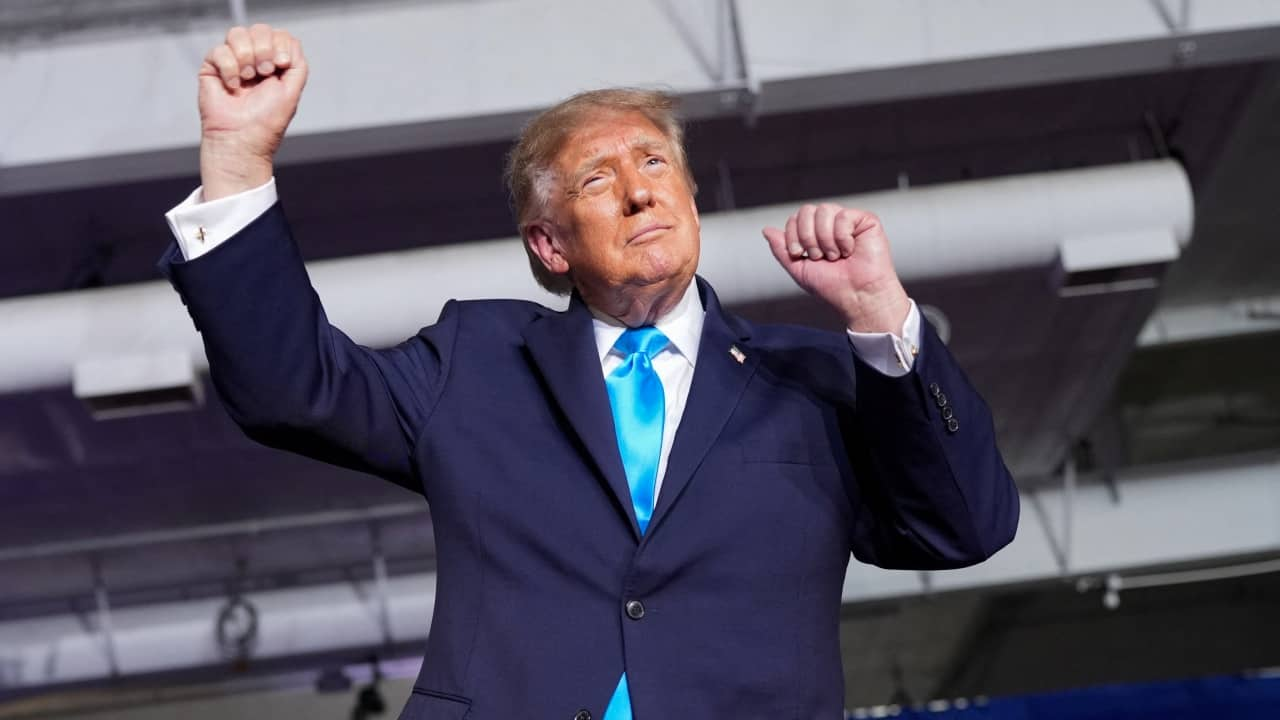
US President Donald Trump’s approval rating hit a record low of 33 per cent just two weeks before the midterm elections. Despite this, vulnerable Republicans are fighting to save their seats by staying loyal. Many lawmakers backed Trump on nearly all votes this year to keep their party in control.
US midterm elections are just two weeks away, as US President Donald Trump's approval rating hits a record low, according to polls by The Washington Post-ABC News-Ipsos and Fox News. Trump's approval rating among American adults stands at just 33 per cent, while 66 per cent disapprove of his performance, according to the Washington Post-ABC News-Ipsos poll. More than half of respondents, 52 per cent, said they strongly disapprove of the president. While Trump is busy blaming senior aides and political operatives for a faltering midterm strategy, questioning campaign spending, faulting redistricting and second-guessing candidate choices, Republicans are fighting to retain control of Congress. Why vulnerable Republicans are sticking with Trump Despite Trump's declining popularity, vulnerable Republican lawmakers have largely remained aligned with the president. According to an analysis of congressional voting by The Washington Post, the 16 House Republicans whose seats are most at risk have backed Trump's position on an average of 96 per cent of votes taken this year. Fourteen of these lawmakers have supported the president on at least 90 per cent of votes in 2026. Three representatives facing toss-up races, Pennsylvania's Ryan Mackenzie, Ohio's Max Miller and Wisconsin's Derrick Van Orden, have voted with Trump on every relevant vote they cast this year. Eight of the 16 vulnerable Republicans have increased their support for Trump compared with last year. They include Arizona's Juan Ciscomani, Pennsylvania's Rob Bresnahan Jr., Iowa's Zach Nunn, Virginia's Jen Kiggans and California's David Valadao. Seven others have broken with the president more frequently, although they remain broadly aligned with his agenda. Pennsylvania's Scott Perry and California's Kevin Kiley, now an independent who continues to caucus with Republicans, are the only two among the 16 to have supported Trump's position on fewer than 90 per cent of their votes. The loyalty contrasts with the 2018 midterms, when vulnerable Republican incumbents backed Trump on an average of 93 per cent of votes. Republicans subsequently lost 25 of the 28 seats identified as being in similarly precarious positions. Which Senate Republicans are at risk? Republicans face challenges in the Senate as well, with nine GOP-held seats rated competitive by Inside Elections. Six of these contests feature incumbents. Five Republican senators running for re-election have voted in line with Trump's position on every vote they cast this year. They include Ohio's Jon Husted, Alaska's Dan Sullivan, Kansas' Roger Marshall, Nebraska's Pete Ricketts and South Carolina's Lindsey Graham's appointed successor, Darline Graham. Maine Senator Susan Collins is the exception among the vulnerable incumbents, having aligned with Trump's public position on 85 per cent of votes this year. In Iowa, Republican Representative Ashley Hinson, who is running to replace retiring Senator Joni Ernst, has also backed Trump on all 67 House votes on which he has taken a position this year. Trump faces internal blame game over midterm strategy Behind the scenes, Trump has reportedly expressed frustration with his political team as Republicans struggle to improve their standing in key races. Much of the tension centres on James Blair, who runs Trump's super PAC MAGA Inc., and White House chief of staff Susie Wiles. Trump has questioned Blair's management of campaign funds, while some officials have raised concerns about Wiles' oversight of the political operation. The president has also questioned why substantial campaign spending has failed to translate into stronger polling numbers. MAGA Inc. has spent about $200 million so far, according to public records, leaving uncertainty over whether Trump will approve additional funding before Election Day. Blair's overseas consulting work has added to the friction. He and Chris LaCivita, who co-managed Trump's 2024 campaign, travelled to Republika Srpska in Bosnia in early October to advise the regional government ahead of local elections, according to reports. Trump subsequently distanced himself from the two men, describing them as "outside consultants" in an October 7 Truth Social post. Trump has also questioned the results of Republican-led redistricting efforts, particularly in Texas, where the party hoped new congressional boundaries would help it gain seats. However, concerns over the cost of living and the economy could weaken Republican support among Hispanic voters, potentially undermining those gains. Why losing the House would matter Democrats are favoured to win control of the House of Representatives, while the Senate remains competitive, according to opinion polls. A Republican defeat in the House would complicate Trump's legislative agenda during the final two years of his term and give Democrats subpoena powers to investigate his administration. Some congressional Republicans have privately acknowledged the possibility of losing their majority, according to a report by Politico. One Republican lawmaker said the party was now hoping to "save as many Republican seats as we can." Trump, meanwhile, has intensified his campaign appearances, urging supporters to vote Republican and asking them to "pretend that I'm on the ballot because here's what happens. Every time I've been on the ballot, we win." The president's declining approval ratings, concerns about prices and dissatisfaction with the Iran war have created additional challenges for Republicans. With vulnerable lawmakers continuing to back Trump on most congressional votes, the midterms will test whether their loyalty to the president can withstand voter discontent.