
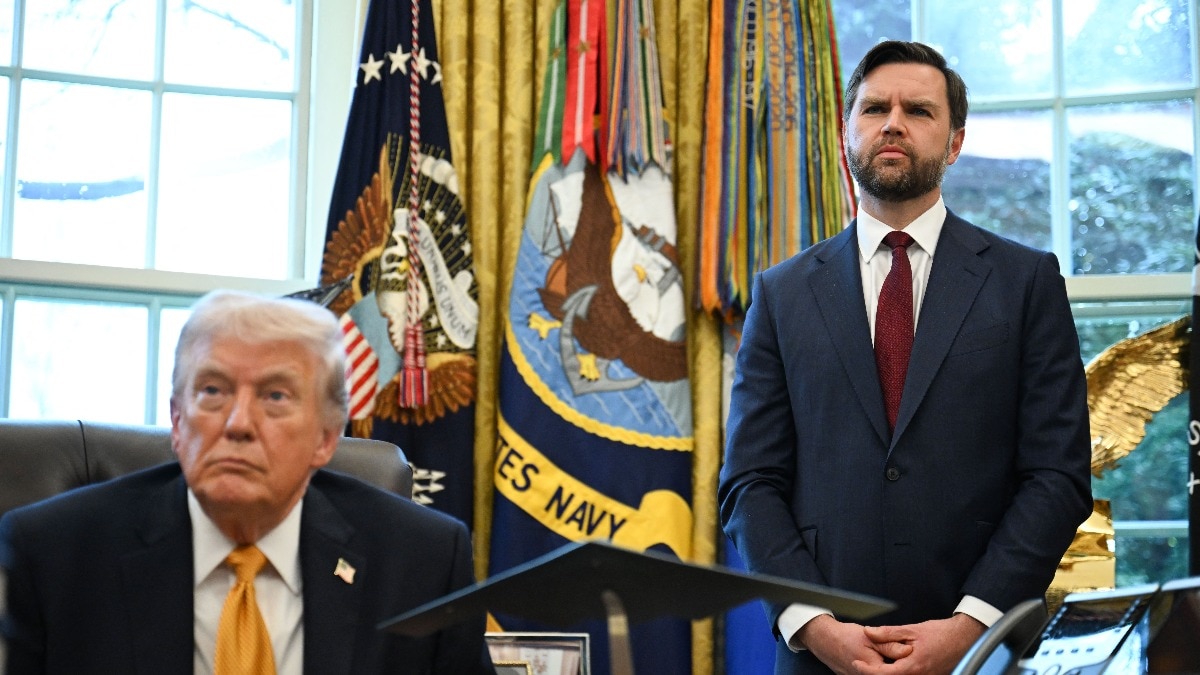
JD Vance and Ron DeSantis are positioning for 2028 after the Republican midterm defeat. On Wednesday, Vance distanced himself from Donald Trump’s strategy, citing voter dissatisfaction with the Iran war and rising costs. Many who backed the party in 2024 voted for Democrats, showing a clear shift in public support.
JD Vance and Ron DeSantis outlined competing paths for Republicans after the midterm defeat. Their interventions intensified debate over the party's direction and leadership beyond Donald Trump.
JD Vance, Ron DeSantis begin positioning for 2028 as Trump faces Republican revolt after midterm rout
The race to shape the Republican Party's future has begun taking shape in the aftermath of the party's crushing defeat in the US midterm elections, with Vice President JD Vance and Florida Governor Ron DeSantis emerging as prominent voices in the debate over its next direction.
Vance on Wednesday made an unusually public attempt to distance himself from parts of President Donald Trump's second-term strategy, while DeSantis warned that the Republican Party faced a prolonged political setback following the Democrats' sweeping victories.
The developments have fuelled speculation over the 2028 presidential race, even as Trump remains in office for another two years.
JD VANCE SIGNALS A SHIFT IN APPROACH
In a lengthy social media post following the election results, US Vice-President JD Vance offered a detailed assessment of why Republicans lost support, pointing to the Iran war, rising living costs and the party's approach to immigration as key factors behind the electoral setback.
Vance said the Republican defeat was not primarily a result of poor voter turnout but reflected a shift among people who had backed Donald Trump and Vance in the 2024 presidential election but voted for Democrats in the 2026 midterms.
Citing conversations with political pollsters, Vance said Republican voters had turned out in significant numbers but many were dissatisfied with the administration's policies and were unwilling to support the party again.
He recalled asking a political data analyst whether strong Republican turnout could translate into an unexpected victory. The analyst, however, warned him that several voters who had backed Trump and Vance in 2024 were angry and planning to vote for Democrats.
Vance said the assessment had proved accurate, adding that the party needed to acknowledge the reasons behind the shift rather than focus exclusively on turnout figures.
He also acknowledged that the Republicans' economic messaging had not been effective enough during the campaign. However, he argued that the reasons for the defeat went beyond the party's communication strategy.
Citing another pollster's findings, Vance identified four major concerns among voters who had switched their support to Democrats: ending the Iran war, addressing the cost of living and inflation, prioritising America's interests and changing the country's relationship with Israel.
"The reason we lost is the war. The president himself said so last night," Vance wrote, directly linking the Republican setback to the administration's military engagement with Iran.
He also defended Fox News host Rachel Campos-Duffy, who had called for a diplomatic resolution to the conflict, saying her advice had been politically sound despite criticism from sections of the Republican establishment.
On immigration, Vance indicated that the administration could reconsider its enforcement strategy, suggesting that authorities should focus more on businesses employing undocumented workers. However, he rejected calls for granting amnesty to undocumented migrants.
Warning against attempts to shift the blame for the defeat, Vance said any honest assessment of the Republican Party's future must begin with the Iran war and the political cost associated with it.
His remarks marked a notable departure from Trump's position on the conflict. While the president acknowledged that the war had contributed to higher fuel prices and Republican losses, he maintained that he would have taken the same decision again.
Vance's intervention has also drawn attention to the political challenges facing the vice-president as he navigates his association with Trump's presidency while questions over his own political future and the 2028 presidential race begin to emerge.
TRUMP NONCOMMITTAL ON VANCE'S 2028 AMBITIONS
Trump, meanwhile, remained noncommittal when asked whether Vance would contest the 2028 presidential election.
Speaking to reporters during a visit to the construction site of the proposed White House ballroom, Trump said he had spoken to his vice-president following the election but did not know whether he intended to run.
"I speak to him about a lot of things, but I mean, we'll see what happens. You don't know who's talking about running," Trump said.
"Maybe he won't run. I don't know who's going to run," he added.
Trump also described Vance's social media statement as "good", indicating that he was aware of his deputy's position even as questions emerged over differences within the administration.
The president's remarks leave the question of his preferred successor open, despite Vance being viewed as one of the prominent potential Republican contenders for 2028.
RON DeSANTIS ENTERS THE POST-ELECTION DEBATE
Vance is not the only Republican leader seeking to shape the party's direction after the electoral setback.
Florida Governor Ron DeSantis also weighed in on Wednesday, describing the Republican Party's performance as being close to an "extinction-level event" in several parts of the country.
He warned that the consequences of the defeat could extend well beyond the next election cycle and affect the party's national prospects for years.
DeSantis also pointed to Florida as an example of how Republicans could maintain political support, arguing that the party needed to build a stronger record of governance and earn voters' trust.
"If the Republican Party doesn't have Texas as an anchor then we are not going to be viable nationally going forward," he said.
The governor's remarks have added to speculation about his political ambitions after his unsuccessful bid for the Republican presidential nomination in 2024.
Former South Carolina Governor Nikki Haley has urged Republicans to accept responsibility for their historic defeat in the 2026 midterm elections, saying the party must stop blaming external factors and focus on voters' concerns.
Speaking on the Today show on Wednesday, Haley said Republicans had failed to listen to Americans struggling with rising grocery, fuel and healthcare costs. She also criticised the party's leadership in Washington, accusing it of prioritising political interests over public concerns.
Haley urged Republicans to accept the setback, reassess their approach and get back to work, adding that the political situation could change within two years if the party addressed voters' priorities.
TRUMP'S WHITE HOUSE BALLROOM VISIT DRAWS ATTENTION
While senior Republicans began assessing the party's political future, Trump made his first public appearance after the election defeat at the site of the White House's under-construction ballroom.
The president spent considerable time discussing the project and watching the installation of its final steel beam, with Interior Secretary Doug Burgum describing the occasion as "a day of celebration".
Trump also spoke about the planned interiors, including chandeliers and marble flooring, before addressing questions about the Republican defeat.
The contrast between Trump's focus on the construction project and the efforts by Vance and DeSantis to address the party's electoral setbacks underscored the competing priorities within the Republican leadership.
With Democrats set to control both chambers of Congress, Republicans now face the challenge of rebuilding their political standing while navigating questions over Trump's legacy and the party's leadership beyond his presidency.
Although the 2028 presidential contest remains more than two years away, the latest developments suggest that the debate over who will lead the Republican Party after Trump has already begun.