
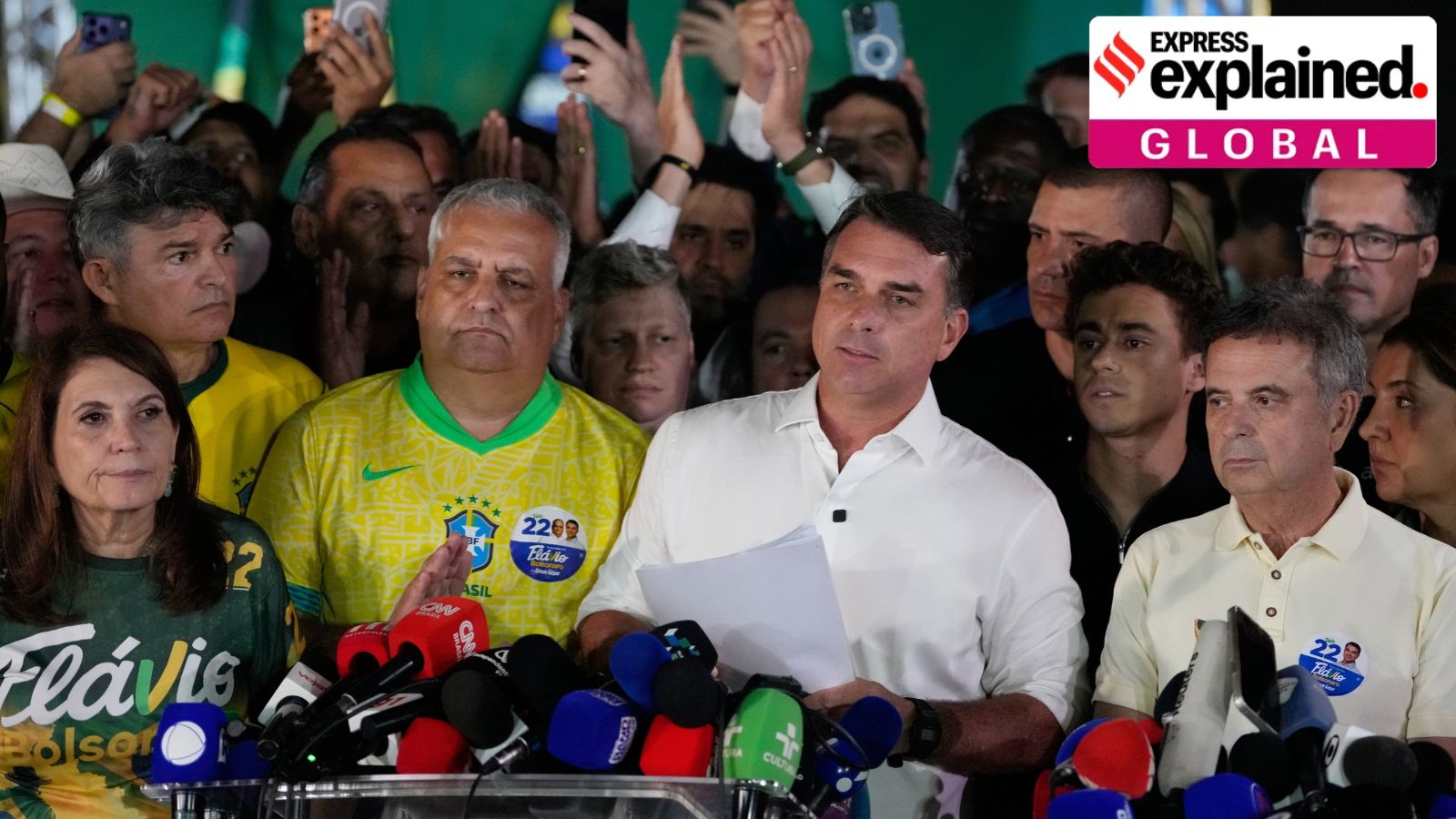
Flávio Bolsonaro fled Brazil for the United States after losing the presidential election to Lula. He missed a court deadline to surrender his passports amid a money laundering investigation. Flávio faces many inquiries, including one about film financing. US President Donald Trump said he would approve their move to America.
Flávio Bolsonaro fled Brazil after losing the presidential election to Lula and missing a court deadline to surrender his passports. He faces investigations into film financing, alleged financial links to a lawyer and possible foreign interference in his campaign.
Flávio Bolsonaro investigations: Flávio Bolsonaro, who lost the Brazil presidential election to incumbent Luiz Inácio Lula da Silva, has reportedly fled the country for the United States.
A jet carrying Bolsonaro and his family left Guayaquil, Ecuador, and was en route to Miami, Florida, on Wednesday morning, where it was expected to arrive mid-morning, The Guardian reported.
The escape had been planned as a contingency in case he lost, Brazilian newspaper O' Globo reported. Flávio's brother, Eduardo, a former congressman, has been in self-imposed exile in Texas since February 2025 and secured a green card last July.
The US State Department on Tuesday (October 27) said it would give Flávio and his family visas to enter the US. US President Donald Trump also said he would approve their move to the country, calling the election "very strange" and "terrible".
Bolsonaro had disappeared for over 24 hours until Argentina's migration authorities said on Tuesday night that he had entered the country.
The Brazilian senator's exit comes a day after the Supreme Court gave him 24 hours to surrender his passports in connection with a money laundering case in which he is being investigated. He failed to meet the deadline, and Brazil's Federal Police revoked his passports.
Flávio Bolsonaro, who had won the first round of the election earlier this month and was widely considered a favourite for the presidency, was defeated in a runoff by the 81-year-old Lula. Lula's victory also bucks a regional trend in which seven consecutive Latin American presidential elections were won by conservative candidates.
Bolsonaro's loss also dealt a major setback to US President Donald Trump's ambitions to expand Washington's influence in the region. Trump has repeatedly clashed with Lula over the years, and considers Bolsonaro, as well as his father, former President Jair Bolsonaro, close allies.
The cases against Flávio
Flávio is involved in three investigations concerning his own alleged conduct, while a fourth inquiry ordered on Tuesday is examining possible foreign interference benefiting his campaign.
'Dark Horse' financing controversy
One case pertains to the financing of the film Dark Horse (2026), an English-language semi-fictionalised biopic about Jair Bolsonaro.
Flávio negotiated a deal worth R$134 million (US$24 million) with disgraced banker Daniel Vorcaro to finance the film. Investigators are examining possible irregularities in the funding, including the source of the money.
Vorcaro's private bank, Banco Master, was liquidated, leaving behind over $7 billion in debts, and he was charged with fraud. Bolsonaro was formally included in the inquiry this July. The senator has denied any wrongdoing, but has also not provided any accounting to support his case, CNN Brasil reported.
According to an investigation by The Intercept Brasil, at least US$10.6 million was paid in six transactions between February and May 2025. The investigation uncovered messages and audio of Flávio pressuring Vorcaro to release funds.
A follow-up report by The Intercept this month traced the first US$2 million payment to a company owned by Fabiano Zettel, Vorcaro's brother-in-law, which is also under investigation in the Banco Master fraud case. The developments raise scrutiny over Bolsonaro's claim about the film being funded entirely through legal means.
Money laundering case linked to disgraced lawyer
Also under scrutiny are Bolsonaro's ties to Vorcaro's lawyer Willer Tomaz, who is accused of laundering over $1 billion through a massive fraud scheme.
According to the Federal Police, Bolsonaro was the "master user" of a bank account linked to Alcazar Holdings, an offshore company owned by Tomaz, which held a stake in a company that owns an executive jet linked to Vorcaro. This access allegedly granted him a "high level of access and management" and "significant operational access" to the account.
The inquiry originated from a probe into unauthorised deductions from pension payments by Brazil's social security agency. As the investigation progressed, investigators examined suspected money laundering involving betting platforms and financial transactions linked to Tomaz.
The Federal Police identified illegal financial transactions amounting to R$ 130 million between March and May 2025, according to CNN Brasil.
Times Brasil reported that a person working for Tomaz reportedly asked the bank to remove Bolsonaro's access to the account in May 2025.
Both Bolsonaro and Tomaz have denied wrongdoing, or even sharing financial ties.
Slander case against Lula
A third investigation concerns a social media post in which Flávio allegedly linked Lula to crimes including international drug and arms trafficking and money laundering.
The post was published on X on January 3, following the illegal capture of Venezuelan President Nicolás Maduro by the US. In June, the Federal Police concluded that Flávio had falsely attributed criminal conduct to Lula. The matter was sent to the Prosecutor-General's Office, which must decide whether to seek charges, request further investigation or recommend that the case be closed.
Allegations of foreign funding
On Tuesday, the Supreme Court ordered the Federal Police to investigate possible foreign funding or other forms of assistance to Flávio's campaign, including alleged links to the US conservative donor network Rockbridge Network.
The wider probe also covers paid political content attributed to foreign-based accounts and possible manipulation of online platforms. Rockbridge has denied involvement.
Like father, like son
Flávio Bolsonaro's departure from Brazil has drawn comparisons with his father, Jair Bolsonaro, who also fled the country before Lula's inauguration as president in 2023. The former president was convicted of attempting a coup after losing the presidential election to Lula.
In January 2023, Jair Bolsonaro's supporters stormed government buildings in Brasilia and attempted to rally military support in an attempt to overturn the election result. The insurrection attempt drew comparisons with the events of January 6, 2021, when Trump's supporters, fired by his "STOP THE STEAL!" campaign, stormed the US Capitol in Washington DC, after his defeat to Joe Biden.
Jair Bolsonaro was subsequently banned from running for office till 2030, and was charged in three separate criminal cases, including one in which he had "planned, acted in, and had direct and effective control over" an attempted coup.
Flávio Bolsonaro has not been formally charged in the three cases he has been named in, has denied wrongdoing and claimed the investigations are political persecution against him. With his Senate term set to expire in February 2027, he will lose his office and the privileges associated with it. The investigations could continue regardless of his election defeat, and their outcome will depend on the evidence and decisions by prosecutors and the courts.
In Trump, we trust
Since his first presidency, Donald Trump has cultivated close ties with the Bolsonaro family.
Jair Bolsonaro's time as president (2019-23) overlapped with Trump's first term (2017-21) and marked a period of close ties between Brazil and the US. The senior Bolsonaro modelled himself on Trump, and earned himself the moniker "Trump of the Tropics". Commentators have seen the friendship between the two men as being built on mutual respect, and a shared disdain for legacy media and scepticism about science and scientists.
Both Jair and Trump have been implicated in legal cases, and have accused their political rivals of targeting them unfairly. More significantly, both have responded to electoral defeats in similar fashion - alleging electoral fraud, refusing to concede the presidency, and instigating insurrections.
In his second term, Trump has sought to implement the "Donroe" Doctrine, his riff on the Monroe Doctrine of 1823. The latter is a foreign policy position first articulated by President James Monroe in 1823, which holds the Western Hemisphere -- specifically the Americas -- as the United States' zone of influence.
Over the following centuries, the US has relied on Monroe, and the Cold War-era Truman Doctrine, which meant to curtail the spread of communism, to justify installing (or attempting to install) friendly regimes in a dozen Latin American countries... including Brazil.
Newsletter
Subscribe
The Trump iteration has also been accompanied by the US President's willingness to use economic pressure to extract concessions from trading partners. This was exemplified by Trump's 50% tariff levy against Brazil in a bid to influence the outcome of the ongoing criminal trial against Jair Bolsonaro.
The Trump administration has expressly stated its intent to fight a new war on drugs in Latin America, even citing this as its reason for its capture of Maduro in January. The US State Department has already labelled 21 criminal groups in the region as terrorist organisations, while the Pentagon has conducted 71 strikes on boats in waters around Latin America, The New York Times reported.
A Bolsonaro victory would have given US President Donald Trump a crucial ally in the region's largest economy. Flávio had pledged to join Washington's anti-cartel coalition, the Shield of the Americas, which Lula has resisted over concerns about Brazilian sovereignty.