
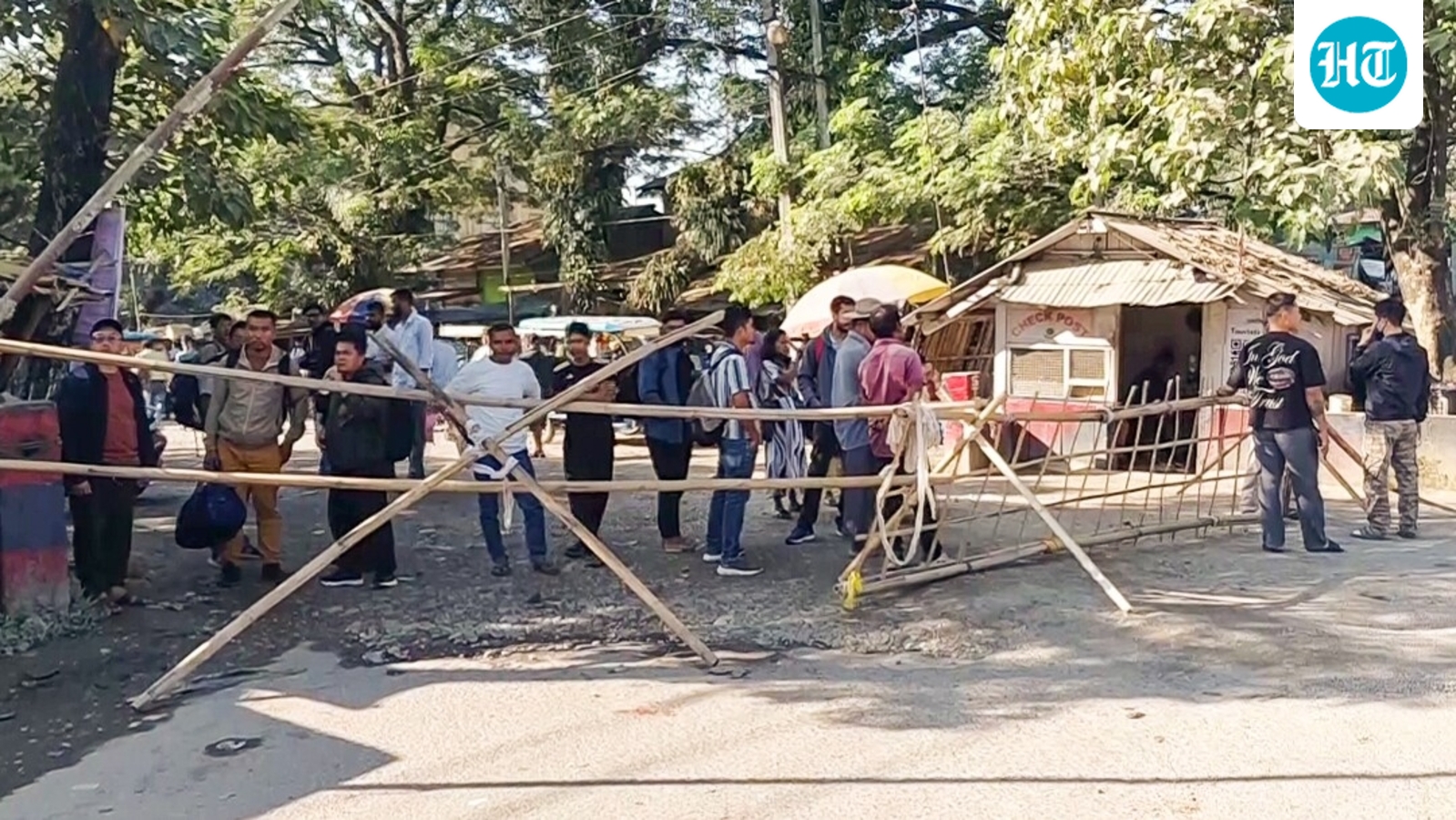
Protesters opposing the 11,200 MW Siang Upper Multipurpose Project burned the NHPC office and vandalized MLAs' houses in Pasighat on Friday evening. Hundreds of people blocked the highway after a 12-hour bandh. Chief Minister Pema Khandu condemned the violence, saying, "I strongly condemn such violent protests and urge everyone to talk."
Hundreds of protesters opposing the proposed 11,200 MW Siang Upper Multipurpose Project (SUMP) allegedly set several government offices and police vehicles on fire at Pasighat in Arunachal Pradesh's East Siang District on Friday evening, officials confirmed on Saturday.
According to officials, the Pasighat office of National Hydroelectric Power Corporation (NHPC), several government offices, one police station and seven to eight police vehicles were allegedly set on fire and damaged by hundreds of protesters claiming to represent Gen Z.
The houses of ruling Bharatiya Janata Party state president Kaling Moyong and MLAs Oni Panyang and Ninong Ering were damaged, and some property was taken away by the protesters, officials said.
"There was a 12-hour bandh on Friday from 5 am till 5 pm by some people opposed to the project. It went off peacefully in Pasighat, but after 5 pm some protesters calling themselves Gen Z insisted on continuing the bandh and blocked the highway. This caused inconvenience to people and halted traffic. The local magistrate and security forces tried to persuade them for two hours to disperse," said Jayanti Pertin, deputy commissioner of East Siang.
"There were several hundred of the protesters. But when they didn't disperse, the magistrate ordered the firing of tear gas shells. There was no baton charge. After that, the protesters got unruly and started pelting stones, which caused hurt to some policemen and officials," she added.
Pertin informed that the protesters then started targeting the NHPC office, Pasighat police station and seven police vehicles, which were burnt down. Some of them damaged the houses of the BJP state president and the two MLAS.
"Eight protesters who sustained minor injuries were later given first aid treatment at the local hospital. The situation remained tense until around 4 am on Saturday. Now it is under control," she stated, adding that no one has been arrested till Saturday noon in connection with the violence.
Arunachal Pradesh chief minister Pema Khandu condemned the violence and urged protesters to talk.
"I strongly condemn such violent protests and urge everyone who has concerns regarding the SUMP project to come and sit for talks instead of resorting to such means. Protesting is a democratic right, but should be done within limits and without causing harm or damage to anyone or properties," Khandu said.
Friday evening's incident follows injuries sustained by four women anti-dam protesters earlier that morning after police reportedly fired tear gas shells to disperse protesters at Dite-Dime near Geku.
The incident occurred at the 65 Bridge in Dite-Dime, where a large number of people had gathered in support of the shutdown when tensions escalated around 7 am after a group of protesters allegedly attempted to breach barricades and attack security personnel.
Friday's shutdown disrupted normal life across Siang and Upper Siang districts and parts of East Siang, with shops and business establishments remaining closed and residents largely staying indoors.
The bandh was jointly called by Adi Bane Kebang United (ABK), SUMP Affected Area Youth Association (SAAYA), Siang Indigenous Farmers' Forum Youth Wing (SIFFYW) and Adi Galo Welfare Society.
The organisations are demanding the release of 10 arrested activists within 24 hours, the reinstatement of suspended gaon buras, the withdrawal of all pre-feasibility report (PFR) activities in dam-affected areas, and the removal of paramilitary and Central forces deployed in the region.
The state government sees the 11,200-MW Siang Upper Multipurpose Project (SUMP) as a strategic safeguard against China's massive hydropower development on the Yarlung Tsangpo in Tibet, but those who call the river's banks home in Arunachal Pradesh fear displacement, ecological destruction, and the loss of ancestral land.
The Yarlung Tsangpo flows into Arunachal Pradesh as the Siang, before joining other tributaries to form the Brahmaputra in Assam and eventually entering Bangladesh.
Officials have expressed concerns about the possible consequences of upstream water regulation, including changes in river flows, potential diversions, and sudden water releases. The Arunachal Pradesh government argues that SUMP could help moderate such fluctuations by creating substantial downstream water storage.
At the heart of the controversy is the government's proposed Pre-Feasibility Report (PFR), a preliminary technical exercise intended to determine whether the massive dam can be built and where it could be located. The government maintains that the PFR is not an approval for construction but only a scientific assessment of the project's technical and geological viability.
For the Siang Indigenous Farmers' Forum (SIFF), which is leading the resistance, however, the survey represents the first step towards a project that could fundamentally alter the region's geography, ecology and indigenous way of life. Protesters have demanded an immediate halt to survey activities, withdrawal of security forces from affected areas and meaningful consultations with local communities.