
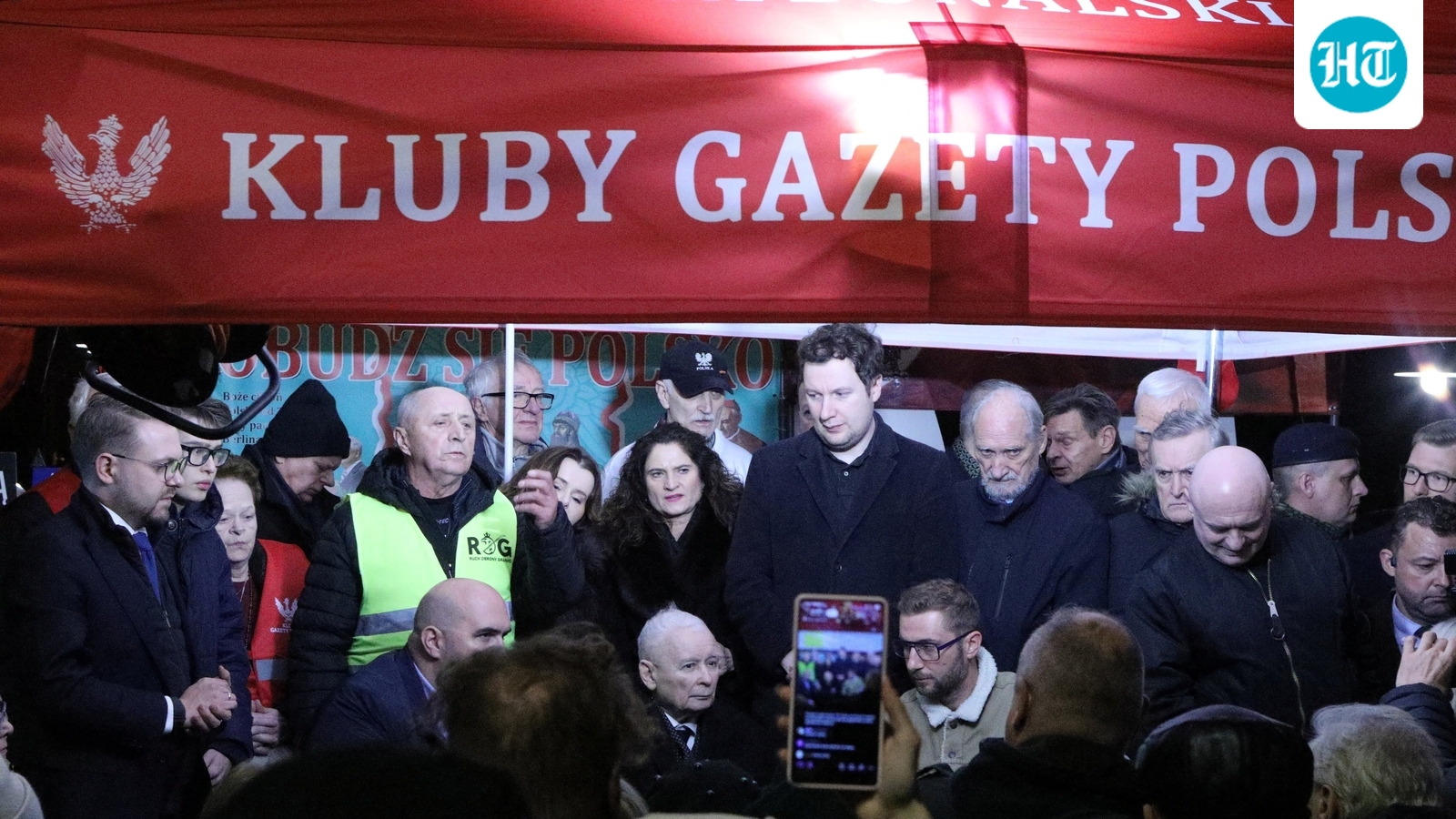
Poland's Constitutional Tribunal president Bogdan Swieczkowski was removed by judge Anna Korwin-Piotrowska on Friday. This sparked unrest as President Karol Nawrocki returned from Senegal to support his ally. Protesters gathered outside the court, and riot police arrested three people. The long-running conflict over the judiciary continues to divide the nation.
Poland's Constitutional Tribunal president Bogdan Swieczkowski was removed by the court's longest-serving judge, Anna Korwin-Piotrowska, on Friday. This sparked unrest ahead of the parliamentary elections slated to take place in 2027.
Polish President Karol Nawrocki was enroute Senegal but turned his plane around after his far-right ally was suspended for a year, escalating the row with pro-EU Prime Minister Donald Tusk and his government for control of the judiciary.
Swieczkowski had been appointed by Tusk's far-right predecessor and after news of his suspension broke, hundreds of protesters gathered outside the tribunal. Right-wing politicians reportedly addressed the crowd and accused the Tusk government of carrying out a coup against the court.
Riot police were deployed to control the crowds. Heavy police presence was seen around the courthouse as cops tried to prevent protesters from entering. Three attempting to get into the premises were reportedly arrested.
Long-running conflict over court sees new drama
The crisis over the Constitutional Tribunal has been carrying on since 2015. It has effectively paralysed the institution, Reuters noted, as the pro-European government and the nationalist president have refused to recognise candidates put forth by either side.
The dispute began with the nationalist Law and Justice seeking to appoint judges to seats already held by the previous government. While the nominees gained a majority on the Constitutional Tribunal, The European Union's top court ruled in 2021 that the tribunal is not independent and impartial in its rulings.
The Constitutional Tribunal is Poland's highest constitutional court. Its main job is deciding if laws passed by parliament and other state actions comply with the nation's constitution. Both sides have been vying for control over this court as it serves as the ultimate gatekeeper for the nation's laws and government policies.
How Tusk and Nawrocki escalated matters
Tusk's coalition took office in 2023 and made the pledge to restore the rule of law, and reform the court. However, when Nawrocki was elected president in 2025, the Law and Justice ally acted to thwart said efforts.
Friday's escalation saw Law and Justice party (PiS) protesting Swieczkowski's ouster.
Earlier in 2026, Nawrocki had refused to swear in three of six judges that the parliament nominated. Swieczkowski, a former deputy justice minister in the Law and Justice administration, did not seat judges elected by the current parliamentary majority.
Meanwhile, in September, the parliament appointed Tusk's ally Maciej Berek to the tribunal, which critics said was undermining the government's goal of restoring checks and balances.
What key figures have said about the ongoing crisis
Nawrocki, while returning to Poland, stressed on the urgency of the situation and said, "At a moment like this, the President must be in Poland. I am cutting short my flight to Senegal. I am returning."
Tusk, justifying the events of the day, wrote on X, "Restoring the rule of law is our duty. After years of PiS-led lawlessness, this is a difficult process, sometimes painful, and it requires decisive action. There is no other way."
Foreign Minister Radoslaw Sikorski said, "The constitutional tribunal was politicized under the previous government. What is happening has the purpose of allowing the majority of duly elected judges to make the tribunal function again," speaking to reporters on the sidelines of the G20 meeting in Atlanta.
Law and Justice party leader Jaroslaw Kaczynski, who has been protesting for weeks in anticipation of this move remarked, "This is the first case of its kind in the world. Starting today, Poland is becoming a police state, and from there it's a straight path to authoritarianism."