
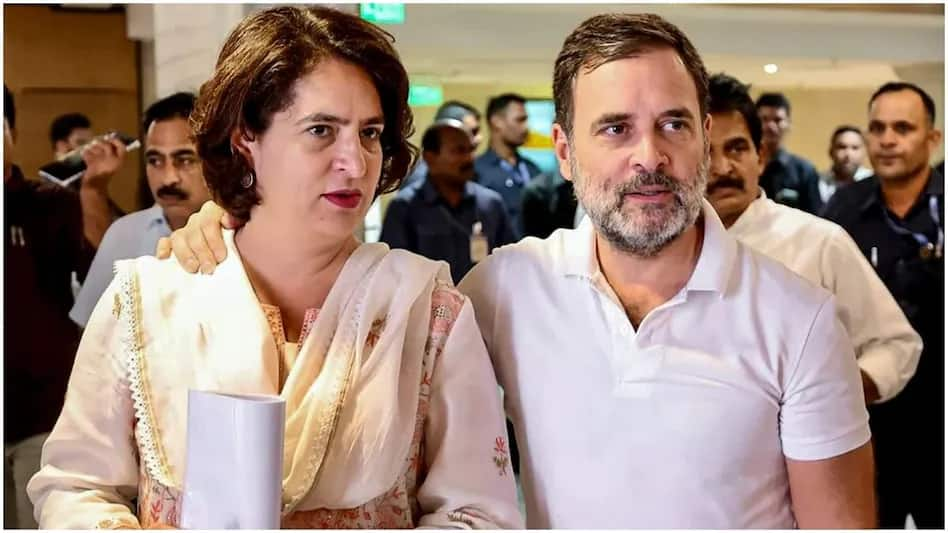
Hindu seer Swami Paramatmananda Saraswati wrote an open letter to Rahul and Priyanka Gandhi regarding a Shiva-Parvati image. He said, "It’s not just a picture. It has deep significance. It symbolises profound wisdom of Upanishads." The seer explained that the image represents complex philosophical teachings about Brahman and Maya.
Market Mastery
Webinar by Vishal Malkan
Find the weak links
in your portfolio by Vishal Malkan
Hindu seer Swami Paramatmananda Saraswati has written an open letter to Congress leaders Rahul Gandhi and Priyanka Gandhi Vadra, explaining the philosophical significance of an image showing Goddess Parvati seated on Lord Shiva's lap, which Rahul recently shared on social media.
In his letter, Saraswati said the depiction was not merely a religious image but represented deeper teachings of the Upanishads concerning Brahman, Maya and the relationship between Shiva and Shakti. He urged the Congress leaders to look beyond the visual representation and understand the spiritual philosophy associated with it through Hindu scriptures and the traditional teacher-disciple lineage.
"I don’t know what exactly you are trying to convey. However I felt like writing. It’s not just a picture. It has deep significance. It symbolises profound wisdom of Upanishads," he wrote.
What the seer said about Shiva and Shakti
Titled 'Shiva and Shakti: The Wisdom Beyond the Image', the letter explains the traditional depiction of Uma-Maheshwara, in which Goddess Parvati is sometimes shown sitting on Lord Shiva's lap.
Saraswati said Sanatana Dharma, also known as Hindu Dharma, has a longstanding tradition of communicating profound philosophical truths through religious representations. He added that their deeper meanings become clear through the teachings of Shastra.
Explaining the concept of Brahman, the seer described it as the ultimate reality revealed in the Vedas and Upanishads, which is inherently formless, unchanging and beyond all actions.
He said when Brahman manifests its power of creation, preservation and destruction, known as Maya, it is understood as Ishvara, or the Lord, represented by Shiva.
"When it invokes/manifests it’s Power of Creation/sustenance/destruction, called Māyā, The Brahman is spoken of as Īśvara (the Lord-Shiva), the all-knowing and all-powerful cause of जगत (the universe)," he wrote.
According to Saraswati, Lord Shiva represents the manifestation of Brahman in a particular form, endowed with Maya, while Goddess Parvati embodies Shakti, the power responsible for manifestation.
"While Pārvatī represents Śakti, referred as, Māyā-(the power of manifestation). Bhagawan Shiva unto whom she owes her existence and manifestation/activities," he said.
He explained their relationship through the Sanskrit concepts of Shaktiman, meaning the possessor of power, and Shakti, meaning the power itself. The latter, he argued, cannot exist independently of its possessor.
Explanation of Maya, Brahman and Ardhanarishvara
The seer further clarified that Maya functions as an Upadhi, or conditioning adjunct, through which Brahman can be understood as the source of creation without undergoing any actual transformation.
He stressed that Maya is neither an intrinsic attribute of Brahman nor something that adds a new quality to it.
Explaining the nature of the universe, Saraswati said it manifests within Ishvara's order through Maya Upadhi and is described as Mithya, meaning a dependent reality that has no independent existence apart from Brahman.
"The universe manifests within the order of Īśvara thru Maya Upādhi and it is understood as Mithyā (dependent reality), having no existence independent of Brahman-The Absolute Truth," he wrote.
He also referred to Ardhanarishvara, the divine representation in which Shiva and Parvati appear as two halves of one form, as another expression of their philosophical relationship.
"The imagery conveys that creative power Maya belongs to Shiva who is independent of it whereas Maya is Not," Saraswati said, explaining the symbolism of Parvati sitting on Shiva's lap.
He added that such representations help explain the connection between the possessor of power and power itself.
Guru-disciple tradition and Rahul Gandhi's post
Emphasising the importance of understanding religious imagery through traditional teachings, Saraswati referred to the Guru-Shishya Parampara, the lineage through which spiritual knowledge is passed from teacher to disciple.
"Sanātana Dharma unfolds the Truth so that we look beyond what an image shows and understand what it teaches," he wrote.
He further said that approaching Hindu traditions under the guidance of a competent Guru, or Shrotriya Acharya, with the appropriate attitude of a disciple, could reveal deeper philosophical meanings even in familiar religious representations.
The letter comes against the backdrop of a political exchange triggered by Rahul Gandhi's remarks about his parents, Sonia Gandhi and former prime minister Rajiv Gandhi.
Speaking at the launch of his mother's memoir, 'Belonging: A Journey of Love', in New Delhi on Monday, Rahul recalled how his parents would sit together during family meals, with his mother seated on his father's lap.
"There would be Papa, and on Papa's lap, there would be Mama," he said.
Rahul recalled considering this a normal expression of affection while growing up. He said he was surprised when he visited friends' homes and found that their parents did not behave similarly.
He also recalled asking his friends, "What is going on? Why is your mother not sitting on your father's lap?"
"This is what we grew up with," Rahul said, adding, "She belonged to my father, and my father belonged to her."
He also told his mother, "Mummy, Papa loved you, but I cannot even tell you how proud he would be of you."
The remarks attracted criticism from BJP leaders, including Assam Chief Minister Himanta Biswa Sarma, who took a swipe at the Congress leader. Rahul subsequently shared the Shiva-Parvati image, prompting the latest intervention by the Hindu seer.