
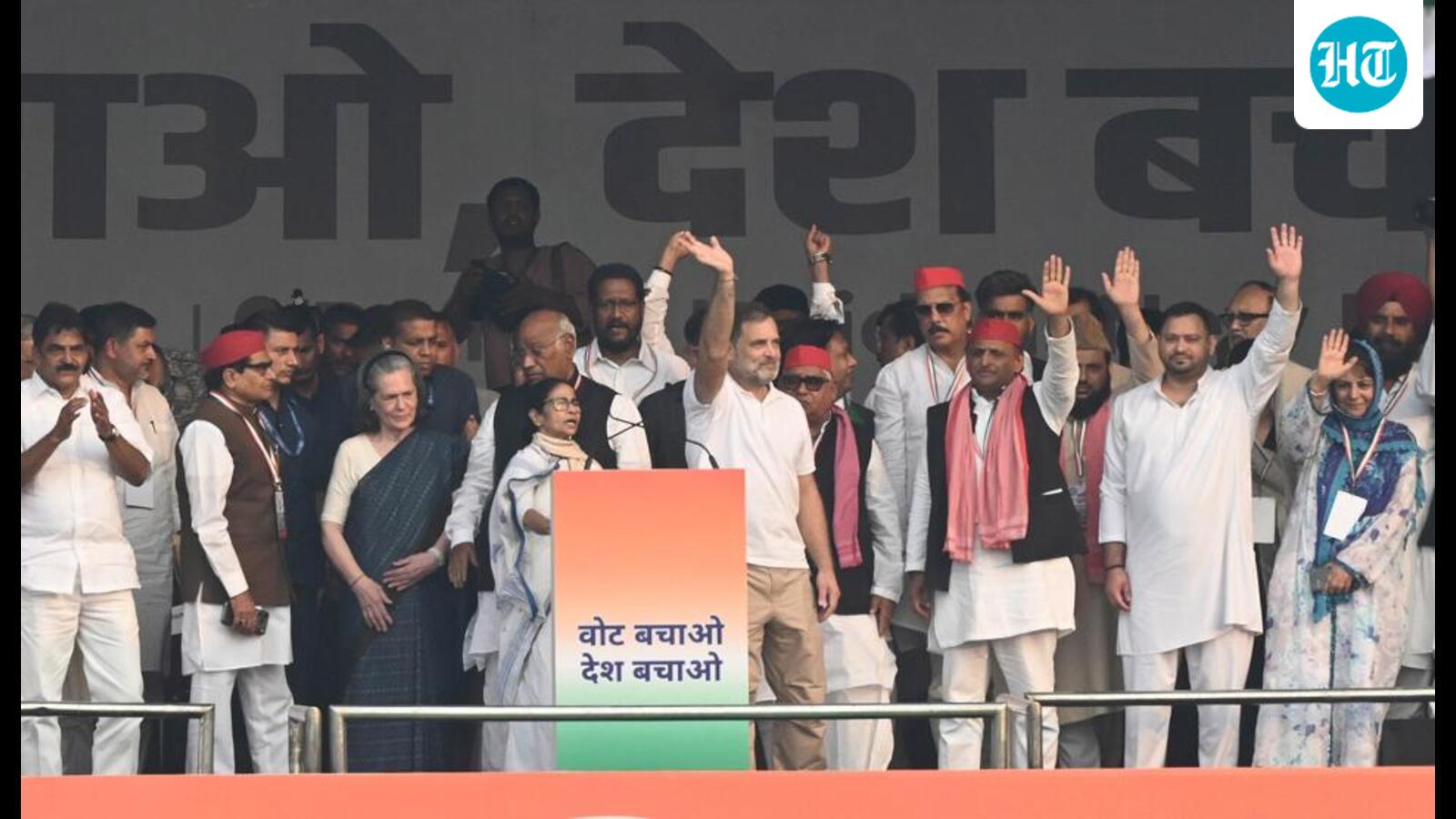
The INDIA bloc held a mega show of strength in the Capital against chief election commissioner Gyanesh Kumar on Sunday. This protest showed the Opposition’s ability to unite, but the real test comes with the five-state assembly elections next year. Leaders must now work hard to turn this into votes.
The INDIA bloc's mega show of strength in the Capital, against chief election commissioner (CEC) Gyanesh Kumar is the parliamentary Opposition's biggest mobilisation of force in recent years. It underlines how the chaos triggered by the special intensive revision (SIR) of electoral rolls has diminished the moral standing of the Election Commission of India (ECI). But the longevity of the movement and possible electoral dividends will only be determined next year in the five-state assembly elections, which present familiar challenges to both the incumbent and the Opposition.
The current moment is different from both the July protests against examination paper leaks and the initial waves of the current stir, which was then dominated by unaffiliated student groups and the Cockroach Janta Party, and is now currently led by the formal Opposition. This is also reflected in the administrative response, which was initially heavy handed that led to Delhi being cloaked in a virtual security blanket and the denotification of Jantar Mantar as a protest site. There is little doubt that the constantly changing and controversial rules under SIR, the media reports indicating disagreements within ECI, and the hardships suffered by common people -- eased only after belated course correction by the poll body -- contributed to the sustenance of the agitation. But whether it carries similar resonance for the ordinary citizen, who was legitimately concerned about her job prospects and the fidelity of the exam system earlier this summer, remains to be seen.
For the Opposition, the protest brought forth hitherto unprecedented scenes of leaders from diverse and often conflicting political trajectories sharing a common stage and issuing a unified appeal. The successful showing will boost the organisational wings of the INDIA bloc, which has struggled to project unity and hold joint events in the past. But the BJP -- which holds that the stir lacks both legitimacy and popular support -- must feel confident given its electoral performance in major states since the 2024 Lok Sabha polls. In that sense, the Opposition may have passed one big test in Delhi on Sunday -- that of mobilisation, dominating the political stage, and stamping its leadership on the protest -- but a bigger one looms in the form of the five-state elections next year. In key states such as Uttar Pradesh and Punjab, the Opposition will need to curb infighting, hit the ground running, and work on the nuts-and-bolts of electioneering if it hopes to translate street protests into formal democratic representation.