
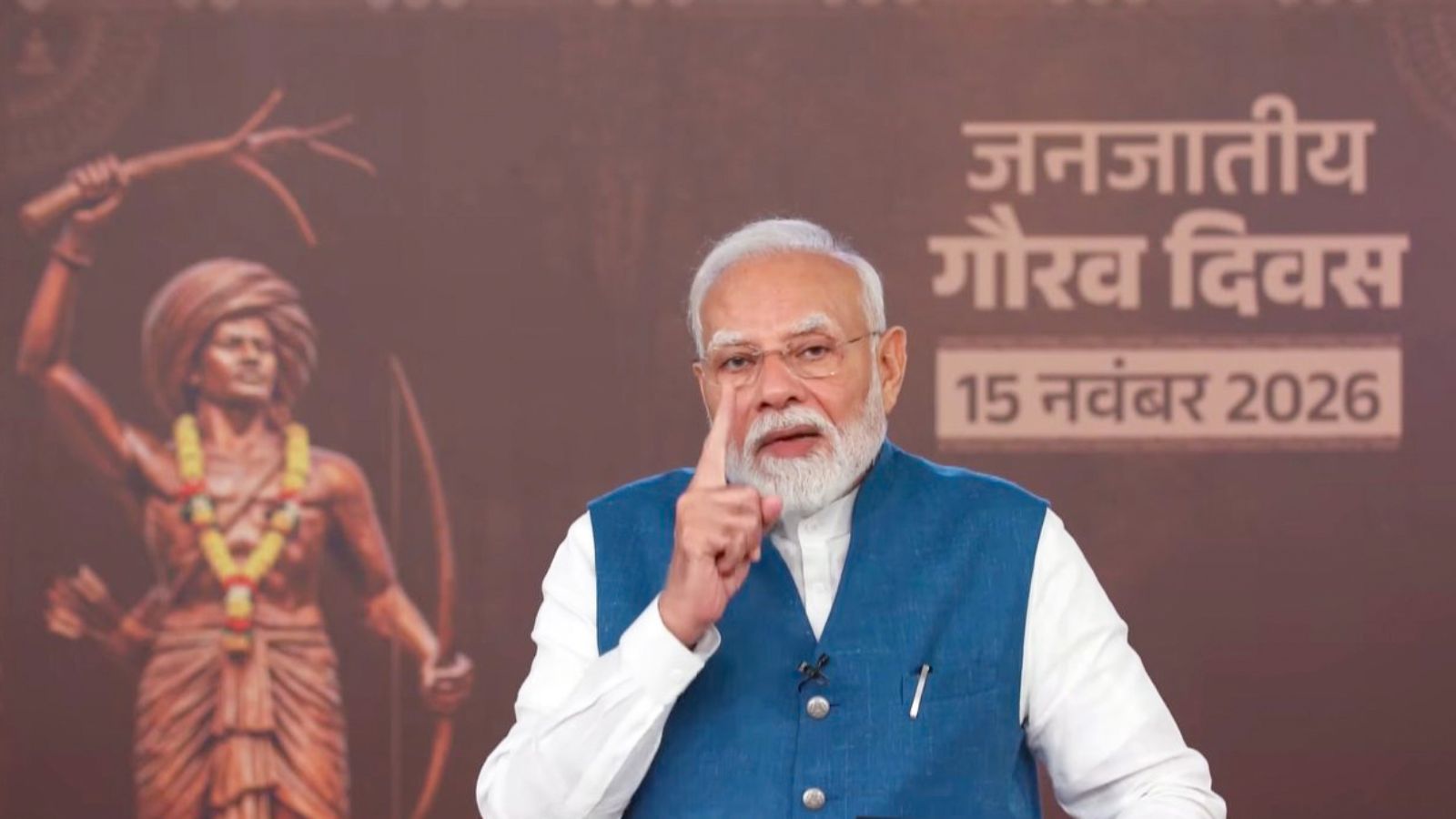
Prime Minister Narendra Modi said on Sunday that over 50 crore people got lifted out of extreme poverty in the past 12-13 years. He also noted that India eliminated Maoist insurgency. Modi said, "Today, that Maoism has ended, mothers and sisters from tribal communities are blessing us," marking significant progress.
Prime Minister Narendra Modi virtually addressed the National Janjatiya Gaurav Diwas celebrations -- held on the occasion of the 151st birth anniversary of Krantisurya Bhagwan Birsa Munda -- in Gadchiroli.
Prime Minister Narendra Modi said on Sunday that over 50 crore people had been lifted out of extreme poverty in the past 12-13 years and that India made significant progress in eliminating Maoist insurgency, describing them as two major achievements particularly significant for tribal communities.
Virtually addressing the National Janjatiya Gaurav Diwas celebrations -- held on the occasion of the 151st birth anniversary of Krantisurya Bhagwan Birsa Munda -- in Maharashtra's Gadchiroli, Modi said, "According to a recent World Bank report, around 50 crore people had moved out of extreme poverty over the past 12-13 years."
Modi described it as one of the biggest achievements since Independence and said the transformation was the result of collective efforts, including welfare schemes introduced by the Centre, not due to any one government.
Modi said the government had prioritised communities and regions that had remained deprived of basic facilities for decades. The PM Janman scheme and the Dharti Aaba Janjatiya Gram Utkarsh Abhiyan, for which the Centre had allocated more than Rs 1 lakh crore, were aimed at reaching particularly vulnerable tribal communities, he said.
Modi also referred to the construction of more than four crore houses for poor families, electrification of 18,000 villages that had remained without electricity for decades, free treatment of up to Rs 5 lakh under Ayushman Bharat, and the establishment of over 1.75 lakh Ayushman Arogya Mandirs.
On Maoist insurgency, Modi said, "Tribal communities had suffered the most from Naxal violence. Around 125 districts were affected by Left-wing extremism in 2014. Hundreds of violent incidents took place every year, claiming thousands of lives, many of them belonging to tribal communities. Previous governments had left tribal communities to their fate. Maoists deprived people of their rights and prevented them from exercising even their voting rights."
Modi also spoke about Maoists forcibly taking away children and young women, leaving families helpless. "Today, that Maoism has ended, mothers and sisters from tribal communities are blessing us," the prime minister said, adding that young people who had been deprived of their childhood were now getting opportunities for education and employment.
Referring to the changing situation in Gadchiroli and other Maoist-affected regions, Modi said the light of hope had reached these areas along with the lamps of Diwali. He also cited his recent Diwali celebrations with security personnel in Bastar, Chhattisgarh.
Highlighting the contribution of tribal freedom fighters, Modi said November 15, the birth anniversary of Bhagwan Birsa Munda, had been observed as Janjatiya Gaurav Diwas since 2021. He said the occasion had evolved into a national celebration recognising the contribution of tribal heroes who had often been overlooked in mainstream historical narratives.
Modi referred to the contributions of freedom fighters such as Tirot Sing, Govind Guru, Rani Gaidinliu, Tantya Bhil, Alluri Sitarama Raju and Rani Durgavati, besides Maharashtra's Raghoji Bhangre, Bhagoji Naik, and Baburao Shedmake.
Rs 30,000-crore projects for tribal development
Modi said more than two lakh programmes had been organised across the country during the year marking the 150th birth anniversary of Birsa Munda, with crores of people participating. He also announced that more than 170 projects related to tribal development had been inaugurated and over 70 projects had their foundation stones laid across the country on the occasion. These included educational and healthcare institutions, tribal research facilities, marketing centres for tribal products and basic infrastructure projects in villages. The projects collectively involved an investment of around Rs 30,000 crore, he said.
Maharashtra Governor Jishnu Dev Varma, Chief Minister Devendra Fadnavis, Deputy Chief Ministers Eknath Shinde and Sunetra Pawar (online), Union Tribal Affairs Minister Jual Oram and Maharashtra Tribal Development Minister Ashok Uike, among others, also attended the event.
Gadchiroli on course to become major steel hub: CM Fadnavis
Earlier, Fadnavis said the contribution of tribal freedom fighters had been neglected in the history taught to generations of students and credited Modi with bringing their legacy back into public discourse.
Referring to Birsa Munda's struggle against British rule, Fadnavis said, "Tribal communities had fought to protect their rights over jal, jangal and zameen (water, forests and land). Maharashtra was the first to implement the PESA Act and began directly transferring funds to villages to strengthen local governance."
The Provisions of the Panchayats (Extension to the Scheduled Areas) Act 1996, or PESA Act, ensures self-governance through traditional gram sabhas for people living in India's Scheduled Areas.
Fadnavis said Gadchiroli, which had struggled with Maoist insurgency for years, was now moving towards becoming a major steel hub. He said the development strategy placed tribal, Dalit, and OBC communities at its centre, prioritising skill development and employment opportunities. He also referred to initiatives such as foreign scholarships for tribal students.
Deputy Chief Minister Shinde said the government was committed to preserving tribal culture while ensuring development opportunities for tribal communities. He praised Birsa Munda's contribution and said Gadchiroli was being transformed from an area once described by some as a terror hub into a major steel hub.
Interaction with beneficiaries from Maharashtra, Gujarat and Telangana
During the programme, Modi interacted virtually with three beneficiaries of tribal welfare schemes from Maharashtra, Gujarat and Telangana, who talked about how government initiatives had changed their lives.
Krishna Nagorao Tekam, a member of the Kolam tribal community from Yavatmal in Maharashtra, told the prime minister that he had received a permanent house under the PM Janman scheme. Responding to Modi's questions, Tekam said his family earlier faced difficulties during the monsoon but now had a pucca house and toilet, which had made their lives easier.
Wazir Bhai Bangda Bhai Kotwalia from Gujarat's Bharuch district spoke about receiving bamboo-craft training and employment opportunities under government schemes. He said his monthly income had increased from around Rs 7,000-8,000 to Rs 20,000-25,000 after receiving training and access to platforms to exhibit and market his products.
"During British rule, bamboo was classified as a tree, and tribal people were jailed and punished for cutting it. Unfortunately, even after Independence, successive governments continued with this law. We later amended it by classifying bamboo as grass, recognising the rights of our tribal brothers and sisters over it. I am confident that you will take this bamboo art from local to global," Modi said during the interaction.
The third beneficiary, Sambhavat Anvesh, a Lambadi Scheduled Tribe student from Telangana, told Modi that he was studying at IIT Kanpur after attending an Eklavya Model Residential School. He thanked the government for providing free education from Classes 6 to 12 and coaching support that helped him secure admission to the institution.
Sambhavat said he was interested in research and innovation and wanted to work on air pollution. Modi encouraged him to pursue research that could make the lives of ordinary citizens easier, saying that opportunities for tribal youth would contribute to the country's future development.
At the Gadchiroli event, Governor Jishnu Dev Varma highlighted the need to preserve the country's tribal cultural heritage while ensuring dignity, recognition, livelihood opportunities, and access to development benefits for communities in remote areas.
The programme also saw the virtual inauguration of 22 ashram school buildings and 51 hostels at taluka and district levels in Maharashtra.
The prime minister also inaugurated several projects virtually.