
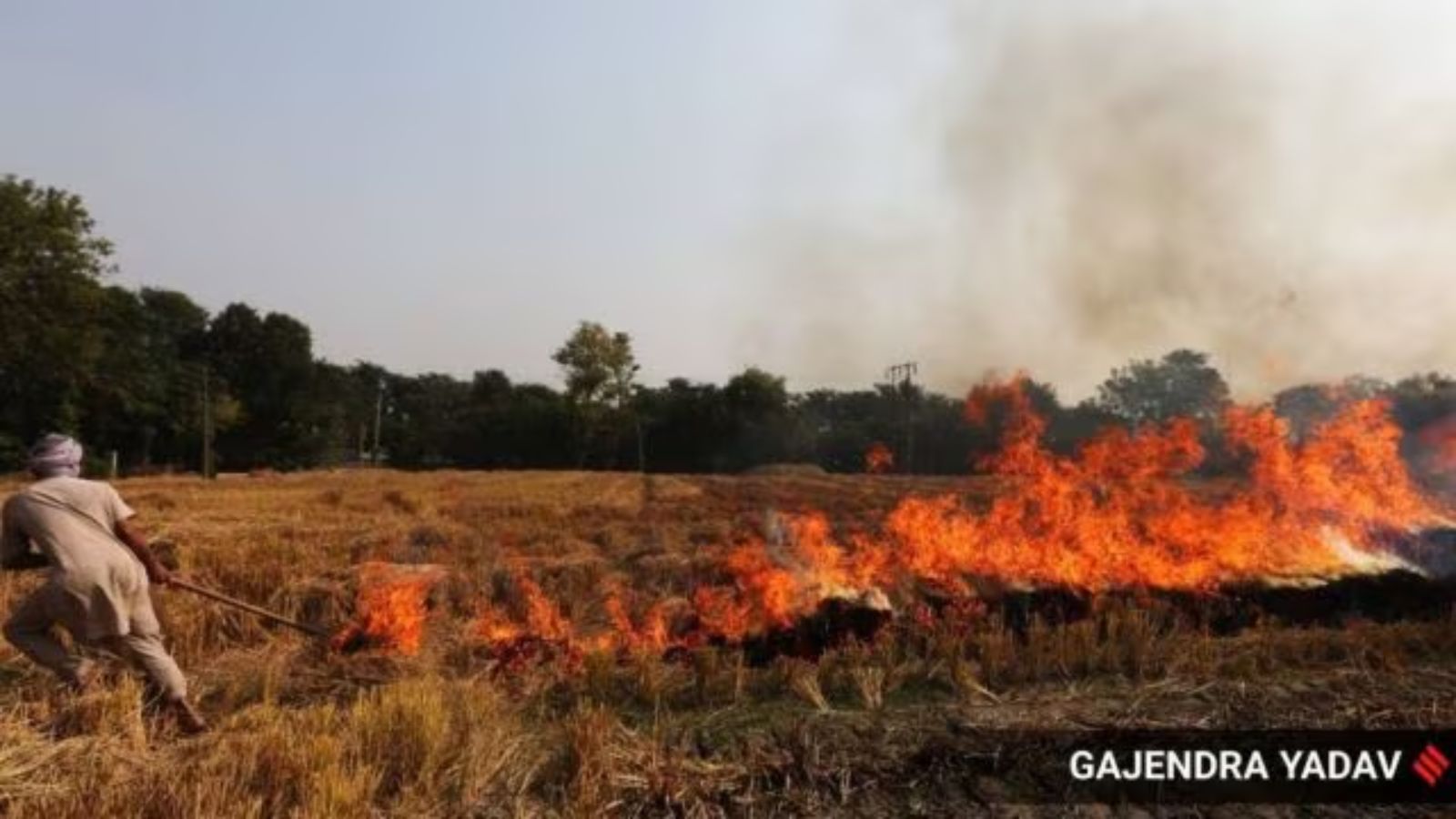
Punjab recorded 1,152 farm fires on November 8, reversing weeks of progress in curbing stubble burning. This single-day spike pushed the season’s total to 4,459 incidents. As many as 20 districts saw more fires than the previous day, with Sangrur reporting the highest count. The surge wiped out earlier gains.
Diwali day farm fires wiped out weeks of marginal progress and pushed the season's cumulative stubble burning count to 4,459.
Punjab's efforts to curb paddy stubble burning suffered a major setback on Diwali, with the state recording an unprecedented 1,152 active farm fire events on November 8 alone, a single-day spike that not only became the highest of the ongoing season but also reversed its year-on-year position in just 24 hours.
The scale of the surge is evident from the fact that Punjab had recorded 3,307 farm fires till November 7, against 3,384 during the corresponding period last year. The state was thus still marginally ahead of last year's performance, with 77 fewer fires, or a 2.3 per cent decline. However, the 1,152 fresh detections on Diwali pushed the cumulative count to 4,459 on November 8, against 3,622 on the corresponding date in 2025 -- an increase of 837 fires, or 23.1 per cent.
In effect, a single day's detections wiped out the marginal improvement recorded over last year and pushed the state's seasonal tally well above the previous year's corresponding figure.
Widespread surge
The Diwali-day spike was not confined to a few pockets. As many as 20 of Punjab's 23 districts recorded more active fire events on November 8 than on November 7, while the remaining three -- Gurdaspur, Pathankot and Rupnagar -- recorded no change. No district reported a decline.
The 1,152 fires detected on November 8 were nearly seven times the 163 recorded on November 7, marking a staggering 606.7 per cent day-on-day increase. The number was also almost double the previous highest single-day count of 584 recorded on November 3.
Another striking comparison is that fires detected on Diwali alone accounted for 58.5 per cent of the 1,968 incidents recorded during the entire preceding seven days, from November 1 to 7. At the previous week's average daily rate, the Diwali-day count matched more than four days of farm fires.
District-wise, Sangrur recorded the highest number of fresh fires on November 8, at 194, followed by Ferozepur (157), Bathinda (132), Patiala (92) and Barnala (91). These five districts together accounted for 666 fires, nearly 58 per cent of the state's total for the day.
Moga recorded 73 fires, followed by Ludhiana (71) and Mansa (62). The daily trend during the preceding week had been uneven, with 175 fires recorded on November 1, 98 on November 2, 584 on November 3, 151 on November 4, 440 on November 5, 357 on November 6 and 163 on November 7. The sudden jump to 1,152 on November 8, coinciding with Diwali, therefore stands out sharply against the preceding trend.
Narrowing sowing window
The timing also raises questions about whether farmers used the festival holiday to clear their fields by burning, particularly as the window to prepare land for the next wheat crop narrows. With the recommended wheat sowing deadline of November 15 approaching, the pressure to clear paddy residue could be a factor behind the surge. However, satellite data shows the number of active fire events but does not establish the motive or exact timing of individual burnings.
The latest cumulative tally of 4,459 is also significantly higher than the 3,622 recorded during the corresponding period in 2025, although it remains below the 6,029 recorded on the same date in 2024.
The figures are based on district-wise satellite data for active fire events during the kharif paddy season, with the monitoring period beginning on September 15.