
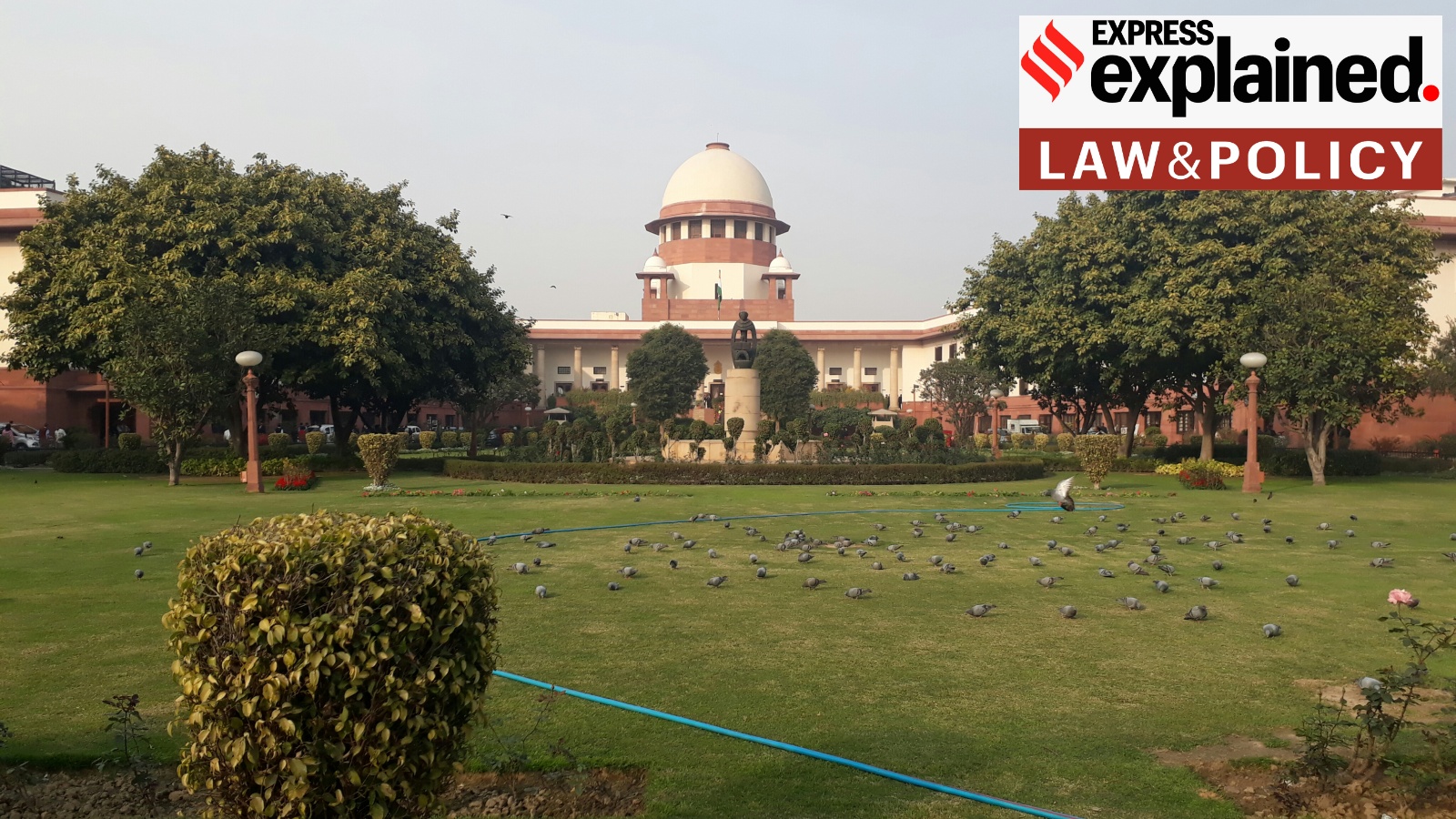
India’s Supreme Court now has 38 judges, yet it faces over 96,000 pending cases. Special Leave Petitions, which the court chooses to hear, make up 80 percent of new filings. While these were meant as a last resort, they now add heavy pressure, making it hard to clear the massive backlog.
India's Supreme Court has increased its sanctioned strength to 38 judges, but a growing number of Special Leave Petitions (SLP) is adding to its caseload. Can stricter admission filters ease the backlog without compromising access to justice? We explain.
Written by Laveesh Bhandari and Shagun Suryam
India's higher judiciary is struggling under an enormous caseload, and the numbers illustrate the scale of the challenge. At the Supreme Court, more than 96,000 cases are being handled by 38 judges, or about 2,500 cases per judge as of the latest available data in the National Judicial Data Grid.
In May this year, the central government increased the top court's sanctioned strength from 34 to 38 judges to help the court respond to mounting backlogs. But does adding judges address the problem?
What is the role of SLPs? And how do they add to the burden?
Since increasing the number of judges implies more cases can be heard and adjudicated, it is natural to assume that this will reduce pendent cases. However, we find that cases accepted by the Supreme Court are also rising over time. The Supreme Court of India hears different types of cases, of these the Special Leave Petitions (SLPs) are the most prevalent. The SLPs are cases that the Supreme Court has a choice to hear.
That is, while petitioners may appeal a judgement by a lower court, the Supreme Court is not bound to hear it, it may choose to do so. As mentioned, SLPs are currently the dominant category of cases filed in the Supreme Court, with some estimates suggesting that they account for around 80 per cent of fresh filings.
Yet, SLPs were not meant to be a routine process. They were originally designed as independent India's substitute to the monarch's prerogative of justice. During Constituent Assembly debates, H.V. Pataskar articulated this rationale, arguing that without a King to serve as a "fountainhead of all justice", India needed an equivalent guardian of justice - therefore, conferring this unfettered discretionary power on the Supreme Court. Despite being a provision that was engineered as a last resort, SLPs have become one of the top contributors to the top court's docket.
Consider how SLPs play out in practice - Sunil Kumar, an Assistant Engineer with the Uttar Pradesh Power Corporation, filed a petition before the Allahabad High Court in 2015 challenging criminal proceedings arising from a 2014 office altercation with a peon who was alleged to have tried to hit Kumar with a slipper, who in turn accused Kumar of threatening to kill him. The High Court dismissed the petition on 13 March 2018. Kumar then filed an SLP before the Supreme Court even though the matter did not raise a substantial constitutional issue. The Court granted leave and allowed the appeal in 2023, nine years after the incident - itself calling the allegations "trivial". Multiply this by numerous similar petitions each year, and the scale of this access becomes clear.
Other apex courts filter far more aggressively. The US Supreme Court hears roughly 70 - 80 of several thousand petitions filed per year and the UK Supreme Court granted only 45 out of 207 permission to appeal applications in 2025-26, while India sends several thousand cases to full hearing every year.
How can the Supreme Court introduce some balance?
The answer is not to close the doors to a constitutional remedy the framers deliberately included, but to stop this accessibility from turning India's highest court into an all-purpose court of appeal by building clear filters and differentiators for the kind of disputes that warrant it. Proposals over several decades have made attempts to separate the Supreme Court's constitutional function from its appellate jurisdiction, or create regional division. But these are only addressing the symptoms and not the underlying problem, namely, that too many appeals of the SLP variety are being accepted by the Supreme Court of India.
One line of reform, that is not much explored, focuses on tightening what makes it to the court's docket in the first place by developing a well-defined threshold. The court foresaw this challenge as early as 2010, when a judgment warned that without broad guidelines on when an SLP ought to be entertained, "the functioning of the court will become impossible" and referred the question to a constitution bench. But when a separate Constitution Bench took up the matter, it refused to restrict the court's power, holding that doing so would work against the interests of justice.
A codified filter has real potential to reduce the apex court's docket burden, but it would also formally narrow the court's own conception of what justice delivery means.
Many SLPs are admitted not because they raise a substantial legal question, but because the court perceives that they would be better able to correct an individual injustice than the lower court could. It is clear, therefore, that the difficulty has not been a lack of recognition that the Supreme Court is carrying functions that are difficult to sustain, but the absence of agreement on how to reorganise or limit those functions effectively.
This unresolved question is becoming increasingly difficult to avoid. If we must preserve broad access to the Supreme Court we need to rethink what 38 judges are being asked to do.
Laveesh Bhandari is President and Senior Fellow at the Centre for Social and Economic Progress (CSEP), formerly Brookings India.
Shagun Suryam is a Research Analyst with CSEP in the President's office. She holds a Masters in Public Administration from the Wagner School at New York University (NYU).