
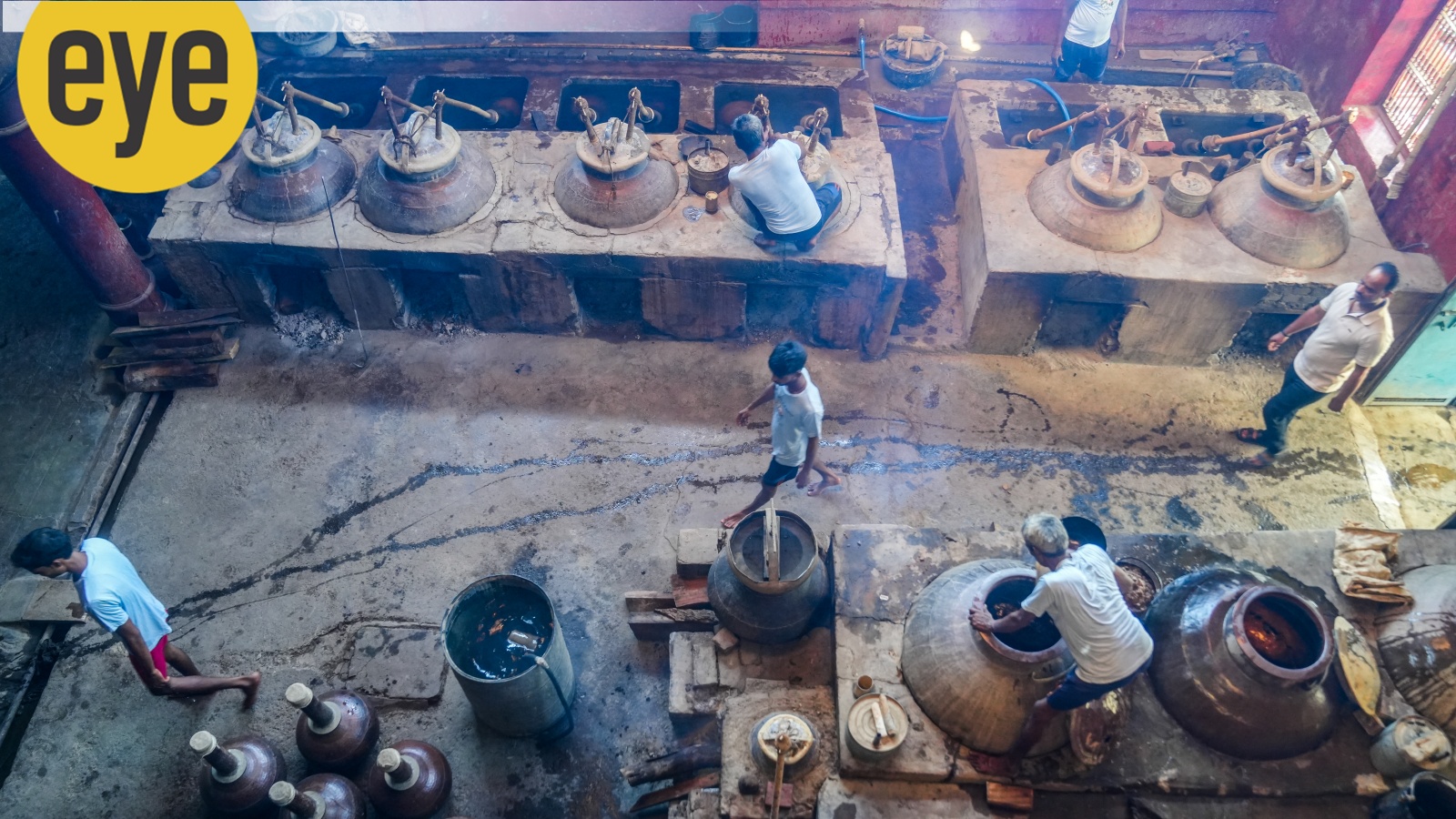
Kannauj, India's perfume capital, currently smells of dust and garbage instead of fragrance. Divy Gupta said, "The best time is around Holi, from March to June." While the distillation season is closed, local perfumers still use the centuries-old deg-bhapka technique to create traditional attars for a new generation of buyers.
The perfume capital of India has been witnessing a revival, with a new generation of perfumers going beyond business to tap into memories, and the centre of it all is the centuries old deg bhapka
It is October. You enter Kannauj, roll down the car window and take a deep breath. Nothing. Then, a few consecutive short sniffs. There is fresh cow dung, sneeze-inducing dust kicked off by vehicles and decomposing garbage. Everything but the heady fragrance that the perfume capital of India promises.
This is partly because it is not the distillation season, says Divy Gupta. "Monsoons leave the water content in flowers too high for oil to be extracted so some distilleries are closed now. The best time is around Holi, from March to June," says Divy, who, with his brother Shubham, co-founded Raahi Parfums, the sister organisation of the legacy fragrance house Makhulal Ayodhya Prasad, established in 1818.
The cold months allow for another kind of distillation -- attars (distilled perfumed oil) with heavy, warm and musky accords like Shamama (made by distilling over 40 spices and roots), Oudh and Henna.
In fact, the absence of the often eulogised fragrant Kannauj air is a testimony to the infallibility of the centuries-old hydro distillation technique of deg-bhapka. It ensures that not a wisp of steam escapes. "Lost steam is lost money," says Mangalam Dubey, a third-generation distiller who works with Delhi-based Esha Tiwari, the founder of Kastoor.
Used by nearly 85 per cent distilleries in Kannauj today, the deg-bhapka remains at the centre of the process, even as a new generation of perfumers spearheads its revival with modern tools like e-commerce and digital marketing.
The Churn
At his kothi, as a distillery is called locally, Pranjal Kapoor oversees the cleaning and chopping of raw materials. Because it is lean season, the pile of roses on the floor outside is rather small. This is the time that he uses to distil other ingredients. There's fresh betel leaves, with its spicy odour, that we know from the paandaan of grandmothers. But it is the heap of beige-brown, seed-like ingredient that intrigues us. Walk closer and its broken bits give off a scent that at the outset, is simply bad. Imagine a fishy sea breeze that has been allowed to stew and is drained of all moisture. You will not want to smell it twice. "These are sea shells," says Pranjal, "The scents you enjoy are not always made with the best smelling raw material. Jasmine has a molecule called indole, also found in human faeces."
Inside, it is only smoke you smell. Six out of the 15 degs are on fire. A short walk across the space that is slowly turning into a furnace stings the eyes and chokes our airways. But the artisans, the dighas, seem unfazed, as they go about prepping the other degs. Some are being filled with raw ingredients, others are being sealed, like you would a biryani on dum.
Pranjal, a sixth-generation perfumer joined the family business -- ML Ramnarain Perfumers -- in 2013, following a stint at CESC Limited, Kolkata.
The year he joined the business, he went to Milan, Italy. "We connected with the best perfumers in the world and since then, several master perfumers from Dominique Ropion, Cécile Zarokian and Sergion Momo have walked the streets of Kannauj," he says.
Today, ML Ramnarain Perfumers supplies fragrance ingredients to the global big four of perfumery -- Givaudan (Switzerland); dsm-firmenich (Switzerland / Netherlands); IFF (International Flavors & Fragrances, United States) and Symrise AG (Germany), covering leading consumer brands ranging from Dior, Tom Ford, Prada, YSL to Gucci and Estée Lauder.
For Esha of Kastoor, the Gupta siblings of Raahi Parfums and the Tandon siblings (Krati and Varun) of Boond Fragrances, the Covid-19 pandemic was the catalyst.
The most conspicuous change was turning a B2B industry into a direct-to-customer (D2C) business. They wanted to make attar more than just an object of transaction and offer an experience by tapping into the emotional power of fragrance.
A three-second Instagram post of roses being harvested at the Guptas's farm is all it took. The post went viral, flooding them with queries. Raahi Parfums grew from there. "After I listed our ancestral firm on Google, our old buyers, since my grandfather's time, started enquiring if we were the same 200-year-old firm," Divy says.
At the Raahi store, our senses are in a swirl of scents. Miniature bottles carry familiar fragrances -- Mogra, Chameli, White Oud, Jasmine and Parijat. One stands out: Rasleela. A deep sniff of the golden oil reveals unexpected notes. The pungency of marigolds. The woodiness of camphor. The smokiness of incense. The raw warmth of burning ghee. For a moment, the shop seems to give way to a temple during aarti.
"That's correct," says Divy, "I came up with the scent after visiting Vrindavan. We were in a temple during an aarti. I wanted to capture that moment in a bottle." There are a total of nine scents that have gone into Rasleela but he refuses to divulge all of them.
For Krati, a corporate professional, and Varun, a filmmaker, of Boond Fragrances, it's the saptaparni, the autumn flower, that lends itself to a heady experiment. Its sweet aroma makes every Bengali nostalgic about Durga Puja. There are few brands that use the flower as an ingredient for perfume because the flower barely retains its smell, quickly dwindling into a medicinal, green scent, once plucked; its yield too is low.
"It took us three years to develop it -- learning when and how to harvest it. In the first year, we experimented with what parts to pluck: do we harvest the whole tree, the leaves, the stems or the blossoms? You experiment, errors happen, and then you have to wait a full year for the next annual bloom cycle," says Pravin Tandon, Boond's in-house perfumer. Despite being in the refrigeration business, he has a natural olfactory instinct. The small twigs of saptaparni on his desk are evidence of the constant experimentation at Boond.
Meanwhile, for Esha, Kastoor was about making Indians aware of their olfactory heritage. With a botanist father, she grew up around flora. "Fragrance is far more than a collection of notes or a pleasant smell. A perfume can have a visual architecture, an emotional architecture, a narrative architecture. It can build a scene, evoke a landscape, hold a memory or tell a story," she says.
Esha reveals that she came up with Kastoor's Mahal while reminiscing about the forts of Gwalior, where she spent part of her childhood. But what does a mahal smell like? "It's in the airiness," she says. The fragrance uses warm and earthy patchouli with notes of lotus and sandalwood.
In the last week of September, Kastoor wrapped up the distillation of their Frozen Jasmine fragrance. Made from the jasmine harvested on a full moon night -- the plant's sap and oils are in high concentration in the petals -- the scent was conceived from Esha's memories of her travels to Madurai. It has a rich top note of jasmine, a minty coolness in the middle and the earthiness of petrichor for the base. "We don't just distil rose and give you the oil. We design fragrances by layering scents," says Mangalam.
A similar goal led Pranjal to come up with Gaia -- Greek for mother earth. He went to a boarding school in the hills and much of his time was spent in the library. "It used to rain a lot... you know that musty smell of books in a closed library?" he asks, admitting that the floral yet smoky scent may not be for everyone. He doesn't say if the memory is a happy or sad one. Just that the smell takes him back to that moment.
The early sparks
Legend has it that the Mughal queen Nur Jahan, while taking a rose water bath in Kannauj, saw a glossy film of oil floating on the surface of water as the sun heated it up. She had accidentally discovered rose oil. Generous patronage from her and emperor Jahangir followed, marking the beginnings of Kannauj as India's perfume capital. But historical records place Emperor Harshavardhana as the original patron of fragrances in the city that, thanks to him, had a steady supply of sandalwood from south India.
Interestingly, the Archaeological Museum in the city places its deg bhapka as a successor of the Indus Valley Civilisation, citing the excavation of a copper distillation pot dating back to the Harappan era.
The deg bhapka technique does not simply blend but infuses fragrances. It involves a deg, a huge copper pot, in which the raw ingredient, say rose petals, go with water. It is then covered with the sarpos, the lid, which is sealed using a clay and cotton mix. Into the hole on the lid goes the chonga -- a long bamboo pipe -- the other end of which goes into the bhapka, a large vase-like utensil, that is put in a reservoir of cold water and contains the attar base of sandalwood oil.
Once the fire is lit, and the fragrant steam rises in the deg, it passes through the chonga and into the bhapka where it condenses. The rose oil blends with the sandalwood oil and the water separates. The bhapka is then tilted to let the water out. That is gulab jal. What's left behind is rose attar, which when diluted with alcohol or water carriers, become perfume or body mist.
When the carrier sandalwood base in the bhapka is not used, the resultant liquid is the ruh (soul) -- the pure plant oil, which is priced significantly higher than attar because of the low yield. About 4,000 kg of flowers produce only 800 g of ruh.
Pranjal's analogy to understand the deg bhapka process is dal. Followed to a T, the same recipe will yield different tasting dals. "It depends on how it is cooked -- on a chulha, in a microwave or on a gas stove," says Pranjal, "Deg bhapka is chulha. It is slow but for us, slow is smooth, smooth is fast."
This method puts Kannauj in a unique position to be the only producer of the mitti scent or petrichor that is created naturally using baked clay shards or kulhads.
"Everywhere else in the world, including Grasse, France, the perfume capital of the world, petrichor is a lab synthesised scent, compounded on a table. Only Kannauj makes it naturally," says Divy.
The Future
Kannauj, which often makes headlines for being the political stronghold of the Samajwadi Party, with both Akhilesh Yadav and wife Dimple Yadav having served as MPs from the constituency, had promising beginnings with perfumery.
The success of the ancient tradition was cut short with the introduction of cheap synthetic aromatics during the chemical revolution of the '90s. "While crafting a natural attar cost around Rs 800, synthetic chemical substitutes were produced for just Rs 20 - Rs 30. This severe price disparity forced Kannauj distillers to survive by supplying industrial flavours to the tobacco industry rather than for fine fragrances," says Divy.
It was around the same time that the government founded the Flavour and Fragrance Development Centre (FFDC) in 1992 to promote indigenous perfumery.
Currently, the institution, housing both modern steam distillation boilers alongside traditional deg bhapka units, trains at least 30 professionals each as part of their year-long courses. "Domestic earning packages range from Rs 30,000 to Rs 40,000 per month, while graduates placed in overseas perfume houses in Dubai or Oman earn around Rs 1.5 lakh as starting monthly salaries. Over 50 per cent students launch their own independent D2C perfume start-ups/brands," says Nadeem Akbar, Deputy Director, FFDC.
For the new generation, who consider themselves custodians of the deg-bhapka heritage, perfume tourism is the natural way forward to keep the legacy alive.
Chef Pranav Kapoor's journey in the kitchen began at six, playing games with his grandfather who would give him a scent and ask, "What comes to your mind?" "Both cooking and perfumery are similar in the ingredients they use -- spices and fruit notes. It's all about balance," says Pranav, also an eighth-generation perfumer.
Combining his acquired and inherited skills, he came up with the idea of perfume tourism sometime in 2017 while walking the streets of Kannauj. "The West has known about us for decades because they have been our clients. I wanted to do this to educate my fellow Indians about the city's rich history," says Pranav, who conducted his first tour in March 2023.
Back on the streets of Kannauj, the fragrance may seem elusive but it is never far away.