
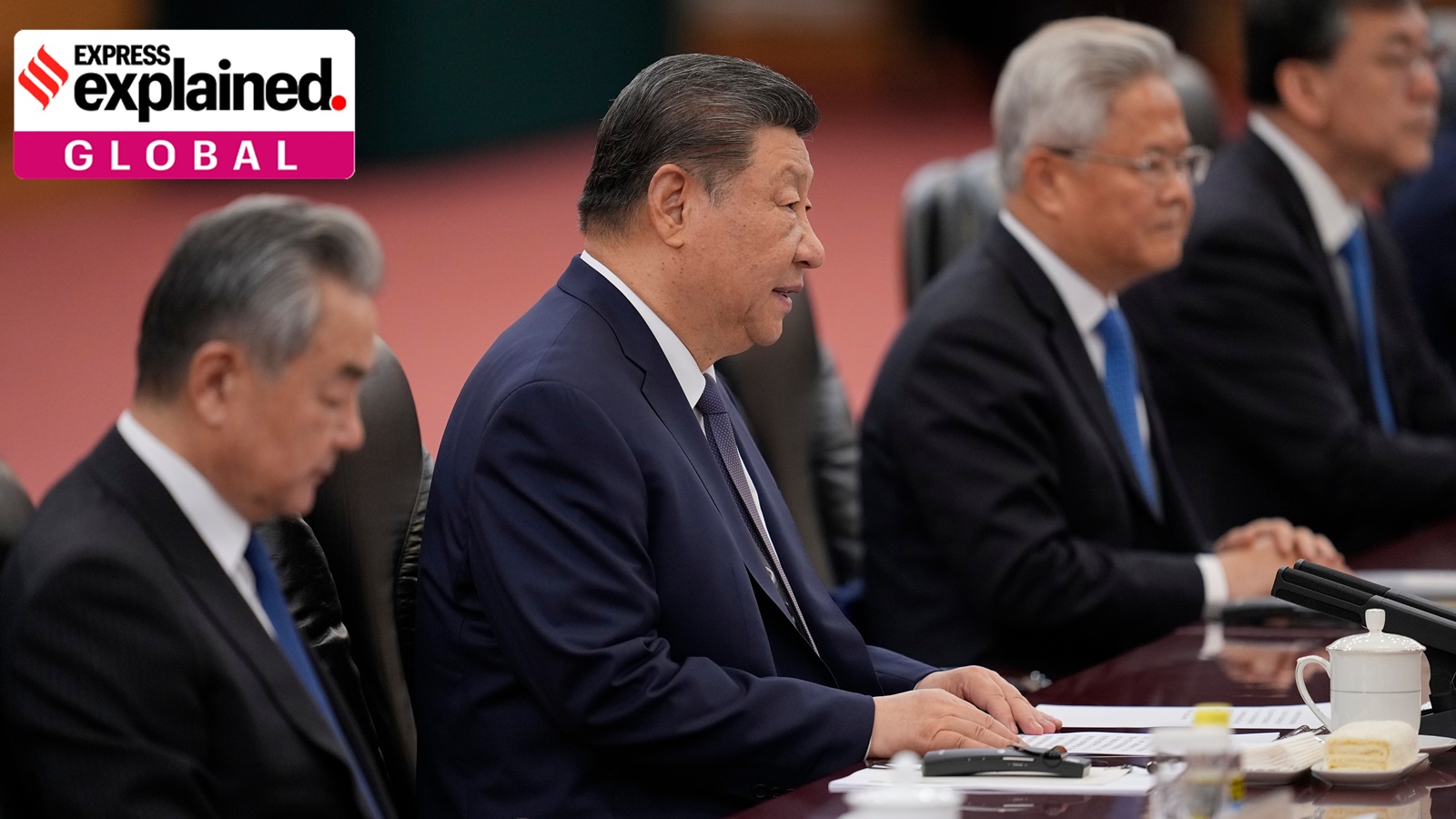
The Fifth Plenary Session of the Party's 20th Central Committee concluded in Beijing on October 29. President Xi Jinping used the meeting to tighten political control and reinforce Communist Party supremacy. Many experts said the session focused on internal discipline and leadership adjustments, which carry strategic implications for India’s future.
For India, the implications of such meetings are strategic.
A key political meeting that recently concluded in China reflected President Xi Jinping's resolve to tighten political control and reinforce the supremacy of the Communist Party of China (CPC).
The Fifth Plenary Session of the Party's 20th Central Committee, held in Beijing from October 26-29, also addressed institutional vulnerabilities, which matter ahead of next year's Party Congress -- an all-important meeting held every five years. According to the official communiqué, the conclave focused on internal Party discipline, leadership adjustments, and preparations for the next political cycle.
For India, the implications are strategic rather than merely political. Understanding China requires looking beyond its economic strength and military hardware to its political architecture, the mindset of its leadership, and strategic behaviour.
Significance of the Plenums
During its five-year tenure, the CPC Central Committee, elected by the National Party Congress (NPC) or the national legislature, holds seven plenary sessions. These serve as important instruments for translating the NPC's political directions into policies and decisions.
Although each plenum follows an established agenda, the 20th Central Committee (established during the 2022 Party Congress) witnessed some deviations. The First and Second Plenums focus on top leadership appointments and state institutional structures. The Third Plenum addresses major economic policies and reforms; this time delayed and held in July 2024.
The Fourth Plenum, associated with Party building, was held in October 2025 and took up the task of finalising guidelines for the 15th Five-Year Plan (2026-2030), an exercise normally reserved for the Fifth Plenum. Consequently, the Fifth Plenum shifted its emphasis towards strengthening CPC governance structures ahead of the 2027 Party Congress. The Sixth traditionally centres on ideology and Party discipline, while the Seventh prepares the agenda for the next NPC.
The Fifth Plenum must be viewed against the evolution of Xi's leadership since 2012. Anti-corruption and Party discipline have been defining features of his tenure. The 20th Party Congress in October 2022 consolidated Xi Jinping's position as China's paramount political leader and reaffirmed his vision of national modernisation and rejuvenation. His term as the general secretary, or top leader, of the CPC was extended for a historic third time.
The record-low attendance at the latest meeting also came amid continuing leadership upheaval, marked by investigations and disciplinary action against civilian officials and People's Liberation Army (PLA) commanders.
Fifth Plenum: Highlights and key outcomes
The communiqué outlined several guiding principles, including strengthening of Party leadership, enforcing rigorous governance across organisations, improving institutional oversight and ensuring governance through Party regulations.
A consequential outcome was the adoption of a resolution reinforcing the CPC's position that its capacity to govern itself is fundamental to its ability to govern China. The emphasis on top-down control was particularly significant.
Perhaps the most consequential development remains the continuing upheaval within the PLA. The Plenum confirmed the expulsion of 33 officials from the Party. These included senior military figures such as Zhang Youxia, former Vice Chairman of the apex military decision-making body, the Central Military Commission (CMC), Liu Zhenli, former Chief of Staff of the Joint Staff Department, Ma Xingrui, former Politburo member and Wang Haijiang, former Western Theatre Commander. This theatre also concerns the border with India.
The shrinking military leadership is evident from the CMC's composition. Constituted with seven members in 2022, it has since seen five members removed, leaving only Xi as Chairman and General Zhang Shengmin, who oversees military discipline. The Plenum did not announce appointments to fill the vacant positions. This could reflect an effort to retain direct control and avoid potential internal challenges, particularly amid suspicions concerning officers associated with the purged figures.
The political signal
The Plenum formally announced that the 21st Party Congress would be held in Beijing in the latter half of October 2027. It will determine the composition of the CPC's senior leadership for the next five-year cycle.
Xi's position remains firmly at the centre of the political system and he is widely expected to seek another term. No succession arrangements have been announced. In China's opaque political system, personnel changes and purges offer important, though not definitive, indicators of leadership priorities. In this context, Zhang Shengmin's elevation to Politburo merits attention, although it does not settle the succession question.
The Fifth Plenum was primarily an exercise in reinforcing the foundations of Xi's political system before the Party Congress. The underlying proposition is that the Party must strengthen and discipline itself to lead China's rejuvenation. The unprecedented removal of senior functionaries, particularly within the PLA, highlights the continuing emphasis on political control.
However, tighter political control cannot, by itself, resolve China's economic challenges. Weak domestic consumption, property-sector stress, local government debt, demographic decline and external technology restrictions remain structural constraints. The 15th Five-Year Plan seeks to address these issues. Excessive political control can constrain private enterprise and discourage innovation. The challenge, therefore, is to balance political authority with the flexibility required for sustained economic growth.
The centrality of national security in China's governance framework was also reinforced. Domestic governance and external policies are increasingly interconnected. Against the backdrop of intensifying US-China competition, the leadership is expected to accelerate efforts towards technological independence, military modernisation and strategic outreach.
Closer to home, China's territorial claims and emphasis on national security will continue to shape the environment along the Line of Actual Control (LAC). The removal of senior PLA commanders should not be interpreted as a moderation of China's strategic objectives or a dilution of its military capabilities. India must closely monitor changes in the PLA's command structure and operational readiness while strengthening its own defence preparedness as part of a coherent China policy.
The writer is a war veteran and former Assistant Chief of Army Staff (Strategy). He has served as Defence Attaché in China and is currently a Professor at Lal Bahadur Shastri Institute of Management.