
On October 20, 64 years ago, Chinese troops invaded India from two sides, winning decisively. The war exposed a dangerous gap between political assumptions and ground realities. Today, an aggressive China continues to exert military pressure along the Line of Actual Control, showing that these past lessons remain very relevant.
On this day 64 years back, Chinese troops invaded India from two sides and won decisively. An expert explains how the defeat's lessons remain relevant all these decades later, especially as China continues to exert pressure on the LAC.
Sixty-four years ago on this day (October 20), Chinese forces invaded India from two sides -- in the West around the Ladakh region and in the East in the Northeast Frontier Agency (today's Arunachal Pradesh and parts of Assam).
On both fronts, its victories were swift and decisive. China captured the strategically crucial Tawang (in the present Arunachal Pradesh), and advanced further, before declaring a unilateral ceasefire just over a month later, on November 21.
The 1962 war was more than a military defeat for India. The strategic shock exposed the dangerous gap between political assumptions and ground realities. Indian policymakers believed that China would not resort to military action, failing to read Beijing's grand designs and realistically assess its military build-up. However, the Communist leadership had been preparing for the showdown since 1959. Even the Indian Army allowed itself to be drawn into a war on the high Himalayas for which it was grossly ill-prepared.
The significance of the 1962 war lies not merely in what happened on the battlefield, but in understanding why India was caught off-guard and what this failure revealed. Incidentally, more than six decades on, an aggressive China continues to exert sustained military pressure along the Line of Actual Control (LAC), a stark reminder about the relevance of the past lessons.
From Panchsheel to strategic mistrust
Having been through the colonial upheavals, both India and China harboured competing ideas of Asian solidarity. India recognised the People's Republic of China (PRC) in 1950 and strongly advocated cooperation between the two Asian powers. In 1954, the Panchsheel Agreement was signed to consolidate the bilateral ties.
However, unresolved boundary issues, divergent perceptions on Tibet and a lack of insight into the Chinese strategic calculus proved to be impediments towards the development of good, neighbourly relations. Beijing's consolidation over Tibet and the flight of the Dalai Lama to India in 1959 led to increasing mistrust.
China's surreptitious construction of a road through Aksai Chin to connect Xinjiang with Tibet in the early 1950s, and its subsequent discovery by India, further soured ties. The boundary dispute turned into an intense contest over the issues of sovereignty and national security. The border clashes in 1959 at Longju in the eastern sector and Kongka Pass in Ladakh heightened the tensions.
India responded by adopting a "Forward Policy" in 1961. The plan involved the establishment of posts close to the Chinese positions to prevent further encroachment of territory.
The Chinese countered by setting up additional posts, at times encircling the Indian positions. Mao Zedong defined it as "armed co-existence". The Indian leadership assumed that a tit-for-tat playbook would not provoke a major Chinese military response. The Communist leadership, however, had concluded that their efforts to prevent Indian advances without bloodshed was not being achieved and that the use of force would bring India to the negotiation table.
India's failed assessments
The overall aim set by the Chinese Central Military Commission for the People's Liberation Army (PLA) was to inflict a crushing defeat on the Indian troops on the border. While the objective in the western sector was primarily to provide security to the Aksai Chin Road, the major military effort was directed in the eastern sector to annihilate Indian forces deployed there.
As evidence of China's military activities grew, so did the gap between the Indian Army's increasing operational commitments and ground capabilities. There was no dearth of inputs, but the failure lay in converting these into accurate assessments. The Indian politico-military intelligence grossly underestimated the scale of the PLA's offensive capability. Besides, there was ambiguity in the political direction as well. The Indian 'Forward Policy' compounded the weakness as the frontline positions were thinly held, isolated and vulnerable. The assumption that the Chinese would not engage in major offensive action proved disastrous.
Chinese offensive
On October 20, 1962, the PLA launched a surprise coordinated offensive in Ladakh and North East Frontier Agency (NEFA), now Arunachal Pradesh and parts of Assam. The PLA overwhelmed several Indian Army positions in the initial stages. After a brief lull, it launched a second major offensive towards the third week of November, almost reaching the 1960 claim line in the western sector and advancing towards plains of Assam in the east.
On November 21, China announced a unilateral ceasefire and withdrew from most of the territory it occupied in the east. But it retained control of Aksai Chin.
History Headline | Aksai Chin, from Nehru to Shah
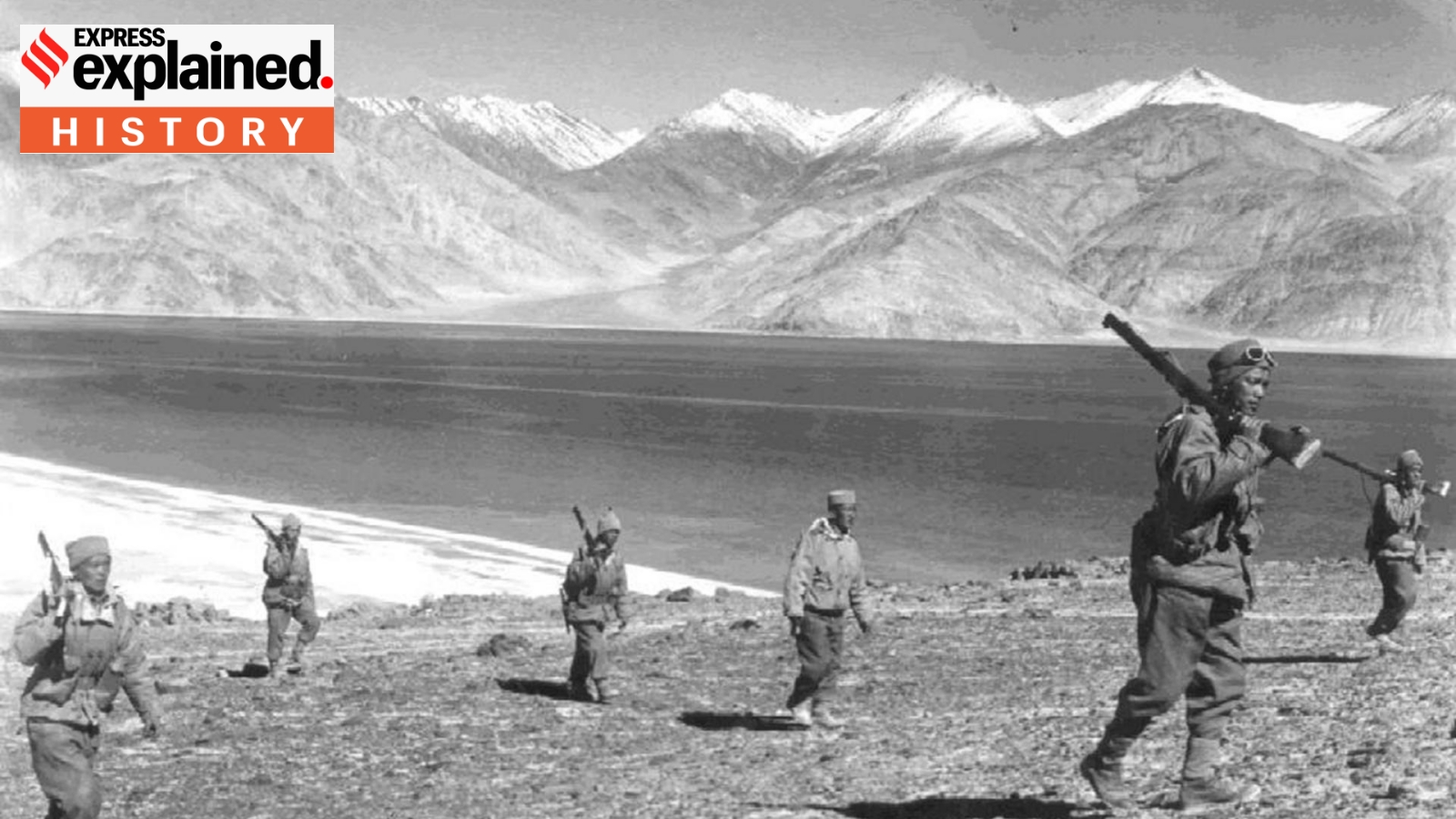
It was a morale-sapping defeat for India. Although ill-equipped with poor logistical support, the Indian Army fought back courageously under the most testing conditions. At Walong in the eastern sector, the Indian soldiers resolutely stood their ground, making the Chinese pay a heavy price.
In Ladakh, too, Indian troops defended isolated positions under heavy odds. The battle of Rezang La, fought on November 18, is testimony to the unparalleled courage of the men of the 13 Kumaon's C Company under Major Shaitan Singh, who literally fought to the last man and the last bullet.
The enduring lessons of the past
The defeat in 1962 was not for lack of courage among the Indian soldiers but a larger systematic failure of preparedness. The debacle triggered a fundamental reassessment of India's security and defence preparedness. It became a defining reference point in the evolution of India's strategic thinking.
Today, national security demands synergy among all the elements of national power, a documented national security strategy, integrated war-fighting doctrines and unified organisational structures. Deep-rooted transformation of the armed forces is no more an option but an imperative.
The border dispute with China remains unresolved, with Beijing's persisting claims over Arunachal Pradesh and Ladakh. The PLA has developed extensive dual-use infrastructure in Tibet and along the LAC, enabling rapid mobilisation of its forces. China's current strategy combines conventional military power with "grey zone warfare" -- cartographic assertions and nibbling actions designed to alter the status of the LAC without triggering full-scale war.
The intrusions in 2020 in Eastern Ladakh demonstrated that dangers of escalation persist. India's response, therefore, must go beyond merely reacting to tactical incursions but ensuring effective border management; incorporating constant intelligence, surveillance and reconnaissance (ISR); and building up resilient logistics and all-weather connectivity. More importantly, India needs capacity to deter aggression and prevent escalation.
The relevance of the 1962 war lies in the lessons it offers, rather than the painful memory of defeat. To this end, the two most important ones are these: Political aims must be backed by strategic capabilities; and an adversary's intent cannot rest merely on assumptions.
(The writer, a war veteran, has held multiple command assignments on the LAC, served as Defence Attache in China, and the co-authored the book 1962: A View from the Other Side of the Hill)