
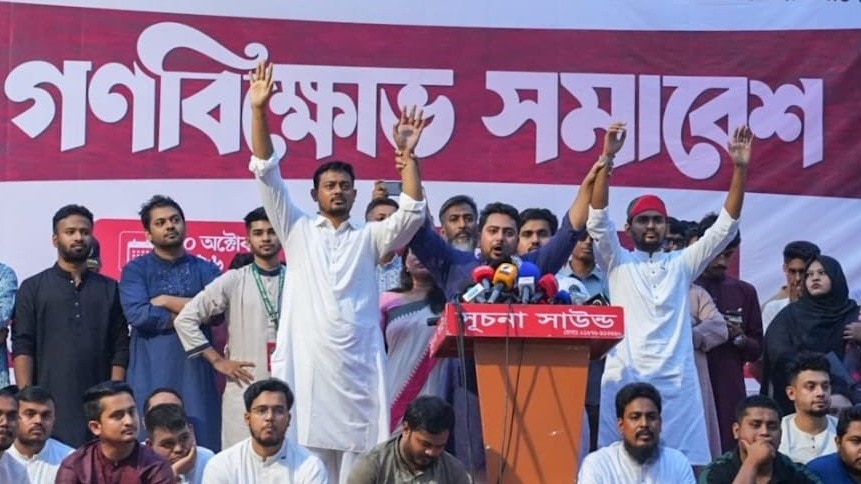
Anti-India rhetoric is rising in Bangladesh as political tensions grow in Dhaka. Protesters at an October 30 rally targeted India over the Ganga water-sharing treaty and regional projects. With Sheikh Hasina planning a December return, many fear these attacks on Delhi could hurt ties between the two neighbouring countries.
From Dhaka's demand for a stronger Ganga water-sharing deal to opposition attacks on the Japan-sponsored Matarbari port, India-bashing is back in Bangladesh. Coming just ahead of Sheikh Hasina's promised return, can the PM Tarique Rahman prevent ties from sliding?
The anti-India rhetoric almost died out in Bangladesh since elections were held in February and Bangladesh Nationalist Party (BNP) chief Tarique Rahman emerged victorious to become the prime minister. Months later, Delhi is finding mention in political speeches and chants in Dhaka due to a mix of political, economic and diplomatic reasons. Two of the key reasons are the Ganga water-sharing treaty, which is coming up for renewal in December, and aspersions over a Japan-backed regional connectivity initiative involving India. A prolonged economic slowdown and former prime minister Sheikh Hasina's plan to return to Bangladesh in December are contributing too.
The tension was on display at a rally organised by the National Citizen Party (NCP) in Dhaka on October 30. The NCP is the party formed by students who led the violent protests against the Awami League government and forced Hasina to flee to India in August 2024. With the Awami League banned from politics, the NCP teamed up with the Jamaat-e-Islami to contest the polls against the BNP and are the primary Opposition alliance in Bangladesh.
The NCP has called for the resignation of several ministers in PM Tarique Rahman's Cabinet, accusing them of failing to deliver on key promises. Its leaders also accused Rahman of authoritarianism, with one describing him as having come "from London to Dhaka with a plan for how to establish corruption, looting, extortion, terrorism and occupation in the country."
But the gathering also became a platform for criticism of India, with protesters raising the slogan: "Dilli na Dhaka? Dhaka, Dhaka" (Delhi or Dhaka? Dhaka, Dhaka!). Such slogans were heard during anti-Hasina protests and during the interim administratio led by Muhammad Yunus.
NCP convener Nahid Islam accused India of conspiring against Bangladesh and raised allegations of killings along the border and the persecution of Muslims in Assam and West Bengal. He also claimed there were plans to demolish mosques in Delhi. These allegations formed part of a wider attack on what he described as Indian interference in Bangladesh's affairs.
Also present at the rally was NCP leader Hasnat Abdullah, who last year threatened to isolate India's seven northeastern states and provide shelter to "anti-India elements".
The NCP and its leaders have been known for their criticism of India. But the latest rally points to what the NCP and the Jamaat leaders are using to whip up anti-India sentiments. The Bangladesh politicians are using water-sharing pacts and regional connectivity plans to attack India even as disgruntlement spreads due to economic troubles in Bangladesh.
GANGA WATER TREATY SET TO EXPIRE, NCP CHIEF WARNS OF NEW FARAKKA MARCH
One of the major issues being brought up by Bangladesh ministers and the Opposition is the Ganga Water Sharing Treaty with India that is set to expire on December 12.
Signed in 1996 by then prime ministers HD Deve Gowda and Sheikh Hasina, the 30-year treaty governs the sharing of Ganga waters at the Farakka Barrage during the dry season. It provides for an equal split when the river's flow falls to 70,000 cusecs or less. When the flow is between 70,000 and 75,000 cusecs, Bangladesh receives 35,000 cusecs, with India getting the remainder. The treaty also guarantees both countries 35,000 cusecs each during three alternate 10-day periods between March 11 and May 10.
However, the BNP-led government is now seeking an arrangement that gives more water to Bangladesh. According to The Economic Times, Dhaka wants the restoration of the "minimum guarantee" clause of the 1977 agreement, which ensured Bangladesh received at least 80% of its scheduled allocation during lean periods.
The 1996 treaty expires on December 12, and its renewal remains uncertain. The Economic Times reported on October 31 that India was unlikely to renew it automatically without a visit by Tarique Rahman.
Rahman has been invited to visit New Delhi several times but has yet to make the trip. He has, however, visited China as part of a trip to Malaysia.
The water-sharing issue has also become a rallying point for the opposition NCP. At the October 30 rally, Nahid Islam said Bangladesh would not compromise on its share of Ganga waters, Dhaka-based Prothom Alo reported.
On November 1, Nahid posted on X: "No water, no transit", warning that Indian goods would not be allowed to pass through Bangladesh and that there would be no corridors or transit facilities if India denied Bangladesh its rightful share of river waters.
He also invoked Maulana Abdul Hamid Khan Bhashani's Farakka Long March of 1976, organised to protest India's diversion of Ganga waters through the Farakka Barrage. "Our sovereignty and water rights are non-negotiable. If necessary, we will march to Farakka once again," Nahid warned.
JAPAN BANGLADESH INITIATIVE DRAWS ALLEGATIONS OF INDIAN INVOLVEMENT
Another anti-India allegation was levelled as Japan and Bangladesh expanded their industrial and connectivity partnership.
During PM Tarique Rahman's October 26 visit to Tokyo, the two countries agreed to upgrade the Bay of Bengal Industrial Growth Belt (BIG-B) into a broader framework called BIG-B for Shared Prosperity, The Daily Star reported. The initiative aims to boost Bangladesh's industrial and transport infrastructure, with the Matarbari deep-sea port in Cox's Bazar district at its centre.
The agreement has also drawn attention to a separate Japanese plan announced in 2023 to connect India's seven northeastern states to the Bay of Bengal through Bangladesh. The Bay of Bengal-Northeast India Industrial Value Chain Initiative envisages better infrastructure and cross-border trade links, potentially allowing Indian goods to reach Matarbari through Bangladesh.
Dhaka has denied discussing the involvement of any third country in the expanded BIG-B initiative. But the separate connectivity proposal has given opposition parties fresh ammunition to question the government's dealings in regards to India.
At the October 30 rally, Nahid accused the Tarique Rahman government of failing to protect Bangladesh from alleged Indian conspiracies. He claimed the PM had attempted to hand India an illegal corridor during his Japan visit, warning that Bangladeshis would not accept such an arrangement, The Daily Star reported.
Jamaat-e-Islami chief Shafiqur Rahman, who was also present at the rally, questioned the government's position on the proposed Matarbari port, referring to discussions during Tarique Rahman's four-day Japan visit. Bangladeshis must be told the purpose and outcome of the trip, he said, adding that the country "could not be leased out in the name of connectivity", reported Dhaka-based newspaper The Daily Star.
ALLEGATIONS OF FOREIGN CONSPIRACIES IN GARMENT WORKERS' PROTESTS
Bangladesh's economy has nosedived after Hasina was forced to flee in a regime-change operation. Amid high energy prices due to the Middle East conflict, and finding no one to blame, some politicians and police officers in Bangladesh are blaming "people across the border".
Bangladesh has witnessed protests by workers of its ready-made garment sector, a major driver of the economy, with protestors clashing with police, blocking highways and vandalising factories and warehouses.
The workers are demanding higher wages, with the minimum wage having remained unchanged since 2023. The protests come amid a prolonged economic slowdown. The World Bank has projected Bangladesh's GDP growth at just 3.4% in FY2025-26, its slowest since the Covid-19 pandemic. It cited weak investment, declining exports, high inflation and lower public investment, and warned that job creation had stalled while rising prices had pushed an additional 2.1 million people into poverty.
The government has blamed former PM Sheikh Hasina and her Awami League for allegedly orchestrating the unrest. But allegations of cross-border interference have also surfaced. Home Minister Salahuddin Ahmed claimed that people from "across the border" were encouraging workers to create unrest and disrupt garment production and exports.
Similarly, The Daily Star reported several senior police officials as having alleged that "third-party" instigation and "domestic and foreign conspiracies" are behind the violence during garment workers' protests in Savar and Ashulia districts.
Jamaat's Shafiqur Rahman, meanwhile, wrote on Facebook that "conspirators and opportunists" appeared to be "trying to destroy the garment industry by fuelling the unrest", and urged the government to take a firm stance.
ANTI-INDIA SENTIMENT COMES AHEAD OF HASINA'S PLANNED RETURN
The political tensions are also unfolding against the backdrop of Shekh Hasina's plan to return to Bangladesh in December.
Hasina has been in exile in India since fleeing Bangladesh in August 2024. In her absence, the International Crimes Tribunal (ICT) sentenced her to death for crimes against humanity. Dhaka has also repeatedly sought her extradition from New Delhi.
At a press conference in New Delhi in August, Hasina said she would return to Bangladesh in December, one way or another. With that deadline now roughly a month away, her announcement has become another point of contention in Bangladesh's political discourse.
Though banned from politics, the Awami League has a large base of loyal voters and workers.
"We hear that the fallen autocrat is supposedly returning to the country this December! We know that this new autocrat will not be able to confront that autocrat under any circumstances... Therefore, the youth of Bangladesh must unite," Nahid was quoted by Prothom Alo as saying.
The convergence of a water-sharing issue, aspersions over a connectivity project, economic discontent and Hasina's impending return has thus created a politically charged atmosphere in Bangladesh, giving anti-India rhetoric renewed traction. The question is whether Tarique Rahman will be able to prevent bilateral ties from getting impacted.