
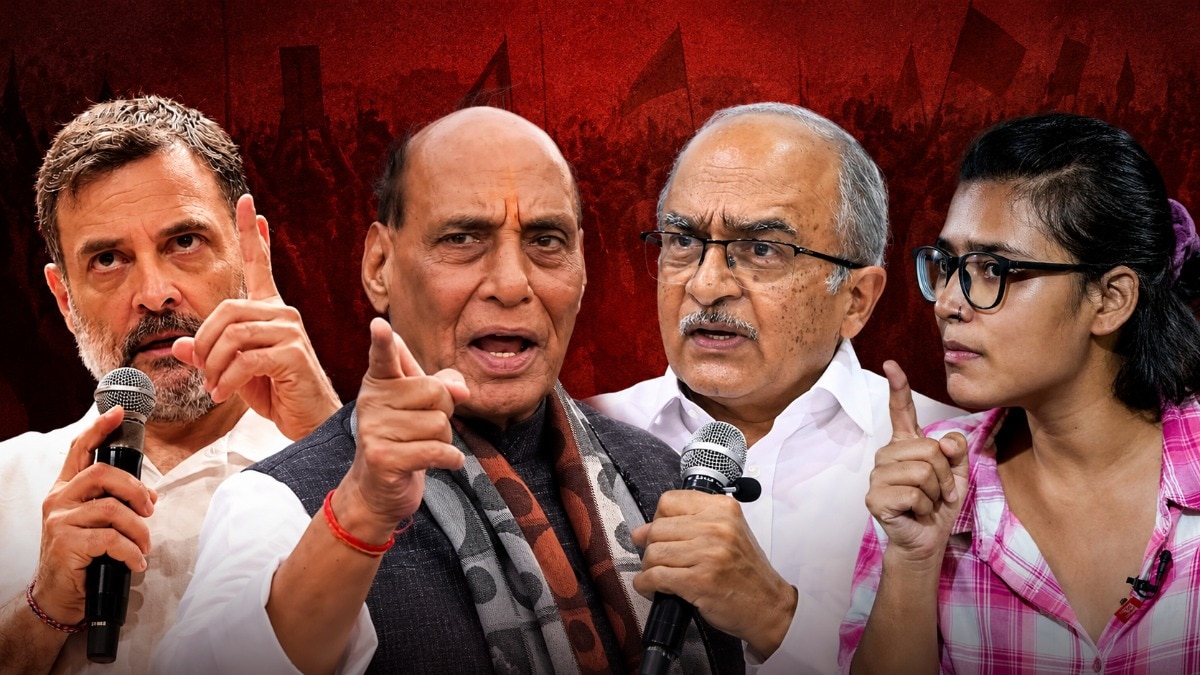
The BJP has warned of a Bangladesh-style regime change bid in India following protests over electoral irregularities. On Thursday, October 15, senior advocate Prashant Bhushan endorsed regime change, sparking a sharp political battle. Congress spokesperson Pawan Khera said, "The Opposition had openly declared its goal of regime change through elections."
Talk of "regime change" has entered India's political discourse at a time when protests over alleged electoral irregularities have brought thousands onto Delhi's streets. The CJP, left-wing student groups and civil society bodies are demanding CEC Gyanesh Kumar's removal, while the Congress is running its own campaign against alleged "vote theft". Amid the stir, the BJP has launched a scathing attack on the Congress, accusing it of misleading the youth and attempting to create anarchy to bring about regime change in India.
The BJP has also warned of an attempt to replicate Bangladesh's 2024 protests, which forced PM Sheikh Hasina out of power. The BJP's concerns have been triggered by AISA chief Neha Bora's praise for Bangladesh's anti-Sheikh Hasina protests and senior advocate Prashant Bhushan's public endorsement of "regime change". The ruling party has linked these statements to Rahul Gandhi and the Opposition-backed protests demanding the removal of Gyanesh Kumar. It all began as an agitation over SIR and Gyanesh Kumar. Now, there's a raging political battle. Are the protesters defending India's democracy as they claim, or are they seeking to destabilise an elected government, as the BJP is claiming?
The trigger was Bhushan's statement at a joint press conference in Delhi on Thursday, October 15, a day before the CJP planned Tricolour march. On Friday, Defence Minister Rajnath Singh led the BJP's attack on the Congress, accusing it and its allies of encouraging Bangladesh-style regime change through street mobilisation.
The BJP has also targeted YouTuber Dhruv Rathee over his remarks concerning the Army and police, with BJP MP Sambit Patra saying, "There can be no bigger anti-national than him."
Meanwhile, Congress spokesperson Pawan Khera mocked Rajnath Singh as "Jagga Jasoos" and "Sherlock Holmes", saying the Opposition had openly declared its goal of regime change through elections, just as happened in 1977 after the Emergency.
"Every time an opposition comes out on the streets, there is a movement, there is a regime change," said Khera, explaining that the Opposition sought regime change through elections.
The row comes against the backdrop of police action against protesters, disputes over the SIR of electoral rolls and growing political mobilisation involving students, lawyers and Opposition parties. Allegations of foreign influence have come from the BJP's highest ranks. Its national president, Nitin Nabin, has accused the Congress and the CJP of acting at the behest of foreign powers. So, where did the talk of regime change begin, who said what to fuel the controversy, and how has the BJP responded with accusations of a Bangladesh-style attempt to destabilise the Narendra Modi government?
WHAT DID PRASHANT BHUSHAN SAY ABOUT REGIME CHANGE?
At a Thursday press conference at New Delhi's Press Club of India, Prashant Bhushan appeared alongside CJP founder Abhijeet Dipke, AISA president Neha Bora, Rajya Sabha MP Kapil Sibal, actor Prakash Raj and other activists. The meeting was convened to address alleged electoral irregularities in the Election Commission, police action against protesters and demands for CEC Gyanesh Kumar's resignation.
"This government keeps on saying this is the opposition's operation of regime change. We are only appealing to save the electoral democracy in this country. If such barbarism continues, there will definitely be a regime change. We all want a regime change. Is there anything wrong with that? Regime change is a democratic right of every citizen, and creating disaffection against the government is not an offence," Bhushan said, defending the constitutional right to seek a change of "regime."
"We all want regime change. Getting regime change is every citizen's constitutional right," he added.
His remarks gave the BJP an opportunity to argue that the anti-SIR and anti-CEC protests' objectives are beyond just electoral reforms.
HOW BANGLADESH ENTERED THE CONTROVERSY
A comparison of the protests in India with Bangladesh's anti-Sheikh Hasina agitation of 2024 had already gained traction before Bhushan's remarks. On October 14, AISA president Neha Bora praised Bangladesh's 2024 anti-Shekh Hasina protests in a video message to the sixth national conference of the country's Socialist Students' Front. Bora was among those who went on a hunger strike at Jantar Mantar demanding Dharmendra Pradhan's resignation as Union Education Minister.
"We know that the Gen Z movement that we are seeing in India first started in Bangladesh. Congratulations to you for showing us the way," Bora said. "We extend our solidarity to you. We take inspiration from you, lessons from the movements that you lead," Bora added.
Her remarks were circulated on X by BJP spokesperson Pradeep Bhandari on the same day.
"Neha Bora, Rahul Gandhi's poster girl says 'Bangladesh showed us the way' for the Revolution! This is Open Admission to Regime Change! Rahul Gandhi & Co are a threat to Indian Democracy!" Bhandari said, a day after the AISA leader from JNU appeared in a joint press conference with the Lok Sabha LoP.
Bangladesh's student-led protests began in July 2024 over government job quotas, but a deadly crackdown, mass arrests and internet shutdowns turned the agitation into a nationwide movement demanding Sheikh Hasina's resignation. On August 5, protesters, reportedly backed by Islamists and foreign forces, marched towards Dhaka in a final push that forced Hasina to flee to India, ending her 15-year rule.
Bora presented the Bangladesh protests as an inspiration for struggles over democratic and voting rights. The BJP interpreted the reference as an endorsement of the methods that removed Hasina from office.
Meanwhile, on social media, allegations that the Ford Foundation and the CIA are also involved in the regime change bid, have added another dimension.
BJP SEES BANGLADESH-STYLE REGIME-CHANGE PLOT BEHIND CONGRESS, CJP PROTESTS
The BJP sees Prashant Bhushan's and Neha Bora's remarks as part of a larger pattern involving CJP protests, Left-wing student mobilisation and Congress's "vote theft" campaign against the Election Commission. The BJP's attacks point to its wider allegation that these protests, coupled with criticism of constitutional institutions and references to Bangladesh's protests, are part of a coordinated attempt to destabilise the Modi government through street unrest.
On October 15, spokesperson Pradeep Bhandari alleged that Bora's comments reflected the thinking of Rahul Gandhi and his political associates. "This is an open admission of regime change. Rahul Gandhi and Co. are a threat to Indian democracy!" Bhandari wrote on X.
The party argued that attempts to undermine confidence in the Election Commission, combined with mobilisation on Delhi's streets, could create conditions resembling Bangladesh's political turmoil.
A day later on October 16, Defence Minister Rajnath Singh escalated the BJP's attack at a press conference in Lucknow. Singh accused Congress and its allies of using young protesters to create political instability. "The young of the country are being made pawns in the politics of anarchy," he said.
RAJNATH SINGH LEADS BJP'S CHARGE; TOP LEADERS ATTACK CONGRESS OVER REGIME-CHANGE
Rajnath Singh argued that the references to Bangladesh and regime change indicated an agenda extending beyond the SIR controversy. He accused the Opposition of attempting to dismantle democratic institutions and said political change must respect constitutional processes.
"India's future is everyone's responsibility. We must choose the path of dialogue and nation-building, not confrontation," Singh said.
His attack amplified the BJPs' charge on the Congress and the CJP without naming them much. Now it was time for the government's senior-most ministers and the BJP's top leadership.
Maharashtra Chief Minister Devendra Fadnavis also attacked the protesters, saying, "After all, it was all about Regime Change." He alleged that the objective was to grab power by provoking students and farmers, spreading hatred along caste and linguistic lines, and tarnishing the image of constitutional institutions. "Spreading anarchy under the guise of a movement is precisely their objective," he wrote on X.
Goa Chief Minister Pramod Sawant also accused the Opposition of pursuing a "regime-change agenda", saying Prashant Bhushan's remarks raised questions about whether political change was being sought through elections or "extra-constitutional agitation". Invoking Prime Minister Narendra Modi, he said the path to power lay in winning public trust and securing an electoral mandate. "In India, governments are changed by the people through the ballot, not by force or by bypassing the Constitution," Sawant wrote on X.
BJP MP Sambit Patra said, "Prashant Bhushan stated that this struggle is about regime change. Let me be very clear. This country is not anyone's private property. It does not belong to any single family. It belongs to 1.4 billion people. When they say they are fighting for regime change, it confirms what the BJP and ordinary citizens of this country have been saying all along. The true intent of Rahul Gandhi and his associates has nothing to do with the SIR issue, nor are they fighting for the future of our children."
BJP leader and Rajya Sabha MP Vinod Tawde alleged that the use of the term "regime change" made it clear that the Congress and Opposition's agitation was not about the Special Intensive Revision (SIR) of electoral rolls, but a conspiracy to seize power by creating "anarchy" in the country.
In a way, Neha Bora's and Prashant Bhushan's remarks have handed the BJP fresh ammunition in a controversy that had centred on the SIR and demands for CEC Gyanesh Kumar's removal. The ruling party now appears to have seized the initiative, with its top leadership lining up to attack the Congress, which until recently had seemed to be on the defensive over alleged electoral irregularities.
Then, on Thursday, Congress spokesperson Pawan Khera hit back at Defence Minister Rajnath Singh over his allegations of a regime-change agenda. He said that the Opposition had never concealed its objective of defeating the BJP government through elections. "We are saying that we will change the regime, sir," Khera said, mocking Singh as "Jagga Jasoos" and "Sherlock Holmes" for presenting the Opposition's stated political goal as a revelation.
Referring to the Congress's defeat in 1977, he asked, "What happened in 1977? The regime did not change?"
"Every time an opposition comes out on the streets, there is a movement, there is a regime change," said Khera. "How does a regime change in a democracy like India? Through elections. The purpose is to change the regime through elections, what other purpose does the opposition have?"
CJP DISTANCES ITSELF FROM REGIME-CHANGE CALL
Interestingly, CJP founder Dipke has rejected the suggestion that changing the government is his organisation's objective. At a late-night press conference on Thursday, Dipke said the CJP wanted Gyanesh Kumar removed and an independent appointment made.
"We are just asking for accountability," he said.
"We are not saying we want a regime change... We are just saying that we will remove Gyanesh Kumar and appoint a new election commissioner in an independent, unbiased manner... Is this a crime?" said Dipke.
While Dipke sought to distance the CJP's demands from the Congress and Neha Bora, who have supported his movement, the BJP has clubbed them together as part of a larger campaign allegedly led by Rahul Gandhi to mislead young protesters and engineer a Bangladesh-style regime change in India.
For context, according to the Oxford English Dictionary, "regime change" refers to the replacement of a government or political system, often through force or external intervention. But, the term is also used colloquially for a change in political leadership.
In a parliamentary democracy like India, a change of government through elections is the constitutional process, while attempts to bring one down through coercion or violence raise different questions. Prashant Bhushan defended regime change as a democratic right. While the remarks can be interpreted as a call for legitimate political change, as he argued, but against the backdrop of street protests and references to Bangladesh's uprising, they have rightfully given the BJP grounds to question whether the intended route to that change is electoral or something beyond it.
Politically, the controversy appears to have shifted the focus from the BJP, which was facing questions over the SIR and the Election Commission, to the intentions of those leading the protests. Prashant Bhushan's regime-change remarks and Bora's Bangladesh reference have given the BJP an opportunity to portray otherwise distinct agitations as part of a larger anti-government campaign. Dipke has been forced to clarify the CJP's objectives.