
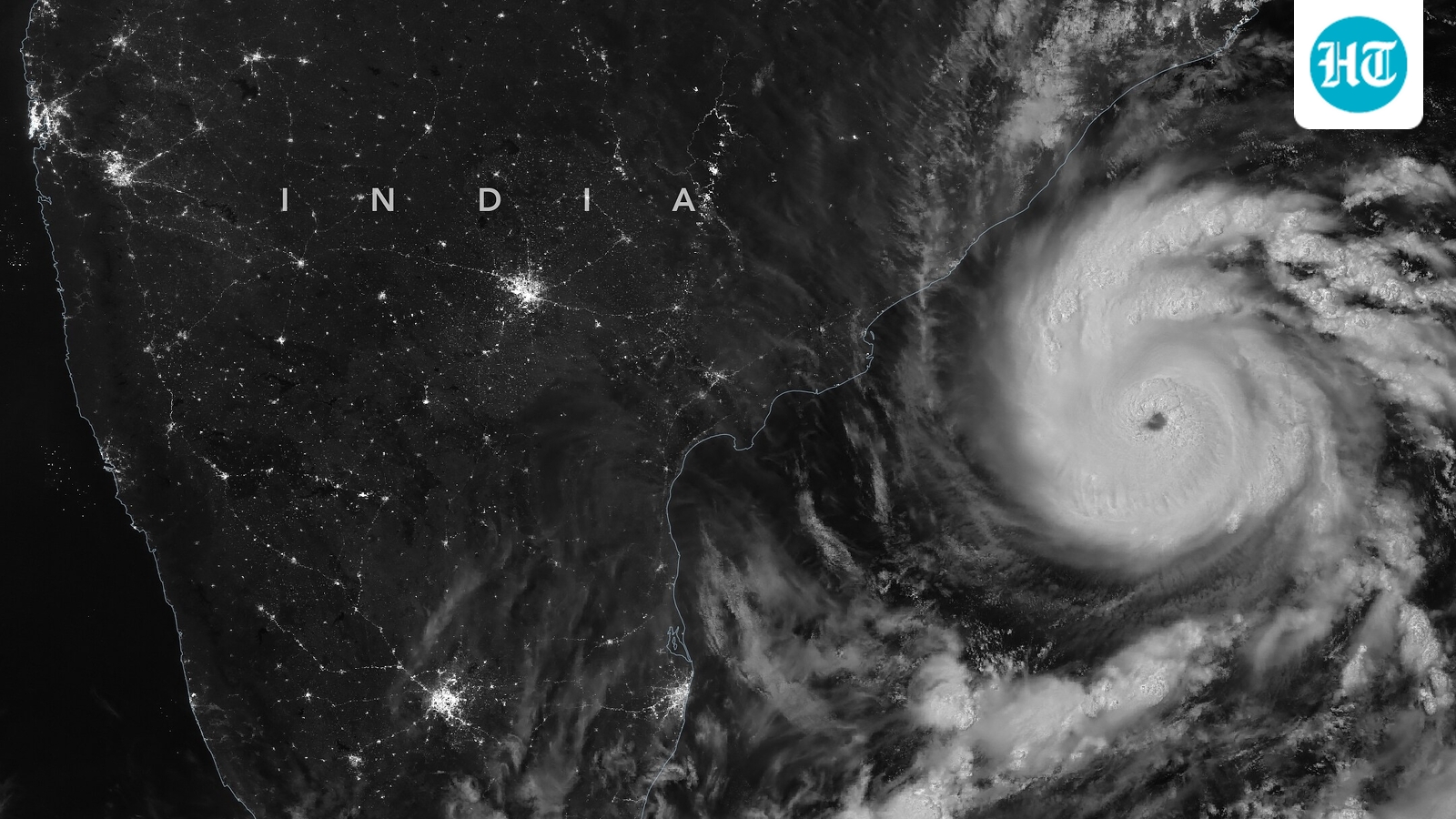
The India Meteorological Department said the deep depression intensified into Cyclonic Storm Murasu on Sunday. It will hit the Andhra Pradesh coast on November 3 with strong winds. "At present, we expect this to form into a cyclonic storm," said Mrutyunjay Mohapatra. The name refers to a traditional percussion drum.
The India Meteorological Department (IMD) on Sunday said the deep depression over the southwest and adjoining west-central Bay of Bengal had intensified into Cyclonic Storm 'Murasu'. The storm is likely to make landfall along the Andhra Pradesh coast in the early hours of November 3, with wind speeds reaching 80-90 kmph and gusting up to 100 kmph.
The development comes days after Cyclone Arnab battered parts of Andhra Pradesh. IMD director general Mrutyunjay Mohapatra said there was also a slight possibility of the storm intensifying into a severe cyclonic storm, although the current forecast indicates a cyclonic storm.
"At present, we expect this to form into a cyclonic storm. Once formed, it will be named as Murasu. There is a slight possibility it may turn into a severe cyclonic storm too, but at present, our forecast is for a cyclonic storm, which should hit the Andhra coastline on the morning of November 3," Mohapatra said.
Follow Cyclone 'Murasu' live updates here.
But what does 'Murasu' mean, and why has the storm been given this name?
The name 'Murasu' was proposed by India as part of the regional cyclone-naming system. According to a report by Mathrubhumi, the Tamil word refers to a traditional percussion drum and an ancient musical instrument. Historically, the drum played an important social role, as it was used to communicate public information and make announcements across villages and kingdoms.
Cyclones are not named randomly. Their names are selected through a structured international system coordinated by the World Meteorological Organisation (WMO).
According to the WMO, naming "tropical cyclones has proven to be the fastest way to communicate warnings and raise public awareness and preparedness." It also helps meteorologists, governments and emergency agencies track storms and avoid confusion, particularly when multiple weather systems are active at the same time.
The Regional Specialised Meteorological Centre (RSMC) in New Delhi is responsible for naming the tropical cyclones that have formed over the Bay of Bengal and the Arabian Sea when they have reached the relevant intensity. A panel of 13 member countries contributes to this system. They are: Bangladesh, India, Iran, Maldives, Myanmar, Oman, Pakistan, Qatar, Saudi Arabia, Sri Lanka, Thailand, United Arab Emirates, and Yemen.
India's contributions include names such as Gati, Tej, Murasu, Aag, Vyom, Jhar, Probaho, Neer, Prabhanjan, Ghurni, Ambud, Jaladhi and Vega.
Cyclone names are used only once. However, the procedure for selecting names differs across regions.
Cyclone Arnab, which hit the Andhra Pradesh coast on October 28, 2026, was named by Bangladesh. Pronounced 'Ornab', the name means ocean in Bengali.
Cyclone Montha, which made landfall near Kakinada and Narasapuram along the Andhra Pradesh coast on October 28-29, 2025, was named by Thailand. The name means a fragrant or beautiful flower in Thai.
Cyclone Shakthi, a severe tropical storm that formed over the Arabian Sea in October 2025, was named by Sri Lanka. Unlike the commonly used Indian term "Shakti", meaning "power" or "strength", the spelling with an 'h' reflects Sri Lanka's transliteration preferences and the agreed-upon naming conventions.