
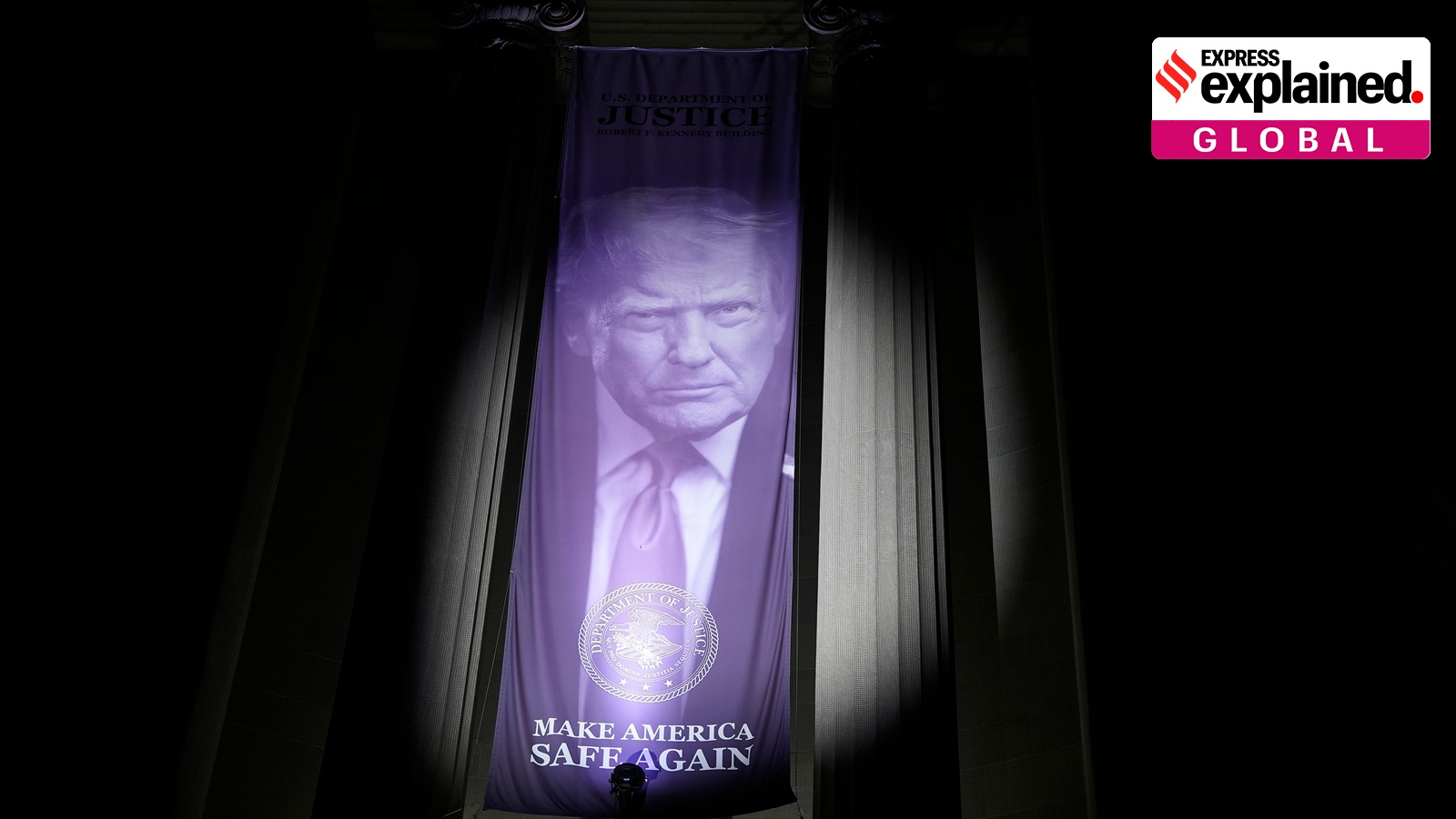
President Donald Trump suffered a big rebuke in the US Midterm Elections Results 2026, with the Republican Party facing defeat in both the US Senate and the House of Representatives. "I am absolutely willing to accept those results," he said. Rising costs of living caused many voters to shift support.
In 2020, Trump lost the election, but large parts of America still saw him as a President who cared for his supporters. In US Midterm Elections Results 2026, he has lost what are Republican constituencies. Here's what the likely impact.
US Midterm Elections Results 2026: Two years into one of the most unpredictable and chaotic US presidential terms in post-World War II history, President Donald Trump has suffered a big rebuke, with the Republican Party facing defeat in both the US Senate and the House of Representatives.
Widely billed as a referendum on Trump's second term, the US midterms have dealt a striking blow to his actions, which have affected the US and the world, including India.
Though votes are still being counted and the final results would take a few days to be certified, it is fair to say that America -- after two full years of Trump's rule -- has made a course correction.
Trump has been gracious enough to accept the poll outcome as results poured in -- "I am absolutely willing to accept those results," he said in an interview with The New York Times. This is a far cry from January 6, 2021, when he encouraged his supporters to storm the US Capitol after losing the election to Democratic presidential candidate Joe Biden.
Here are the major takeaways from the US midterms:
First, Trump faces his biggest drubbing since 2020. That year, he lost the election, but large parts of America still saw him as a president who cared for his supporters. This time, he has lost what are usually Red states -- primarily Republican constituencies -- and that means that he has lost a significant part of his base in those Red states as well.
Second, Trump gained in 2024 in areas that traditionally voted Democratic, including among African Americans, the Hispanic community and Indian Americans. Their main grievance was the rising cost of living -- the cost of eggs had become the key barometer. That has waned in the last two years.
Third, the key reason for losing these seats and constituents is affordability and the rising cost of living. Ordinary people -- Republicans, Democrats and undecided voters alike -- all suffered from rising petrol, diesel and gas prices in the US. This was especially acute in the Midwestern states, which are largely rural, where people drive gas-guzzling cars and travel long distances to reach markets, hospitals, schools and other amenities. They felt the pinch. This was due to the war in West Asia that the US and Israel launched against Iran in February. The cost of the war wasn't abstract or far away; ordinary Americans felt it each time they filled their cars at petrol pumps and gas stations.
Fourth, the war in West Asia -- or the Middle East, as Americans call it -- shocked and surprised MAGA (Make America Great Again) Republicans, who had heard candidate Trump promise to end the "never-ending and endless wars". As President, he waded into the conflict without weighing the pros and cons. The result was eight months of war, with the Strait of Hormuz becoming a chokepoint and gas prices rising. This was a completely different scenario than he had imagined. And his voters were bitter at the experience.
Fifth, the US President came across as corrupt and interested in making money through his business interests and those of his family and friends. Be it the crypto deals, or the deals in the Gulf or in critical minerals in Pakistan, or influence and the lobbying industry in the US for tech titans and granting pardons for many, it all amounted to a windfall for the President's wealth -- his personal riches grew by USD 2.2 billion in the first year alone -- a massive USD 6 million a day. This was unprecedented for any sitting US President and the voters didn't forgive him.
Sixth, his crackdown on illegal immigrants hurt the fabric of American society, a mosaic of immigrant communities, including Hispanics, African Americans, Asians and, of course, Indians. This did not go down well among the Republican base as well, which had voted with their feet in favour of Trump in 2024. The ICE raids -- which he renamed as NICE raids -- backfired as women and children were picked up from homes and schools, and deported to countries where they did not belong.
Seventh, the executive power he wielded to slap tariffs on countries across the world added to the cost of living, since the tariffs amounted to a tax on his own citizens. This was another self-goal which led to rising prices across commodities, which were imported from countries far and near: from China to Canada, India to Mexico -- all making their way to the US.
Eighth, Americans disliked his attempts to dominate institutions ranging from the judiciary to the US Congress. The American system has long relied on checks and balances on executive power. This diminishing of guardrails was felt by Americans across the board, and they could see the President being unchecked and causing harm to their society and the country.
Ninth, many were also disgusted by his association with Jeffrey Epstein, and while he had been found in the company of questionable credentials in the past, and has made many profanities and abusive language earlier, the moral corruption that the pictures of the Epstein files demonstrated also had an impact on the middle class Americans.
Tenth, the election of so many Democratic Congressmen and women will open up the space and the race for new leaders in the party, which had to marshal former US President Barack Obama to run its campaign. It will have a new crop of leaders now, who will be candidate hopefuls for the US Presidential elections in 2028.
So, what do the midterm results mean for Trump, the world and India?
Trump is not going to be the usual lame-duck President that the US is used to, and that is something that the world will be bracing for in the coming months.
Foreign policy pivot
Traditionally, presidents hemmed in by the opposition in Congress have pivoted to foreign policy. This might unleash a President who has been reckless in his adventurism in West Asia.
So, as right-wing political commentator Tucker Carlson, who was once a Trump supporter, has indicated that Trump might launch nuclear strikes -- while that may or may not play out, but what is certain is that he will not sit back and would want to dominate the headlines through foreign policy moves.
A Democratic-controlled US Congress, both House and Senate, could mean that his powers will be checked by stopping the funding to the war, but the President has wartime executive powers to carry on with the budget that has already been assigned.
Economic impact and investigations into shady deals
India would be affected if the war drags on and energy prices remain high or rise further, draining its economic growth.
For many Democrats, a flip in the US Congress would mean more investigations and hearings to be launched against Trump and his crony capitalist friends and family. This could open up the space for investigations into the crypto deals and the critical minerals deals, and hotel and Trump tower deals that have been made in the last couple of years.
While this may drag the Pakistan military into the dragnet of investigations, it may also cast its net on Indian businesses who have dealt with the Trump family and his friends, and the administration has been favourable to them.
Tariff powers and its consequence
The power to impose tariffs which Trump has amassed, and the US Congress had delegated to the American President in the last couple of months, will be an area which India, China and the world will look at. Since the era of tariffs and trade wars had meant a setback to the era of predictability in the global economy, this is something that Delhi and other world capitals will be watching on. Whether the US Congress wrests control of the tariffs powers will be something that will interest Delhi.
The Indian government has been dragging on the negotiations with the US administration on the trade deal, and the mid term outcome will not have an impact -- as Washington will be seen to be in a weaker position.
Anti-immigration crackdown
The last two years have seen a rise in anti-immigrant racism and restrictions. The pushback against anti-immigrant crackdown will serve as a reminder to the US administration that the immigrant communities have tremendous veto power, and so do the big businesses. The restrictions on the H1B visa, the curbs on student visas and OPT, and other such restrictions on movement of people -- these are going to be areas of interest for India and the world. How does the Democrat-controlled Congress deal with these issues of law and order versus flow of regular immigrants who are among the best and the brightest from the world and want to travel to the US to study and work. This will be a live issue for many immigrant communities, which are getting elected as African-Americans and Indian-American get elected in the US Congress and from the states.
Trump's approach towards China and Russia
While the war in West Asia has sucked oxygen from the debate, the key geopolitical focus for many in the world and India, will be Trump's approach towards China and Russia in the next two years. His relationship, strategy and approach towards Chinese President Xi Jinping will be consequential for the world, and India.
Especially since many in Delhi have started questioning their strategy towards Beijing, and have perceived to be soft, in the second term.
Europe will be looking at his strategy towards Russian President Vladimir Putin, especially since the war in Ukraine has been grinding on for almost five years -- it is longer than the first World War, and the Transatlantic partnership has frayed.
Any attempt to cut deals with both China and Russia will have repercussions on its long-time partners and allies alike.
Focus on AI
One important strategic area in which the world will be watching US policy is AI. The Trump administration has put a great amount of focus and priority on AI, with its use and control of semiconductors, and building data centres. They have got some pushback from areas where the data centres are coming up, and one will have to see how the US administration responds to that challenge. But, its control of access to technology vis-a-vis China will also be watched, since many would oppose Chinese state-controlled hegemony of AI in the larger scheme of things.
India's human rights record under lens with Democrat-controlled Congress
With a Democrat-controlled US Congress, India will be under stronger scrutiny from the American political class over the human rights issues in India -- from state of religious freedom to voter registration to the treatment of minorities. This will be a political challenge for the Indian government led by Prime Minister Narendra Modi, who will have to deal with Democrat Congressmen and women who have been questioning the handling of protests by students, Opposition and the civil society alike.
Time to look for next Presidential candidates
The race to become the US presidential candidate in 2028 has officially begun. With the midterms out of the way, the playing field from the Republican side will take a hard look at the Vice President J D Vance and Secretary of State Marco Rubio who will have to distance themselves from Trump in the next two years so that they can run the race without Trump's baggage.
And, on the Democratic side, there will be a plethora of new names, apart from the traditional establishment candidates, which everyone will take note of.
Delhi's team at the embassy in DC and the eight consulates beyond the American capital have their task cut out for the next two years.