
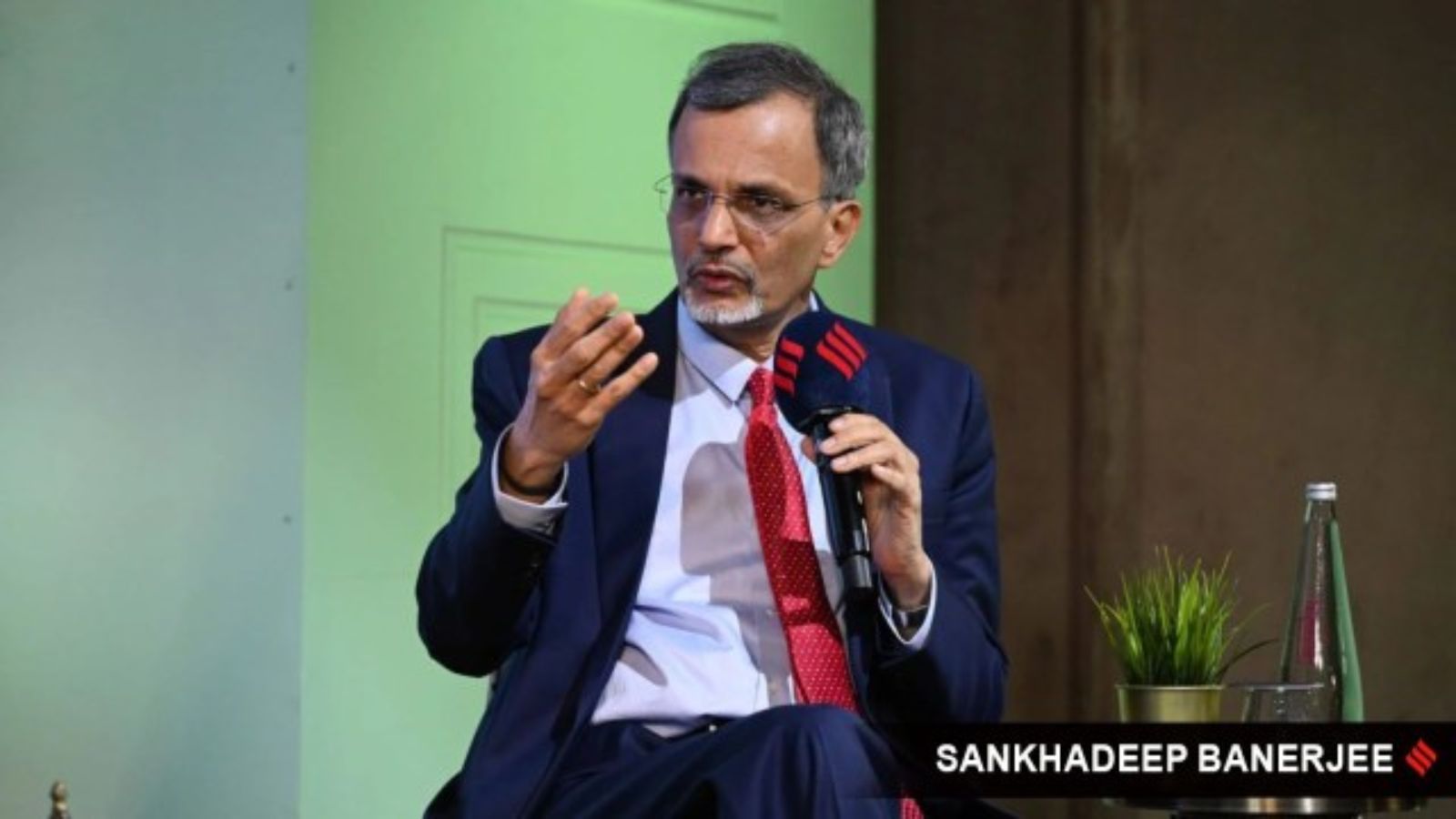
Chief Economic Adviser V Anantha Nageswaran said on Thursday that the US is colder towards India as it views the nation as a resource rival. He noted that geopolitics will mess with economic goals over the next 20 years. Meanwhile, a trade agreement remains just a few minor punctuation points away.
According to the Chief Economic Adviser, a trade agreement with the US seems to be "just a few minor punctuation points away".
The second Trump administration has been "colder" towards India because it sees it as a rival in the market for resources, according to Chief Economic Advisor (CEA) V Anantha Nageswaran, who added that geopolitics will "mess with our economic goals over the next 20 years".
"Many people expected Trump 2 to be similar to Trump 1 vis-à-vis India. But Trump 2 has been relatively colder, even hostile on occasion... The reason why the US is viewing India in some cases as a partner and in some cases as a rival is because India will also be in the market for resources. And developed nations want to bring manufacturing to their own shores and they need resources," the government's top economist said on Thursday the Indian Statistical Institute-Delhi's Delhi Macroeconomics Workshop, organised by India Sustainable Growth Hub.
"It is not that you are anti-China, part of Quad, and therefore you are with me. No. Sometimes you are with me and sometimes you are going to be a rival for me as well. That is why you have to understand how geopolitics will now mess with our economic goals over the next 20 years," he further said, adding that US Secretary of State Marco Rubio's recent visit to Jamnagar and Mumbai, and not New Delhi, is "part of the game of figuring out whether you are part of Bloc A or Bloc B".
"It is all about what resources you can provide - the refining capacity in India becomes a leverage," he said, adding that the quest for Greenland and Venezuela and to make Canada the 51st state should all be understood from the perspective of the need for real resources.
The CEA's comments come amid continued messages from the Indian and US government that the negotiations over a trade deal are almost complete, with Nageswaran himself saying on Thursday that the agreement seems to be "just a few minor punctuation points away". And despite discussions over the trade deal, the US and India have enjoyed a fractious relationship over the last one-and-a-half years or so, including the imposition of a 25% penal tariff last year for the purchase of Russian arms and energy products.
According to Nageswaran, the worst type of shocks will now be "by design", with the 21st century to see a "violent" world due to the battle over resources such as rare earths and semiconductors. Further, open trade, peace, and plentiful supply "can no longer be assumed; in fact, they should be assumed away".
This competition for resources is not limited to developing counties, Nageswaran warned. With advanced economies looking to bring back the manufacturing they have outsourced over the years, developing and developed countries are rivalling each other for funds.
"Just to give an example, in September, Canada hosted an investment summit, looking for $1 trillion of investment. Next month, Germany is going to do it. We would have thought that we are competing with other emerging economies for FDI. But we are going to be competing with countries which were earlier thought of as providers of capital, but are now in the market for capital themselves," he said.
While India continues to receive record amounts of Foreign Direct Investment in absolute terms, the number has come down sharply in recent years on a net basis due to Indian companies investing more abroad and foreign investors taking back home previously invested money. So far in the first five months of 2026-27, while gross FDI has been $54.93 billion, up 21% year-on-year, net FDI was $13.79 billion, up 43%. This is a big improvement from 2025-26, when net FDI was just $6.71 billion after coming in at under $1 billion in 2024-25.
However, Nageswaran remains optimistic about the Indian economy, saying that the impact of the various trade agreements that have been signed and yet to become operational has not yet played out. According to him, some of these new agreements have a lot of scope for labour intensive manufacturing and services products.
At the same time, for the beneficial impact to sustain, India needs to build buffers for resources beyond crude oil and create frameworks for their release. He listed industrial metals, fertilisers, and active pharmaceutical ingredients (APIs) for which buffers need to be created. "That is a policy we have to focus on. Without that, there is no manufacturing growth."