
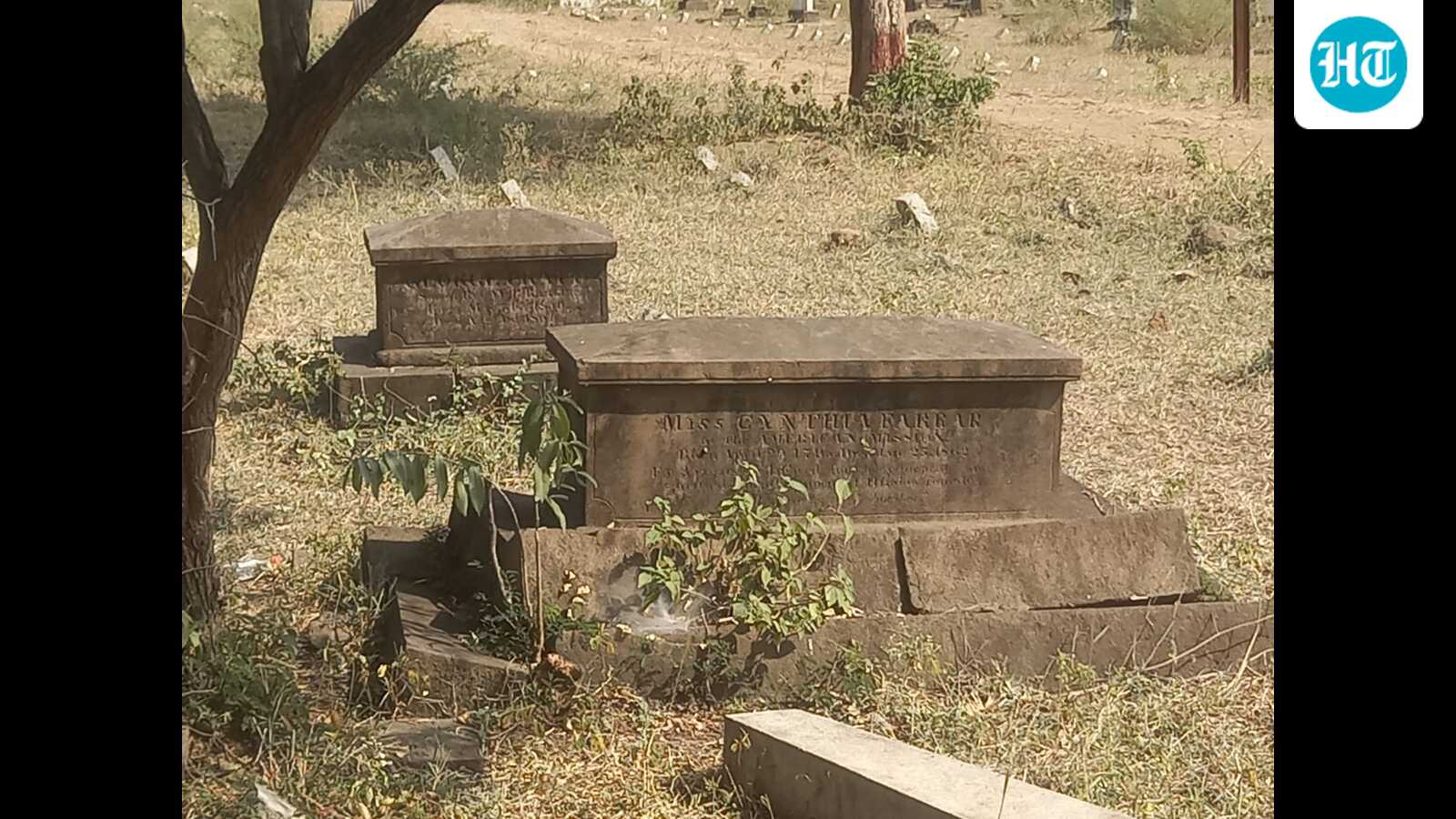
Three history enthusiasts found the tomb of American missionary Cynthia Farrar in Ahilyanagar on October 16. The team searched for five years before finding her grave near the fort. Wagh said, "We searched through around 500 to 550 graves, one by one." Her work influenced early girls' education in Maharashtra.
After nearly five years of rummaging through hundreds of graves and historical records, three history enthusiasts have chanced upon the tomb of American missionary Cynthia Farrar in Ahilyanagar; restoring a missing physical link to a pioneering chapter in Maharashtra's girls' education movement.
The stone tomb - discovered on October 16 at an old, British-era cemetery near Ahilyanagar fort - bears an inscription commemorating Farrar and her work of 35 years towards the education and spiritual enlightenment of Hindu women. Farrar's educational work in the region bears early influences such as those of Mahatma Jyotirao Phule's efforts to establish schools for girls in Pune.
The trio of Abhijit Wagh, Bhairavnath Wakale and Asif Khan Dulekhan - members of the Ahilyanagar Itihas Premi Mandal - spent four to five years trying to establish the location of Farrar's grave. Although historical accounts record her death in Ahilyanagar in 1862, the researchers could not initially trace her final place of rest. They searched a cemetery near Lal taki in Siddharthnagar where the graves of reverend Narayan Waman Tilak and American missionary Samuel Fairbank are located, but Farrar's tomb wasn't there. The breakthrough came when the team stumbled upon Farrar's name in British-era burial records listing 465 people and their burial locations in Ahilyanagar; leading them to the old cemetery near Damdi masjid, close to Ahilyanagar fort.
"We had been searching for four to five years. We were looking for information in old books and records, but we could not establish the exact location of her grave. When we found the British records, we got a clear lead and decided to search the cemetery again," Wagh said. "On October 16, we went to the cemetery and started checking the graves. We searched through around 500 to 550 graves, one by one. At around 10 am, we finally found the tomb. Farrar's name was clearly engraved on the stone," Wagh said.
The inscription reads, "In memory of Miss Cynthia Farrar of the American Mission born April 20, 1795 died January 25, 1862. For 35 years, she laboured for the education and spiritual enlightenment of Hindu females. Her works do follow her," Wagh added. Following the discovery, the researchers cleaned the tomb, offered flowers, and paid their respects to Farrar.
Khan Dulekhan, president of the Ahilyanagar Itihas Premi Mandal, said, "The inscription on Farrar's tomb itself mentions that she worked for the education and spiritual enlightenment of Hindu women. Her work was focused on bringing women into education and social progress."
Born on April 20, 1795, Farrar arrived in Bombay on December 29, 1827, as a missionary associated with the American Marathi Mission. After working with girls' schools in Bombay, she returned to the United States in 1837 because of health concerns and came back to India in 1839. She subsequently worked in Ahilyanagar, where the mission had established a girls' school in 1838, and remained associated with its educational activities until her death on January 25, 1862.
Farrar's work is linked to her association with Jyotirao Phule. According to Khan Dulekhan, Phule's friend Sadashivrao Govande who worked in Ahilyanagar, learned about the teaching methods and curriculum deployed at the girls' school and shared the information with Phule. Historian Dhananjay Keer's biography of Phule recounts Phule's visit to Farrar's school in Ahilyanagar with Govande. Historical accounts have associated the interaction with Phule's subsequent efforts to establish girls' schools in Pune. Researcher Hari Narke has written about Savitribai Phule's teacher training under Farrar in Ahilyanagar and under another missionary in Pune. Savitribai went on to teach at the schools established by the Phule couple, and became a pioneering figure in women's education. In his statement to the Hunter Commission on October 19, 1882, Jyotirao Phule recalled that Christian missionaries had established a girls' school in Pune about 25 years earlier, inspiring him and Savitribai to take up the cause of girls' education.