
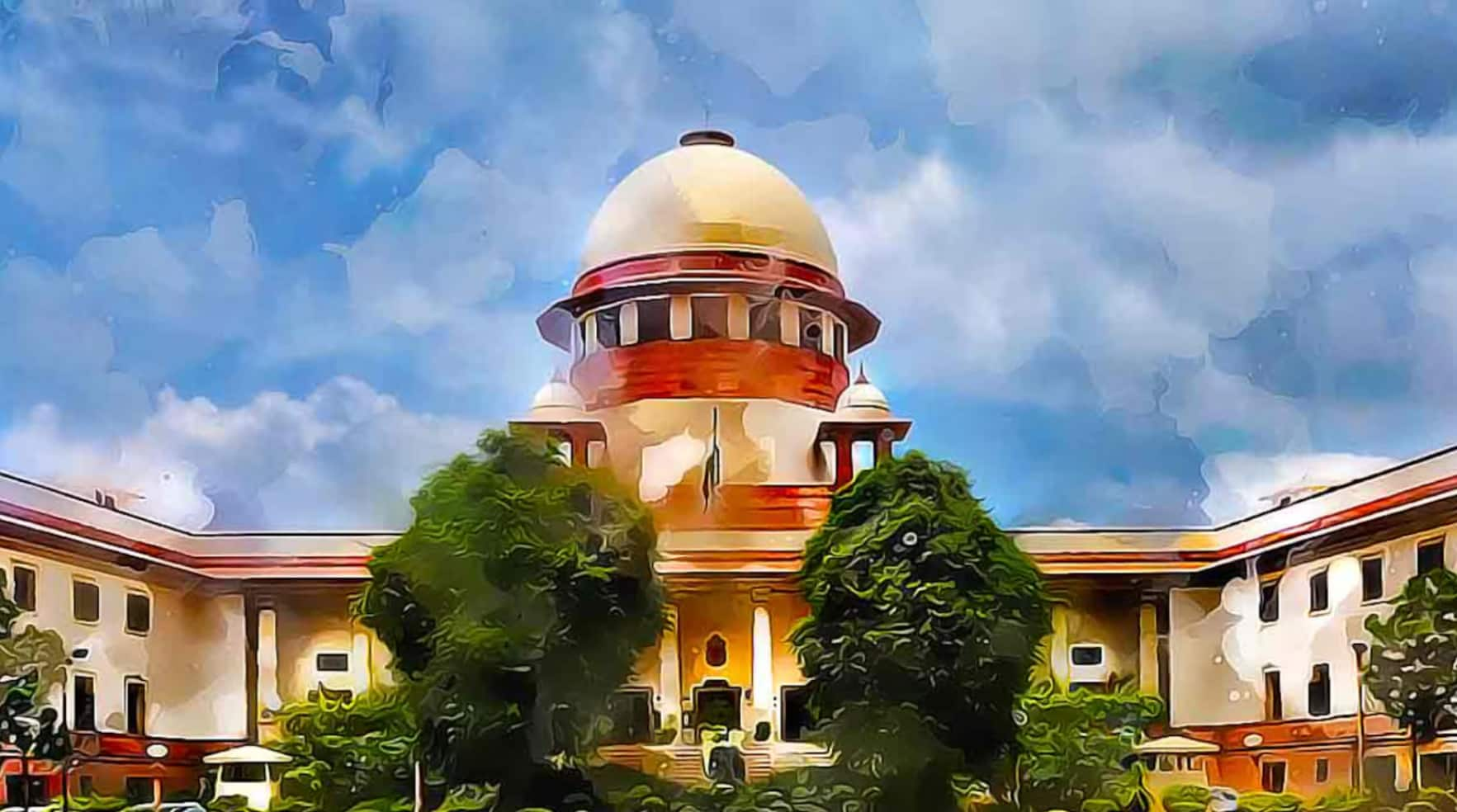
The Supreme Court has questioned laws disqualifying people with more than two children from local elections. On November 4, the bench said, "The foundation of such laws, that is, the fear of overpopulation, has crumbled due to demographic changes." Judges noted India’s fertility rate fell below the replacement level.
Market Mastery
Webinar by Vishal Malkan
Find the weak links
in your portfolio by Vishal Malkan
The Supreme Court has called for reconsideration of laws disqualifying people with more than two children from contesting local body elections, observing that India's changing demographic profile has undermined the reasoning behind such restrictions.
A bench of Justices PS Narasimha and Alok Aradhe, in its 37-page November 4 judgment in Mangala Bhimrao Ingle v. The Additional Commissioner, Amravati Division & Ors, seen by Moneycontrol, said the fear of population explosion, which had formed the basis for introducing such provisions, no longer reflected the country's demographic realities.
The court also raised concerns over the impact of these restrictions on political representation, women's rights and reproductive autonomy guaranteed under Article 21 of the Constitution. It referred the issue to a larger bench for reconsideration of the 2003 judgment in Javed v. State of Haryana, which had upheld the constitutional validity of the two-child norm.
Why has the Supreme Court questioned the two-child norm?
The bench observed that India's Total Fertility Rate (TFR) has declined from 3.02 in 2003, when the Javed judgment was delivered, to 1.9, falling below the replacement fertility rate of 2.1.
The replacement rate represents the average number of children required per woman for one generation to replace itself without migration.
"We are of the strong opinion that laws that penalise having more than two children have lost their relevance. The foundation of such laws, that is, the fear of overpopulation, has crumbled due to demographic changes in the past few decades," the court said.
According to the Sample Registration System, India's crude birth rate declined from 36.9 births per 1,000 people in 1971 to 18.3 in 2024. During the same period, TFR dropped from 5.2 to 1.9 children per woman. The latest National Family Health Survey (NFHS-6) estimated the rate at approximately 2.0 in 2024.
The World Bank estimated India's population growth at 0.887% in 2025, compared with approximately 1.6% in 2005.
The bench clarified that India's overall population has not started declining, largely because of demographic momentum created by earlier decades of higher fertility. However, contraceptive use, improved women's education and delayed marriages and first childbirth have contributed to falling fertility.
Why does the falling fertility rate matter?
The court highlighted the implications of declining fertility for India's future workforce and ageing population.
The proportion of people aged 60 and above increased from 8.3% in 2014 to 9.7% in 2024. Government projections indicate that this could reach nearly 15% by 2036.
The Economic Survey 2025-26 projected that approximately 65% of India's population would be between 15 and 59 years around 2030, with the working-age population expected to exceed 98 crore over the next decade.
Citing the India Ageing Report 2023, the judgment noted that the elderly population's share could increase from 10.5% in 2022 to 20.8% by 2050, potentially increasing pressure on labour participation, public finances and social support systems.
The bench also referred to China, which abandoned its one-child policy in 2015 and subsequently permitted three children in 2021, introducing incentives for childbirth. Japan's ageing population, high public debt and healthcare expenditure were cited as additional examples of the challenges associated with declining fertility.
What did the 2003 Javed judgment say?
In Javed v. State of Haryana, the Supreme Court upheld provisions of the Haryana Panchayati Raj Act, 1994, disqualifying people with more than two living children from contesting or holding panchayat positions.
The court had then relied on concerns surrounding population growth and its economic consequences, concluding that the restrictions did not violate Article 14.
The present bench questioned whether that reasoning could continue to justify such restrictions after two decades of demographic changes.
It also referred to Rajbala v. State of Haryana (2016), which relied on Javed while upholding additional eligibility restrictions for local elections. These included educational qualifications, outstanding cooperative dues, unpaid electricity bills and the absence of a functional toilet at a candidate's residence.
The judgment noted that these educational requirements made approximately 68% of Scheduled Caste women and 41% of Scheduled Caste men ineligible to contest panchayat elections.
It also discussed Sukanya Shantha v. Union of India (2024), which questioned the exclusionary impact of such restrictions on Scheduled Castes.
How do two-child laws affect women and reproductive autonomy?
The bench observed that women could face disproportionate consequences because reproductive decisions are frequently influenced by patriarchal family structures.
A 2009 study conducted in Rajasthan, Madhya Pradesh and Gujarat, sponsored by the Ministry of Panchayati Raj, documented instances of forced abortions, abandonment of pregnant wives and denial of paternity to avoid electoral disqualification.
The judgment also discussed son preference and gender-biased sex selection, noting that these influences on family planning extend across socio-economic groups.
Tracing the origins of such restrictions to the K. Karunakaran Committee, the court noted that it had recommended disqualification for candidates with more than two children, from panchayats to Parliament. Although the Constitution (Seventy Ninth Amendment) Bill, 1992 was introduced in the Rajya Sabha, political consensus could not be achieved. A draft Cabinet Note for its withdrawal was prepared in 2007, but no decision followed. No corresponding central-level law was enacted.
The bench emphasised that reproductive choices, including whether and when to have children, fall within Article 21. It observed that electoral penalties force individuals to choose between having children and participating in democratic governance.
Which states have two-child restrictions, and what happens next?
According to the compilation submitted by amicus curiae Rukmini Bobde, seven states have repealed the two-child norm, while 15 do not have such a policy. Assam, Goa, Gujarat, Maharashtra, Odisha and Uttarakhand continue to have restrictions.
The bench referred the matter to a larger bench for reconsideration of Javed. It directed the Registry to place the judgment before the Chief Justice of India for constitution of an appropriate bench.
The Supreme Court stayed the Bombay High Court's order against Mangala Bhimrao Ingle, allowing her to continue as sarpanch of Kakoda Gram Panchayat until disposal of the civil appeal.