
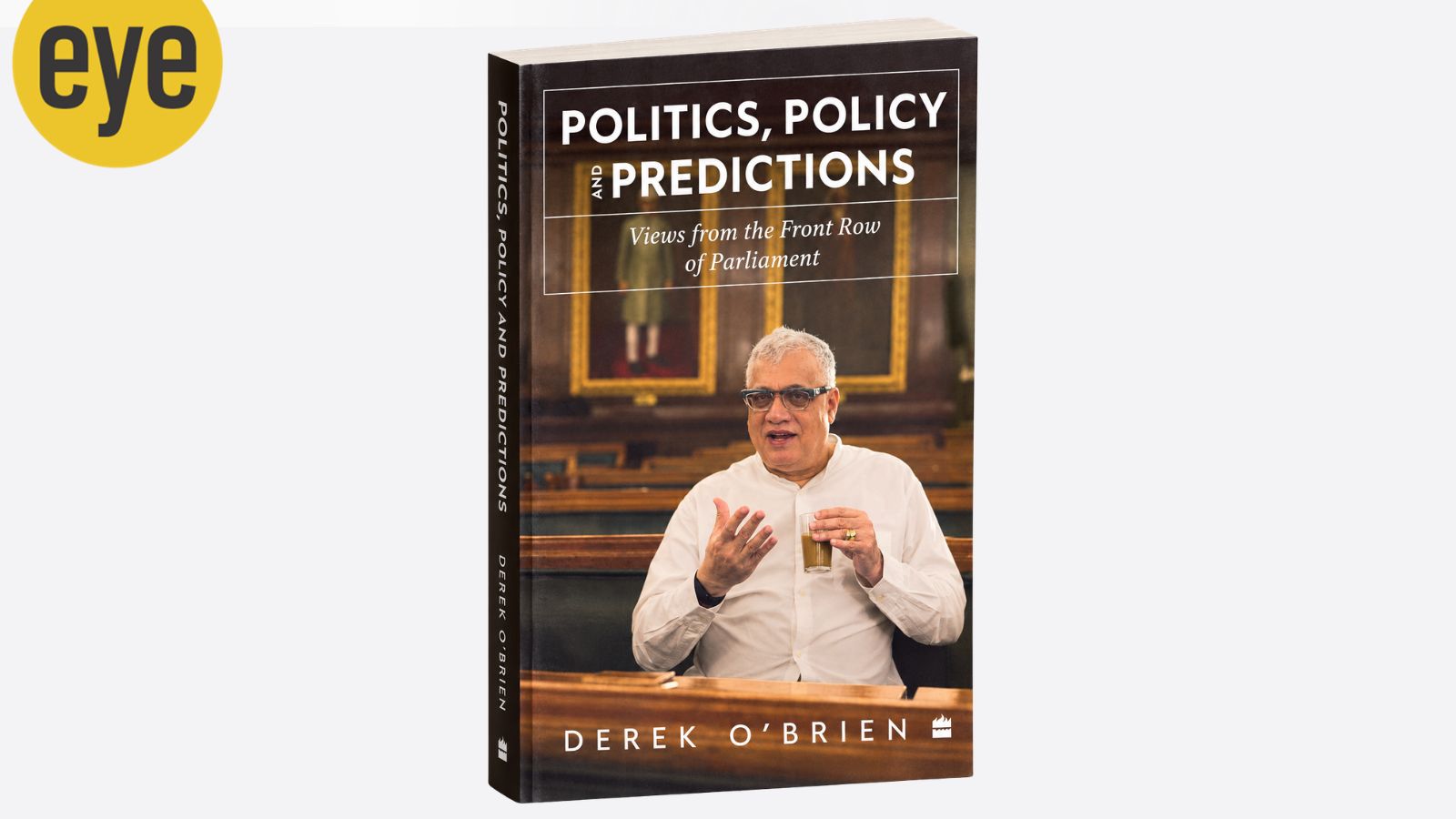
Derek O’Brien’s new book traces the decline of parliamentary accountability in India. He said, "Parliament today lacks the spirit of accommodation, discussion and consensus." Between 2019 and 2023, the suspension of MPs rose 13-fold. Many bills got passed in under two hours, as the legislature lost its voice for debate.
In Politics, Policy and Predictions, Derek O'Brien marshals statistics and examples to trace the decline of parliamentary deliberation and accountability
If one ends up feeling slightly shortchanged, it is because one assumed that author Derek O'Brien, a seasoned and articulate politician and popular quiz master, would have presented his impressive data with more of his trademark humour, insight, and flair. A few amusing and colourful first-hand vignettes on the everyday working of Parliament, in which the author has occupied front-row seats for years, would have livened up what is a somewhat dry account of just how the BJP slowly subverted one of India's most sacred institutions.
From a healthy interactive forum, O'Brien says, Parliament has transformed into an increasingly authoritarian legislature, with only the outward trappings and rules in place. Parliament today lacks the spirit of accommodation, discussion and consensus, which the makers of our Constitution had envisaged.
Still, O'Brien must be commended for driving home his point through a series of striking statistics and examples. For instance, between 2019 and 2023, there was a 13-fold increase in suspension of MPs, compared to the earlier 15th Lok Sabha session between 2009 and 2014.
Unsurprisingly, no BJP MP has been suspended since 2014. The Rajya Sabha, of which O'Brien is a member, was envisaged as a second chamber in Parliament to conduct dignified debate and serve as a forum for checks and balances by delaying impulsive and hasty legislation. But, in 2023, 47 per cent of Opposition MPs were suspended for raising the reasonable request of a discussion and statement from the home minister on a major Parliament security breach. (Blocking the move seems to have been done simply to avoid a discussion since a BJP MP had authorised visitor passes to the protesters who jumped from the railing in an exhibitionist bid to disrupt Parliament).
With almost no Opposition MPs in the House, a discussion on the Provisional Collection of Taxes bill saw only six MPs participating and it was cleared in 30 minutes. For the Telecommunication Bill, only eight MPs took part. Since 2019, over a 100 Bills have been pushed through in less than two hours.
O'Brien accuses the ruling party of acting secretly and stealthily while introducing bills of far reaching consequences. A telling example is the Jammu and Kashmir Reorganisation Bill 2019, a consequential bill that stripped the region of its statehood. The supplementary List of Business reached the MPs at 11:18 am, while the Bill was introduced at 11:07 am. It was discussed and passed the very same day.
Other important bills concerning the principles of federalism, for instance, the Delhi (Amendment) Bill 2023, were similarly cleared post haste. The disregard for parliamentary norms and tradition was glaring when the report of the Joint Parliamentary Committee on Waqf was presented in early 2025. Portions of dissent notes by MPs in the parliamentary subcommittee were simply blanked out with white pencil. Lack of public scrutiny and hastily pushing through bills has led to a dramatic decline in the quality of legislation.
The government's cavalier attitude towards the Opposition is reflected in the fact that the position of Lok Sabha deputy speaker, traditionally held by an Opposition MP, has been vacant since June 2019. Earlier seven out of 10 bills were sent to subcommittees for scrutiny, now just around two out of 10 are discussed in detail in committees, where prior consultation can be held with stakeholders and the public.
The government seems to have reservations about sharing information. Often, it is simply a case of 'knowing but opting not to tell', O'Brien surmises. 'No Data Available' has become the NDA's standard answer to parliamentary questions, though Question Hour in Parliament was devised to keep the government in check and highlight flaws in the system, which need correction. For instance, the Union government still relies on 2011 data for welfare eligibility, resulting in over 15 crore people being denied access to the public distribution system. The government generally ducks all Opposition demands to call a special session.
The author recalls ruefully that he learnt by rote in his civics class in middle school that the government is answerable to Parliament, and Parliament, in turn, is answerable to the people. So when Parliament is regularly sidelined, who is the government answerable to, he wonders.