
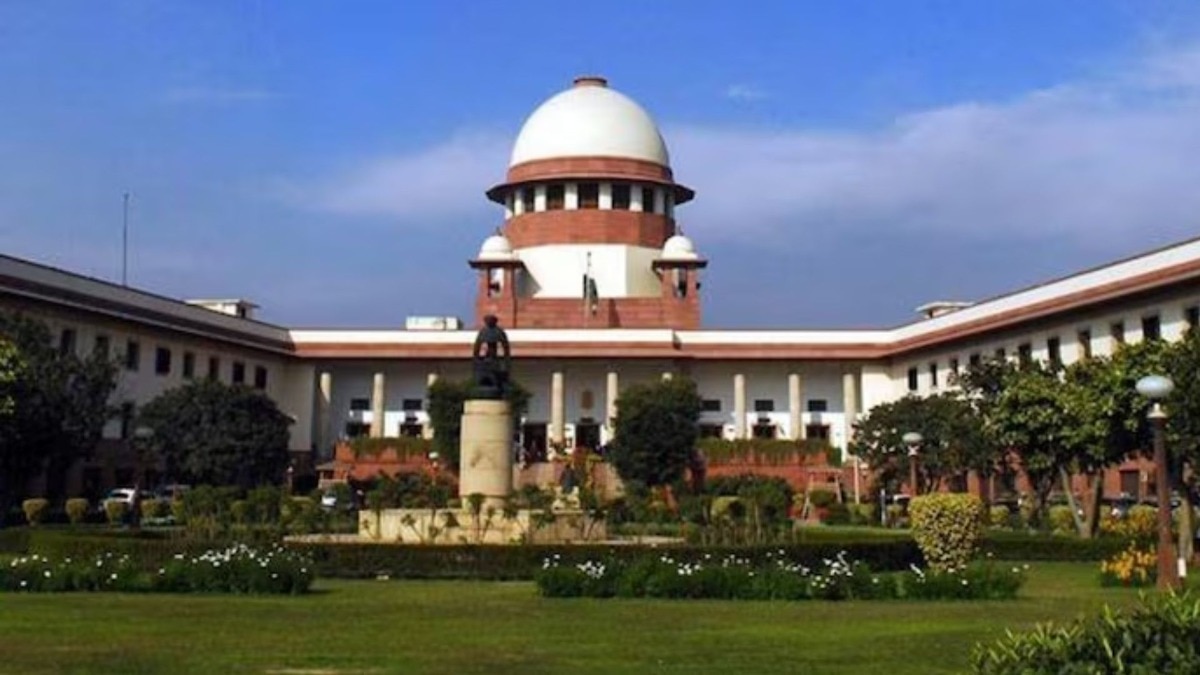
The Supreme Court on Wednesday questioned if laws disqualifying people with more than two children from local elections remain relevant. Judges noted India’s fertility rate fell from 3.0 to 1.9 since 2003. They said, "The need of the hour is to have policies in tune with the present realities."
The Supreme Court on Wednesday questioned the continued relevance of laws disqualifying people with more than two children from contesting local body elections, saying the fear of overpopulation that once justified such restrictions had weakened amid changing demographic realities. Warning that the effects of slowing population growth could be difficult to reverse, the court stressed the need to guard against a potentially irreversible decline in fertility, news agency PTI reported.
A bench of Justices P S Narasimha and Alok Aradhe said the relevance and justification of legislation must be assessed in light of contemporary social conditions rather than solely on the circumstances prevailing when it was enacted.
"Adapting to change is important for achieving justice, as failure to adapt produces injustice and is, in a sense, an abuse of power. Thus, failure to use power to adapt to change is in its own way an abuse of power," the bench said.
The observations came while hearing a plea by Mangala Bhimrao Ingle, whose election as sarpanch of Kakoda gram panchayat in Maharashtra was set aside on the ground that she had more than two children. Her disqualification was based on Section 14(1)(j-1) of the Maharashtra Village Panchayats Act, 1959.
The court said a law enacted to address a particular social problem could cease to serve its intended purpose if the circumstances underlying it changed substantially.
SC FLAGS NEED TO REASSESS TWO-CHILD NORM
The bench referred to the Supreme Court's July 2003 judgment in Javed vs State of Haryana, which upheld provisions of the Haryana Panchayati Raj Act, 1994, disqualifying people with more than two living children from contesting or holding panchayat positions.
It noted that India's total fertility rate (TFR) had declined from 3.0 in 2003 to 1.9, underlining the need to revisit policies framed around population control.
"The need of the hour is to have policies in tune with the present realities. We need to guard against potentially irreversible decline in fertility and respond to the changing demographic realities," the bench said.
The court warned that India could soon face an ageing population, with a disproportionately large share of people beyond working age. Citing experiences from other countries, it said the consequences of such demographic changes could have serious economic and developmental implications.
"The rolling effect of a decelerating population growth is very hard to reverse," the bench said, citing China.
It also referred to Japan, which continues to face high public debt and increased public expenditure on healthcare and long-term care for its ageing population after years of population decline.
COURT QUESTIONS IMPACT ON WOMEN'S RIGHTS
The bench said the rationale for linking population control with the right to contest elections deserved reconsideration, particularly in view of the implications for women's rights.
It pointed out that the 2003 Javed judgment had dismissed concerns about the impact of the restriction on women on the ground that both men and women were equally subject to disqualification.
"This does not sit in accordance with the social realities of the country," the bench said.
The court cited son preference as an important factor influencing reproductive decisions, noting that families sometimes choose to have additional children until a male child is born.
"Demographic studies have demonstrated that son preference influences reproductive decisions, including the desire to have additional children until the birth of a son," it said.
The bench observed that reproductive autonomy was not entirely beyond regulation, but any restriction on it had to be continuously tested for reasonableness.
"The imposition of electoral disqualification upon the birth of a third child places a person in the position of choosing between the exercise of their reproductive autonomy and continued participation in democratic governance," it said.
SC SAYS LAWS MUST EVOLVE WITH CHANGING REALITIES
Invoking the principle of temporal reasonableness, the bench said the constitutional validity of a law could not always be determined solely by the circumstances prevailing at the time of its enactment.
"The question, therefore, is not whether the law must remain static or be permitted to change. Change is inherent in the life of the law," it said.
The court also stressed that reviewing the implementation of legislation was an integral part of the rule of law. It said the executive had a constitutional duty to ensure that laws achieved their intended objectives and to identify and address shortcomings in their implementation.
"While this court cannot direct the legislature to repeal or amend a law, it can certainly examine whether the continued operation of that law remains constitutionally sustainable in light of changed circumstances," the bench said.
The Supreme Court referred the matter to a larger bench for reconsideration of the legal principles laid down in the 2003 Javed judgment.
It also clarified that its earlier interim order allowing Ingle to continue as sarpanch would remain in force until the appeal is decided.