
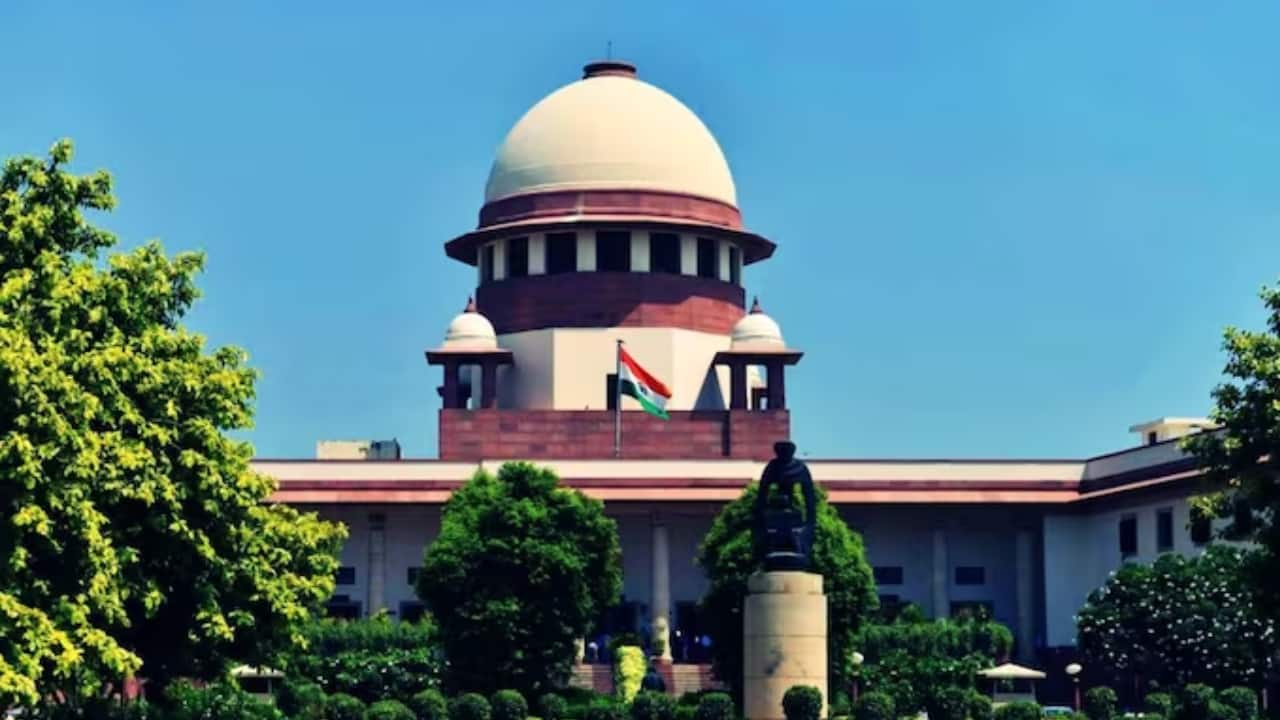
The Supreme Court on Wednesday, November 4, agreed to hear a plea regarding the Election Commission’s Form 6 requirement for deleted Delhi voters. The court scheduled the matter for November 19. Petitioners argued that previously registered voters should not have to apply as new electors after their names were removed.
Market Mastery
Webinar by Vishal Malkan
Find the weak links
in your portfolio by Vishal Malkan
The Supreme Court on Wednesday, November 4, agreed to examine concerns over the Election Commission of India’s (ECI) decision to allow voters excluded from the draft electoral rolls during the Special Intensive Revision (SIR) in Delhi to seek fresh enrolment through Form 6, even if they were registered voters earlier.
A bench comprising Chief Justice of India (CJI) Surya Kant and Justices Joymalya Bagchi and V Mohana scheduled the matter for November 19 and asked petitioners Anjali Bharadwaj and Amrita Johri to file an appropriate application placing the poll panel’s November 3 clarification on record.
Assuring voters that there was no reason to be apprehensive while the matter remained under judicial consideration, the Chief Justice indicated that the court could also consider directing the ECI to extend the deadline further, if required.
The issue was brought before the bench by advocate Prashant Bhushan, appearing for the petitioners.
Petitioners question EC’s Form 6 clarification
Bhushan argued that the ECI’s latest communication did not address the concerns raised by the Supreme Court during its October 28 hearing and continued to require previously registered voters, whose names were removed during the SIR exercise, to apply as new electors.
According to The Indian Express, Bhushan submitted that the clarification “completely ignores” the court’s oral observations concerning the use of Form 6 for voters placed in the Absent, Shifted, Dead or Duplicate (ASDD) categories.
He argued that these individuals were already part of the 2026 electoral rolls until May-June 2026 and should not be treated as first-time applicants merely because their names were missing from the draft list.
The petitioners maintained that voters should instead be allowed to seek restoration through Form 8 or submit their enumeration forms, depending on the circumstances.
Bhushan also flagged the possibility of prosecution arising from the declaration required under Form 6, arguing that previously enrolled voters could be placed in a difficult position by being asked to present themselves as new applicants.
“They are in the horns of a dilemma,” Bhushan told the bench, as reported by The Hindu.
What did the Election Commission say?
In its November 3 communication to the chief electoral officers of states, the ECI stated that individuals whose names were missing from the draft electoral rolls could submit Form 6 to seek inclusion in the final list, irrespective of whether they had been registered as voters previously.
The poll panel also clarified that filing Form 6 in these circumstances would not, by itself, constitute a false declaration, even if the applicant had participated in earlier elections.
It further said that no proceedings under Section 31 of the Representation of the People Act, 1950, would be initiated against an elector merely because the person had appeared in an earlier electoral roll and subsequently submitted Form 6 during or after the SIR exercise.
This protection would apply provided the applicant was not already registered in another parliamentary or Assembly constituency and had otherwise complied with the statutory declaration requirements.
The ECI also referred to the Delhi High Court's observations in Nilotpal Datta v. EC, stating that voters need not fear prosecution for making a declaration merely because they had been enrolled or had voted in previous elections.
However, Bhushan contended that the assurance against prosecution did not resolve the larger question of why existing voters were being asked to register afresh.
What did the Supreme Court say on October 28?
During its October 28 hearing, the Supreme Court had questioned the ECI's insistence on Form 6 for individuals whose names had been removed from the draft electoral rolls despite their earlier enrolment.
The bench observed that the right to vote was vital and could not be taken away merely because an elector was absent.
It also asked the poll panel to develop a mechanism to contact approximately 47 lakh voters whose names were missing from Delhi's draft electoral rolls, out of a pre-revision electorate of around 1.45 crore.
The court suggested that shifted voters be permitted to use Form 8 and that those who could not be contacted or had failed to submit enumeration forms be allowed to file them belatedly.
The Chief Justice also urged the ECI to publish details of voters it had been unable to contact and facilitate their communication with booth-level officers (BLOs).
"You see how to reduce this gap of 43 lakh. We will take up after two weeks," the CJI had orally remarked.
"Ask them to contact nearest BLO and fill Form 8," he added.
The court had also advised the ECI against rigidly enforcing the deadline and asked it to consider accepting enumeration forms from voters whose names had been deleted.
At the time, the ECI had indicated that it would consider accepting delayed enumeration forms and extending the October 30 deadline, if necessary.
47 lakh names omitted from Delhi draft rolls
The dispute stems from the SIR exercise in Delhi, following which the ECI published the draft electoral rolls on August 31.
The revision resulted in approximately 47 lakh names being omitted from the pre-revision electorate of around 1.45 crore voters.
The petition filed by Bharadwaj and Johri seeks directions to the ECI to make public the list of electors who received notices during the revision exercise, along with the specific reasons for issuing each notice.
The petitioners have also raised concerns about the manner in which voters excluded under the ASDD categories can reclaim their place in the electoral rolls.
The Supreme Court will next consider the petitioners' objections to the November 3 clarification on November 19. The bench has indicated that it may seek a further extension of the deadline if the circumstances warrant it.