
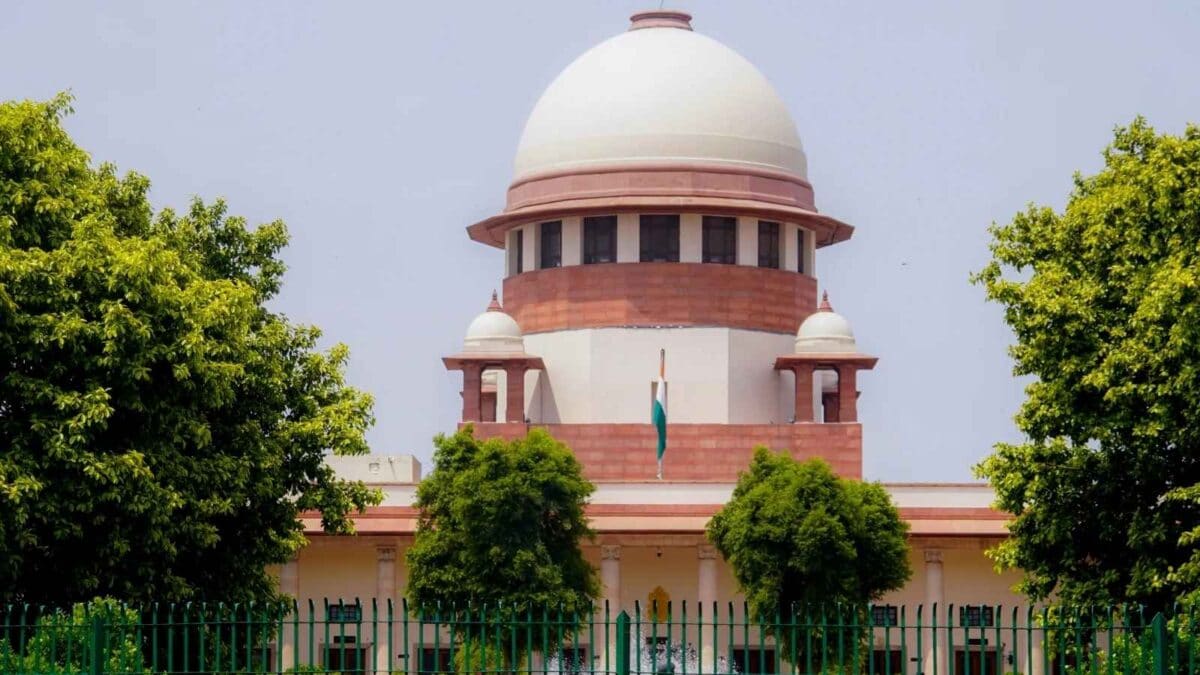
The Supreme Court sought the Centre’s response on whether to regulate marriages between close blood relatives. Chief Justice Surya Kant said, “We will not direct them. We will only sensitise them.” The court noted that social reform laws fall under the legislature’s domain, while stressing the need for public awareness.
A bench comprising Chief Justice Surya Kant observed that the court could not regulate such marriages as bringing in social reform legislation fell within the legislature's domain.
The Supreme Court sought Centre’s response on whether legislation should be introduced to regulate marriages between close blood relatives, saying it wanted to sensitise the government about the issue rather than issue any directions.
A bench comprising Chief Justice Surya Kant and Justices Joymalya Bagchi and V Mohana observed that the court could not regulate such marriages, also known as consanguineous marriages, as bringing in social reform legislation fell within the legislature’s domain.
The bench was hearing a petition filed by Charvi S, a Bengaluru-based law student, who questioned whether the law should continue to permit a practice that, according to her plea, exposes children to foreseeable and avoidable genetic risks.
“We are issuing notice for the limited purpose of impressing upon the Union of India to consider the desirability of bringing a suitable legislation, or to ensure wide publicity through different channels, including a proper curriculum," the bench said.
“We can issue notice for the limited purpose of impressing upon the Union of India to consider the need for a suitable legislation. We will not direct them. We will only sensitise them," it added.
The petition, filed through advocate Anjuman Tripathy, cited medical studies suggesting that consanguineous marriages can increase homozygosity, thereby raising the likelihood of recessive genetic conditions in children.
According to the plea, the potential risks include congenital malformations, sensory impairments, developmental disabilities, infant deaths and other adverse health outcomes.
During the hearing, the petitioner’s counsel argued that the issue involved inter-generational equity and called for greater public awareness about the possible consequences of such marriages.
The counsel also sought safeguards, saying that people should be informed about the risks before making decisions about marriage. The plea claimed that the practice was prevalent in some rural areas, where people may marry cousins within their families without being aware of the possible consequences.
The bench said the issue required public awareness, while emphasising that marriage was a matter of personal choice and individuals should be able to make informed decisions.
Referring to an earlier case involving marriage with an HIV-positive person, the court observed that it had recognised marriage as a matter of personal choice.
The petitioner told the court that she has a 40 per cent visual impairment and is an offspring of a first-cousin marriage conducted in accordance with a traditional practice in her community. The plea urged the court to declare, or alternatively interpret, Sections 5(iv) and 5(v) of the Hindu Marriage Act, 1955, to ensure that exceptions permitting marriages within prohibited or ‘sapinda’ relationships are accompanied by public health safeguards.
These safeguards, it said, should include counselling, disclosure of genetic risks, medically advised screening and certification.
“Without these safeguards, such practices are beyond the authority granted by Articles 14 and 21 of the Indian Constitution," the petition said.
The plea clarified that it was not seeking to criticise specific community practices or devalue people with disabilities. Instead, it argued that the State had a constitutional responsibility to prevent foreseeable and avoidable harm to children.