
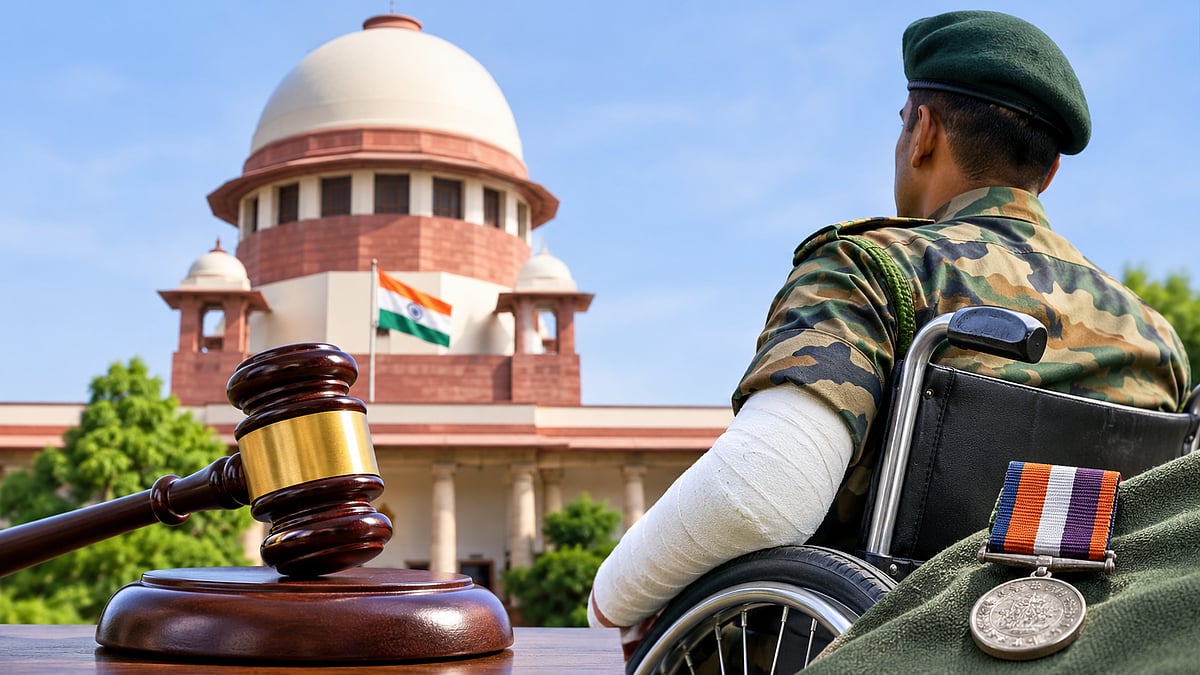
The Supreme Court ruled that an accidental gunshot wound from a service weapon qualifies for war injury pension. The bench said, “Weapon ownership and intention are distinct facts.” They directed the government to pay Ex-Subedar Major Devi Singh his pension from his retirement date on March 31, 2019, without delay.
New Delhi: The Supreme Court has ruled that an officially recorded accident involving a service weapon cannot be converted into a self-inflicted injury to deny war injury pension to an Army personnel.
A bench of Justices Satish Chandra Sharma and N Kotiswar Singh allowed the appeal of Ex-Subedar Major and Honorary Lieutenant Devi Singh and directed the Union government to grant him the War Injury Element of pension from the date of his retirement on March 31, 2019.
The court set aside the Armed Forces Tribunal (Lucknow) order of May 10, 2023, which had rejected the claim mainly because the Adjutant General’s branch had not issued a final battle casualty certificate.
“The distinction pertinent to note here is that the exclusion is of a self-inflicted injury injury, not of every injury in which a serviceman’s own weapon happens to be the source of the bullet... Weapon ownership and intention are distinct facts,” the bench pointed out in its judgment on November 20, 2026.
The bench held that in the absence of contrary contemporaneous material, an officially recorded accident cannot be converted into a self-inflicted injury merely because the weapon belonged to the appellant.
Relying on Union of India Vs Saroj Devi (2024), it said official contemporaneous certificates must be given due evidentiary weight.
The court also opined absence of the name from a later digital database or destruction of files in the 2014 floods could not disprove surviving records.
“The appellant, therefore, cannot be made to suffer for no fault on his part,” the bench held, directing sanction of war injury element within three months, adjusting the disability pension already paid.