
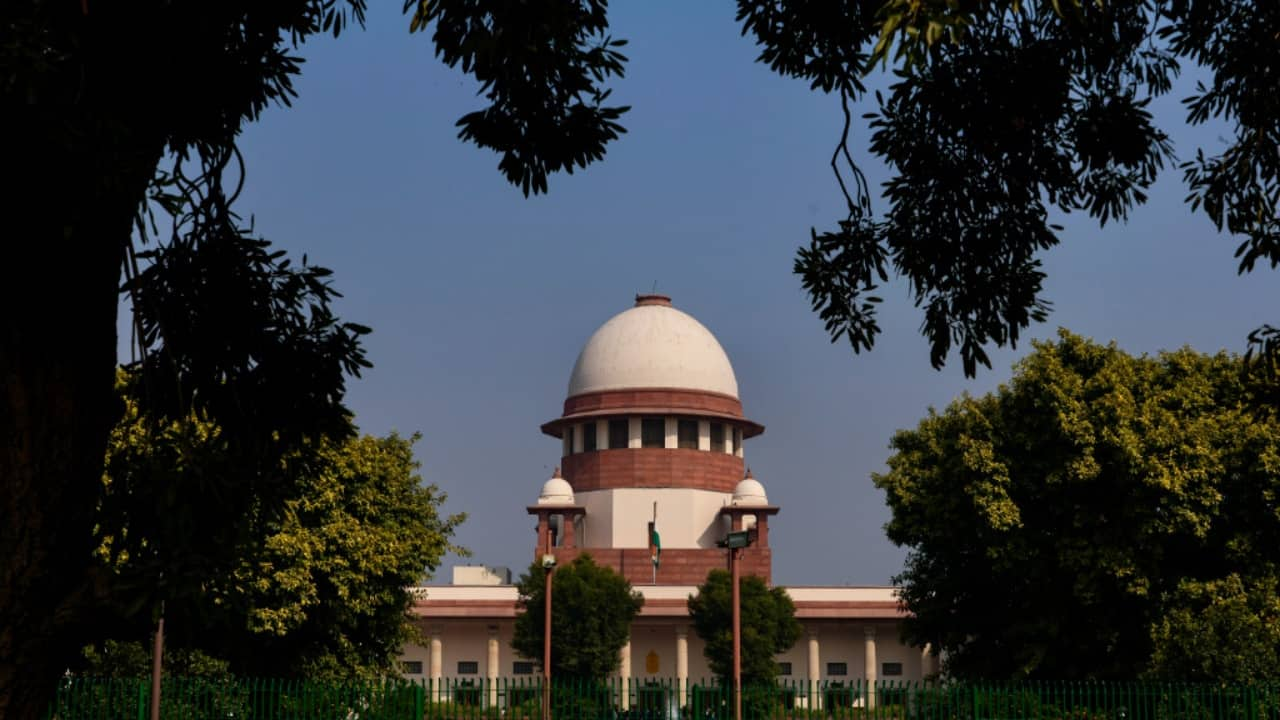
The Supreme Court on Friday (October 30) asked the Ministry of Electronics and Information Technology to add enforcement rules to its policy on court video misuse. The Bench said the policy must stop people from sharing or selling clips. "Necessary measures for taking action against those who fail" will be included.
Market Mastery
Webinar by Vishal Malkan
Find the weak links
in your portfolio by Vishal Malkan
The Supreme Court on Friday (October 30) asked the Union Ministry of Electronics and Information Technology (MeitY) to incorporate enforcement provisions in its proposed policy to deal with the unauthorised extraction, uploading and commercial exploitation of audio-video recordings of judicial proceedings.
A Bench comprising Chief Justice of India (CJI) Surya Kant and Justices Joymalya Bagchi and V Mohana said the proposed policy must provide for action against individuals and entities violating the court's directions restricting the circulation of courtroom recordings on social media and other digital platforms without prior approval.
The court was hearing a batch of petitions concerning the livestreaming, recording and publication of judicial proceedings, including a plea in Harshita Grover v Union of India & Ors seeking safeguards against the unauthorised use and monetisation of court hearing videos.
"Necessary measures for taking action against those who fail to comply with the directions will also be incorporated in the policy regime," the Bench ordered.
The development comes amid concerns over courtroom footage being extracted, circulated and commercially exploited online, as well as the potential for misleading representations of judicial proceedings through selectively shared recordings.
MeitY considering policy after suggestions from High Courts, stakeholders
During Friday's hearing, Solicitor General Tushar Mehta informed the Supreme Court that suggestions on regulating the use of courtroom recordings had been received from several High Courts, lawyers and other stakeholders.
He said the recommendations had been forwarded to the Ministry of Electronics and Information Technology for consideration and that the government was working on a policy to address the issue.
"There have been breaches (of the court's directives against unauthorised circulation of courtroom videos). I don't want to escalate, but there have been breaches. I had a word with the Secretary...It is under consideration by the Ministry, for formulation of a policy," Mehta told the Bench.
The Solicitor General also flagged violations of the Supreme Court's earlier directions and requested the court to consider ordering the removal of content uploaded in breach of its restrictions.
On the previous hearing, the Bench had asked its Registry to forward the suggestions received by the court to the Solicitor General. Other parties, intervenors and High Courts had also been allowed to submit their recommendations to Mehta, who was tasked with preparing a draft proposal.
The proposed framework is intended to address concerns involving commercial exploitation, misrepresentation, misquoting and the circulation of misleading material relating to court proceedings.
What are the Supreme Court's restrictions on courtroom videos?
The Supreme Court had, in an order dated July 24, prohibited the unauthorised extraction, publication and commercial use of audio-video recordings of judicial proceedings.
The directions cover activities including dissemination, monetisation, posting, reposting, uploading, transmitting, modification, storage and hosting of courtroom recordings on social media platforms and other digital services.
The order stated that such activities could not be undertaken without prior permission from the Secretary General of the Supreme Court or the Registrars General of the respective High Courts.
The Bench subsequently clarified that its restrictions would not prevent recognised news organisations from reporting on court hearings. However, media organisations would also have to adhere to the prohibition on circulating audio or video recordings without the requisite approval.
The court has maintained that reporting on judicial proceedings and distributing recordings of those proceedings are distinct matters, with the latter remaining subject to its restrictions.
Prashant Bhushan proposes authenticated repository, watermarking
During Friday's proceedings, advocate Prashant Bhushan, appearing for an intervenor, suggested that the Supreme Court should maintain an authenticated repository of its proceedings on its official website.
He proposed using digital watermarking and cryptographic signatures to establish the authenticity of official courtroom footage and help distinguish genuine recordings from manipulated or misleading clips.
According to Bhushan, officially released recordings should carry verifiable digital signatures or watermarks, allowing viewers and digital platforms to establish whether footage has originated from an authorised source.
He also suggested that the court should make its proceedings available through this repository so that people seeking to use excerpts could obtain them from an authenticated source.
Justice Bagchi said administrative arrangements along these lines were already being developed independently.
"That we are doing separately on the administrative side. We are also contemplating, and in fact some High Courts have put in place arrangements where you cannot make an extraction from the feed on the YouTube channel set up for the court concerned," the judge said.
However, the Bench acknowledged that preventing unauthorised recordings remained difficult to enforce, particularly when individuals use secondary devices such as mobile phones to record proceedings.
Justice Bagchi observed that recording courtroom proceedings through such means would amount to contempt of court, but said implementation remained the principal challenge.
Court supervision over use of clips; Bhushan flags concerns for journalists
The question of whether journalists, YouTubers and legal commentators should be allowed to use portions of official courtroom recordings without obtaining prior permission also came up during the hearing.
Bhushan argued that requiring permission from the Secretary General before using authenticated extracts could create difficulties for those reporting on judicial proceedings.
He contended that such restrictions could conflict with the principles of open justice recognised by the Supreme Court in its Swapnil Tripathi judgment, which dealt with livestreaming of court proceedings.
Bhushan also questioned the scope of the restriction on commercial exploitation, arguing that the expression could be interpreted broadly. He cited the example of a YouTuber seeking to report on a case using an excerpt from an official court recording.
Justice Bagchi responded that permission from the Secretary General would be necessary in such circumstances.
Mehta, meanwhile, argued that YouTubers generate revenue from the content they publish and that such activity cannot automatically be treated as serving a public purpose.
The Bench reiterated that judicial supervision would extend to both the portion of a recording being extracted and the purpose for which it was intended to be used.
"Court supervision is to the extent of how much you are extracting and for what purpose," Justice Bagchi said.
Bhushan maintained that the requirement could create practical problems for journalistic reporting. The court, however, said it would consider these concerns at the appropriate stage.
"We will examine the problem when we cross it," Justice Bagchi remarked.