
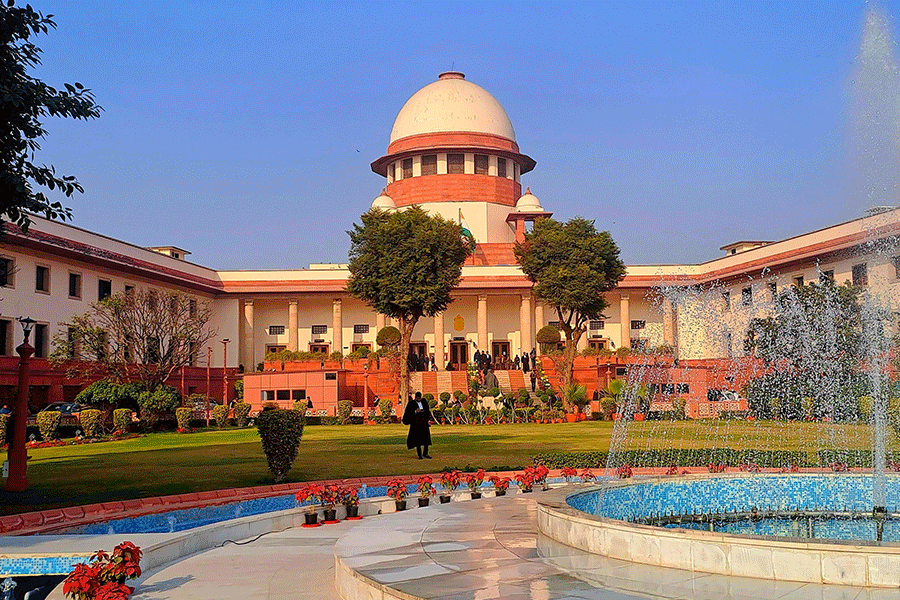
The Supreme Court on Tuesday issued notices to the Centre regarding the mandatory singing of the full Vande Mataram. Petitioners said the six-stanza directive undermines secularism and could deepen communal divisions. They argued the song’s depiction of conflict in Anandamath promotes anti-Muslim sentiments and attacks the country’s basic constitutional structure.
Petitioners argue the six-stanza directive undermines secularism and could deepen communal divisions, citing the song's depiction of conflict with Muslims in Anandamath
The Supreme Court on Tuesday issued notices to the Centre on two petitions seeking the quashing of the government's decision mandating the rendition of the full Vande Mataram at events as being unconstitutional and anti-Muslim.
The petitions have contended that the decision making it mandatory to sing all six stanzas of Vande Mataram was an attempt to change the character of the polity of India from a "secular republic" to a "theocracy" based on Bankim Chandra Chattopadhyay's novel Anandamath.
A bench of Chief Justice Surya Kant, Justice Joymalya Bagchi and Justice V. Mohana heard the petitions filed by Balakrishnan Sathyabhama Mavoji, a retired Dalit IAS officer from Keralam, and Ambedkarite and Buddhist follower B.D. Borkar. They have alleged that the full version of Vande Mataram promoted Islamophobia and anti-Muslim sentiments in the country.
This is the third petition filed on the issue. The bench had on September 22 sought a response from the Centre on another petition filed by Carnatic singer T.M. Krishna challenging the Union government's circular mandating the singing of all six stanzas of Vande Mataram and the recent amendment giving the national song the same status as the national anthem -- Jana Gana Mana.
According to Mavoji's petition, the full version of Vande Mataram is part of Anandamath, in which Hindu ascetics wage a holy religious war against Muslims who are violently killed and destroyed. The Hindus eventually seek support of the British in this holy war, the petition said.
"...Anandamath is therefore filled with violent and hateful invective against Muslims. The unstated but undeniable consequence of the impugned orders would be to irreversibly deepen communal division and conflict in India by outraging the religious and spiritual feelings of minority religions, promote enmity and conflict between different communities by advancing the supremacy of dominant communities, and promote enmity between Hindus and Muslims such that the unity, solidarity, harmony of our country as a whole is irreversibly mutilated.
"The impugned orders are a direct attack against the foundational constitutional basic structure features of fraternity and secularism," Mavoji's counsel, senior advocate Mohan Gopal, and advocate-on-record Vaibhav Choudhary told the bench.
The petition filed by Borkar made similar contentions on the full version of Vande Mataram.