
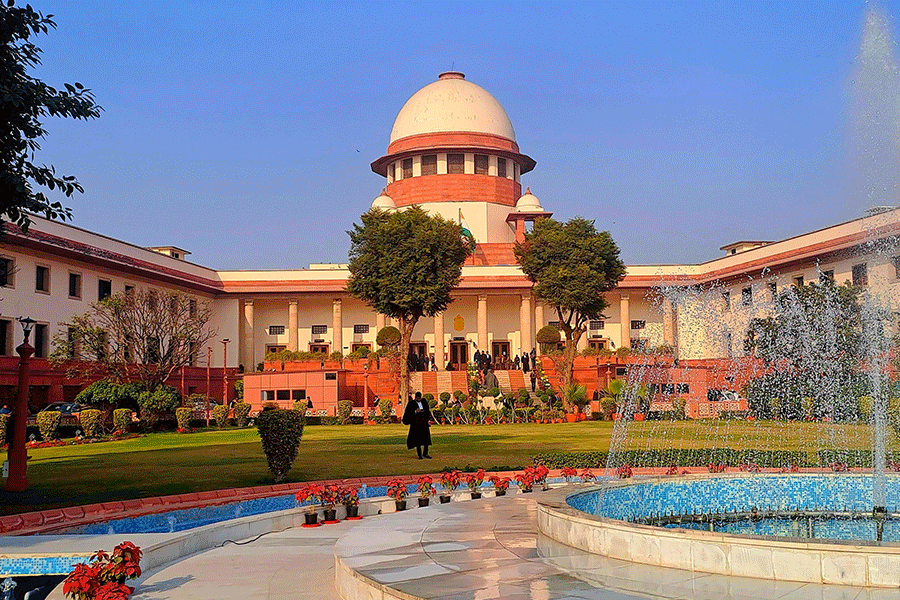
The Supreme Court gave petitioner Swaty Singh a week to file a rejoinder in the Jantar Mantar protest site case on Friday. The bench said factual claims need affidavit support after Solicitor General Tushar Mehta questioned written submissions. The court will now hear the matter after the one-week period ends.
Bench says factual claims need affidavit support after Solicitor General Tushar Mehta questions Swaty Singh's written submissions
A dispute over written submissions delayed the Supreme Court hearing on Friday on a challenge to Delhi police's decision to drop Jantar Mantar as a designated protest venue. The bench gave petitioner Swaty Singh a week to file a rejoinder and adjourned the hearing for that period.
Solicitor General Tushar Mehta questioned some factual assertions in the submissions circulated on Singh's behalf. Senior advocate Mukta Gupta, appearing for Singh, said the submissions set out legal propositions and cited court rulings, and that they contained no disputed factual assertions.
The bench, comprising Chief Justice Surya Kant and Justices Joymalya Bagchi and V Mohana, said any factual assertion had to be backed by an affidavit so that someone took responsibility for its accuracy. Mehta also sought a rejoinder on affidavit for that reason.
Mehta told the bench that a letter seeking an adjournment of Friday's hearing had been circulated on behalf of Additional Solicitor General S V Raju, who was unavailable. The letter was later withdrawn, he said.
On October 15, the bench had issued notices to the Centre and Delhi police on Singh's public interest litigation. She challenged an October 11 standing order by Delhi police commissioner Anurag Kumar that de-notified Jantar Mantar and designated Ramlila Ground, Burari Ground and CBD Ground in east Delhi as alternative venues for protests and demonstrations.
The bench had earlier said orally that it would examine whether the authorities had considered how Jantar Mantar was used and how effective it was as a protest venue.
Senior advocate Gopal Sankaranarayanan, appearing for a litigant, had sought restoration of the notification designating Jantar Mantar as a protest site. He pointed out that the de-notification had been presented as being in line with an earlier Supreme Court order. Mehta clarified that the earlier ruling was not the basis for the decision and said a committee set up to examine the issue had submitted a report setting out the reasons.
Singh's plea argued that moving demonstrations to distant, outlying areas could make the fundamental rights to peaceful assembly and free expression ineffective. It said the right to protest included the ability to communicate grievances, express dissent and bring issues to the attention of public authorities and society.
"The location of a protest is, therefore, not an inconsequential administrative consideration," the plea said. It added that proximity to the institutions concerned, public access and visibility to the intended audience could directly affect a demonstration's effectiveness.
The plea also called the standing order arbitrary and procedurally deficient.
"A notification which withdraws an existing venue can't be regarded as preserving the right to protest merely because alternative locations have been identified, particularly when the detailed arrangements governing access to those locations are left to a subsequent standard operating procedure," the plea said.