
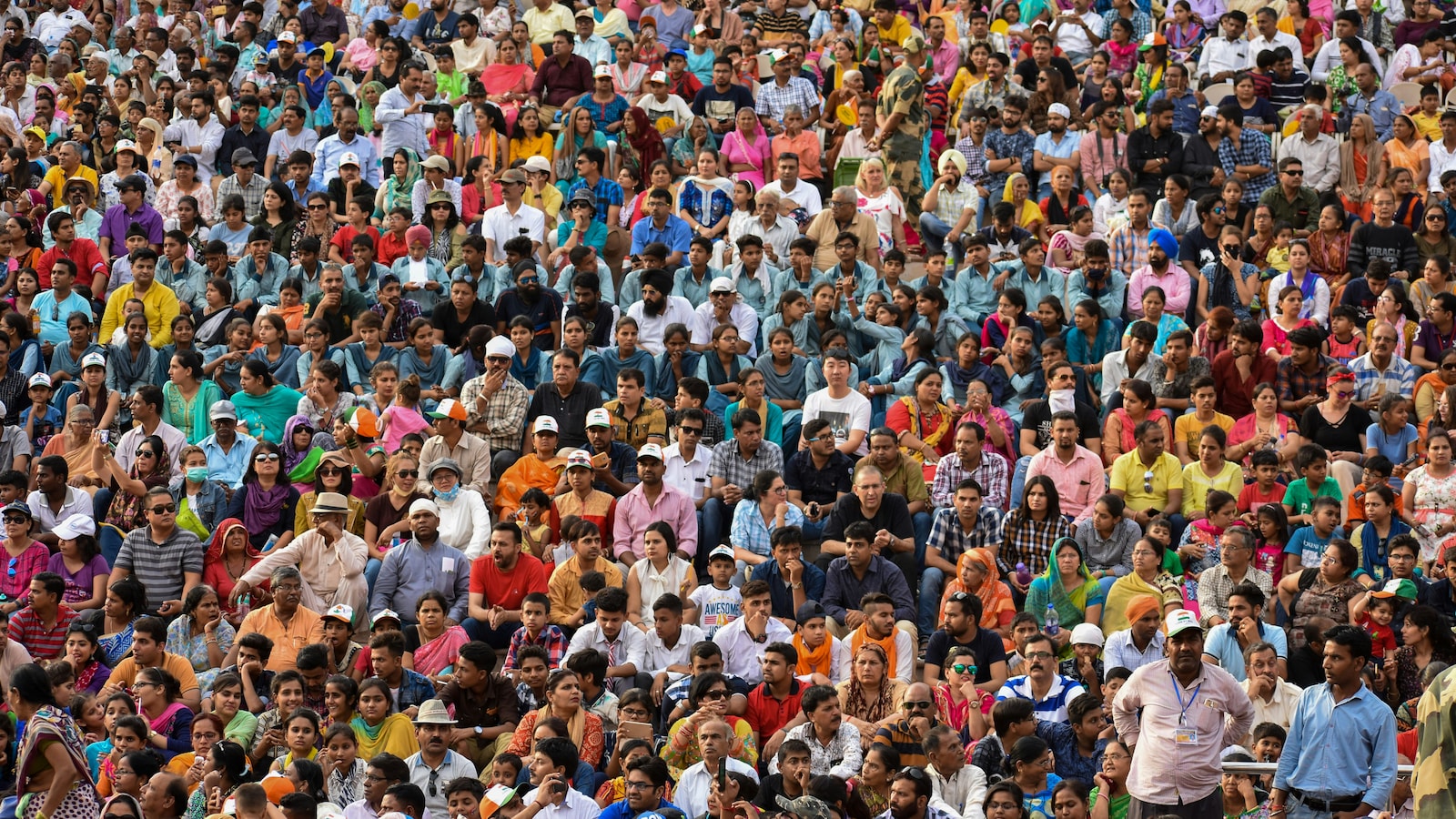
The Supreme Court said on November 4 that laws penalising people for having more than two children have lost relevance. India’s fertility rate fell from 3.02 in 2003 to 1.9 in 2024. The court noted that the country must now rethink policies as the share of older people rises.
The falling fertility rate threatens India's demographic advantage.
India's population may continue to grow for years, but its demographic profile is changing. Fewer children are being born, the share of older people is rising, and the country's working-age population is approaching a turning point. The shift has prompted the Supreme Court to flag the long-term consequences of falling fertility, saying India needs to rethink population policies framed around fears of overpopulation.
In a significant observation on Wednesday (November 4), the Top Court said laws penalising people for having more than two children had lost their relevance in view of the country's changing demographic realities. The court pointed out that India's Total Fertility Rate (TFR) had fallen from 3.02 in 2003 to 1.9 in 2024, below the replacement level of 2.1.
The observation came while the court was hearing the plea of Mangala Bhimrao Ingle from Maharashtra whose election as sarpanch of Kakoda gram panchayat withing the administrative jurisdiction of Amravati division was set aside on the ground that she had more than two children.
The court has referred the matter to a larger bench for reconsideration of its 2003 ruling in Javed vs State of Haryana, which had upheld the validity of a two-child norm for contesting local body elections.
But beyond the legal question, the court's observation points to a larger demographic challenge: What happens when a country that once worried about having too many people begins to grapple with an ageing population?
What Is The Total Fertility Rate
TFR measures the average number of children a woman is expected to have during her reproductive years.
A TFR of 2.1 is considered the replacement level, at which a generation would broadly replace itself, assuming other demographic factors remain unchanged.
According to the Sample Registration System (SRS) Statistical Report 2024, India has already crossed the threshold with a TFR of 1.9 due to increasing use of contraceptives and rising education among women.
India's Elderly Population Set To Rise Sharply
One of the most significant consequences of falling fertility, combined with longer life expectancy, is a gradual shift towards an older population.
According to the Ministry of Social Justice and Empowerment, India's population aged 60 and above is expected to increase from approximately 10 crore in 2011 to 23 crore in 2036.
The elderly's share of the total population is projected to rise from 8.4 per cent to 14.9 per cent over the same period. At the same time, the proportion of children below 15 years is expected to decline from 30.9 per cent in 2011 to 20.1 per cent in 2036.
The projections indicate that India will have a significantly larger elderly population and a smaller share of children in the coming years.
What Happens To India's Demographic Dividend?
For years, India's relatively young population has been considered one of its biggest economic advantages. A large working-age population can support economic growth by expanding the labour force, increasing productivity and supporting consumption.
However, this advantage is not permanent.
The Ministry of Health and Family Welfare's Annual Report 2024-25 says that people aged 15-59 account for 64.2 per cent of India's population. Their share is projected to peak at approximately 65 per cent around 2036.
As fertility declines and older generations account for a growing share of the population, the proportion of people available to support economic activity and dependents could eventually come under pressure.
This does not mean India will suddenly run out of workers. Rather, it means that the country will have to prepare for a gradual change in its age structure.
The challenge will be to create enough productive jobs, improve skills and increase workforce participation, particularly among women, so that the demographic dividend translates into sustained economic growth.
India's falling TFR has been a concern for the Rashtriya Swayamsevak Sangh (RSS) and its chief Mohan Bhagwat has been among the most vocal proponents of larger families.
Speaking at the Kathale Kul Sammelan in Nagpur in December 2024, Bhagwat said a society's fertility rate should not fall below 2.1, warning that a sustained decline could threaten its long-term survival.
He also argued that families should ideally have at least three children.
Got a follow‑up question on this article? Go on
How may i help you today
Show full article
Track Latest News Live on NDTV.com and get news updates from India and around the world