
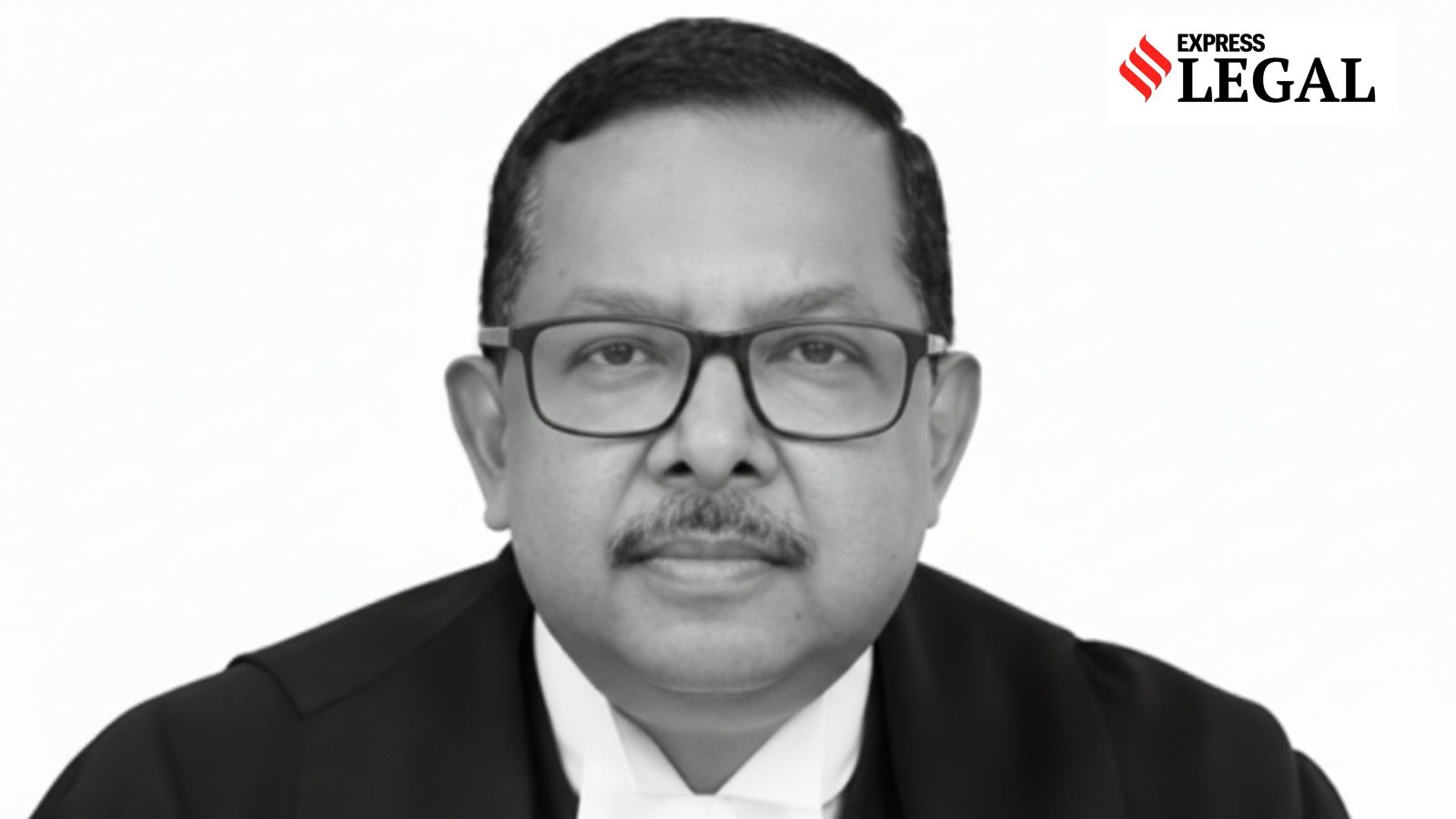
Supreme Court Justice Ujjal Bhuyan said a society that fears questions becomes vulnerable to authoritarianism. Speaking at the 12th convocation ceremony of the University of Science and Technology Meghalaya on October 31, he noted, "I believe scientific temperament lays the foundation for the rule of law." He urged students to reason.
Speaking at the 12th convocation ceremony of the University of Science and Technology Meghalaya on October 31, the judge also said a society that treats tradition as beyond scrutiny could fail to reform unjust practices.
Supreme Court Justice Ujjal Bhuyan has said that a society that fears questions becomes vulnerable to authoritarianism, and a society that treats tradition as beyond scrutiny may fail to reform unjust practices.
Speaking at the 12th convocation ceremony of the University of Science and Technology Meghalaya on October 31, the judge highlighted the importance of scientific temper in the context of the rule of law.
"I believe scientific temperament lays the foundation for the rule of law. This is because arbitrary power thrives on ignorance, fear, and unexamined belief. A society that accepts claims without evidence is susceptible to superstitious beliefs and becomes vulnerable to misinformation. A society that fears questions becomes vulnerable to authoritarianism. A society that treats tradition as beyond scrutiny may fail to reform unjust practices," he shared with the students.
Justice Bhuyan also underscored the importance of public reasoning, calling it the "very essence of a healthy participatory democracy".
"But for that we need to have an informed citizenry. We can have an informed citizenry only when there is access to information. Therefore, information is the key."
Referring to the work of renowned economist Amartya Sen, the judge said that public reasoning finds particular exposition in Sen's The Idea of Justice, where he distinguishes between institutional democracy and functional democracy.
"This habit of public reasoning is the very essence of a healthy participatory democracy. But for that we need to have an informed citizenry. We can have an informed citizenry only when there is access to information. Therefore, information is the key," he noted.
Circulation of information and scrutiny by public reasoning, therefore, becomes part of the due process by which a democratic society resonates with justice, the judge added.
On diversity in educational institutions, the judge said that a university is also a place to discover the diversity around you where students share space with fellow students who hail from diverse backgrounds.
"They speak different languages; they belong to different faiths; and they hail from different regions with different ethnic backgrounds. Their upbringing, their food habits, and consequently their ways of thinking may be different from yours; so also their cultural identities. This diversity tells us first to unlearn ourselves and then to discover shared values. Our strength is our diversity. As the saying goes: our unity lies in our diversity. Therefore, diversity is to be cherished and not something which should be disowned," he said.
'Us and Them'
Commenting further on the significance of diversity and how it teaches us to move away from the "binary" of "us and them", the judge emphasises respecting differing views from one's own before forming an opinion.
"In this shared space, learning is not limited to textbooks. It is imbibed when we respect and understand each other's point of view, though we may have a differing opinion. Understanding diversity will help us transition into a more inclusive and accommodating society. Because of competing claims and societal conflicts, we easily fall into the trap of exclusiveness. Willingly or unwillingly, we get drawn into a false narrative: the binary of 'us' and 'they'," he said.
In his view, to make our society more just and humane, it was essential to "move away from such a destructive binary of 'us' and 'they' and embrace the idea of oneness".
"Therefore, the narrative must shift from 'us' and 'they' to 'we'. Not for nothing, the Preamble to the Constitution of India starts with the expression 'We, the People of India'. The Constitution does not address only one section of India. It speaks to all citizens of India as equal members of the constitutional order. The concept of 'we' therefore gives constitutional expression to all people who are diverse in their identities but united by a constitutional framework. Therefore, 'we' represent a larger idea of belonging in which our individual identities or group identities do not diminish our shared constitutional unity," he added.